A DC contactor measurement uncertainty decision rule explains how a measured result and its uncertainty will be used to state conformity with a specified requirement. Agree the rule before testing, identify the applicable limit and record the rule in the report. A reading just inside a limit is not automatically a defensible pass under every rule. Equally, adding an arbitrary margin after seeing an inconvenient result does not improve the evidence. For buyers reviewing contactor test reports, the practical task is to connect the requirement, measurement boundary, uncertainty information and conformity statement without inventing a universal guard band.
Start with the decision the report must support
Decide whether the requested service is a measurement, a conformity statement or both. A laboratory can provide useful measured data without deciding whether the product meets a particular purchasing requirement. If purchasing expects a pass or fail, that expectation must appear in the agreed work rather than being inferred from a table of readings.
Identify who owns the requirement and who is authorized to accept the result. A supplier drawing, project specification and test standard can describe different quantities or conditions. Resolve that difference before commissioning the work. The laboratory should not be left to choose whichever document happens to produce a convenient conclusion.
ILAC G8 provides guidance on decision rules and conformity statements. Its central relevance here is the treatment of uncertainty when making a decision. It is not a contactor rating document and does not establish a universal acceptance margin for electrical products.
Define the measurand and test boundary
The measurand is the quantity intended to be measured. For a contactor review, the description must be more precise than resistance, time or temperature. The report needs the relevant terminals or reference points, operating state, configuration and conditions. Without that boundary, two technically competent laboratories can produce numbers that answer different questions.
For example, resistance measured through a defined main-contact path is not interchangeable with a reading that includes different leads, connections or fixtures. A switching-time result also depends on the chosen triggering and event definitions. The acceptance requirement must refer to the same quantity as the reported result.
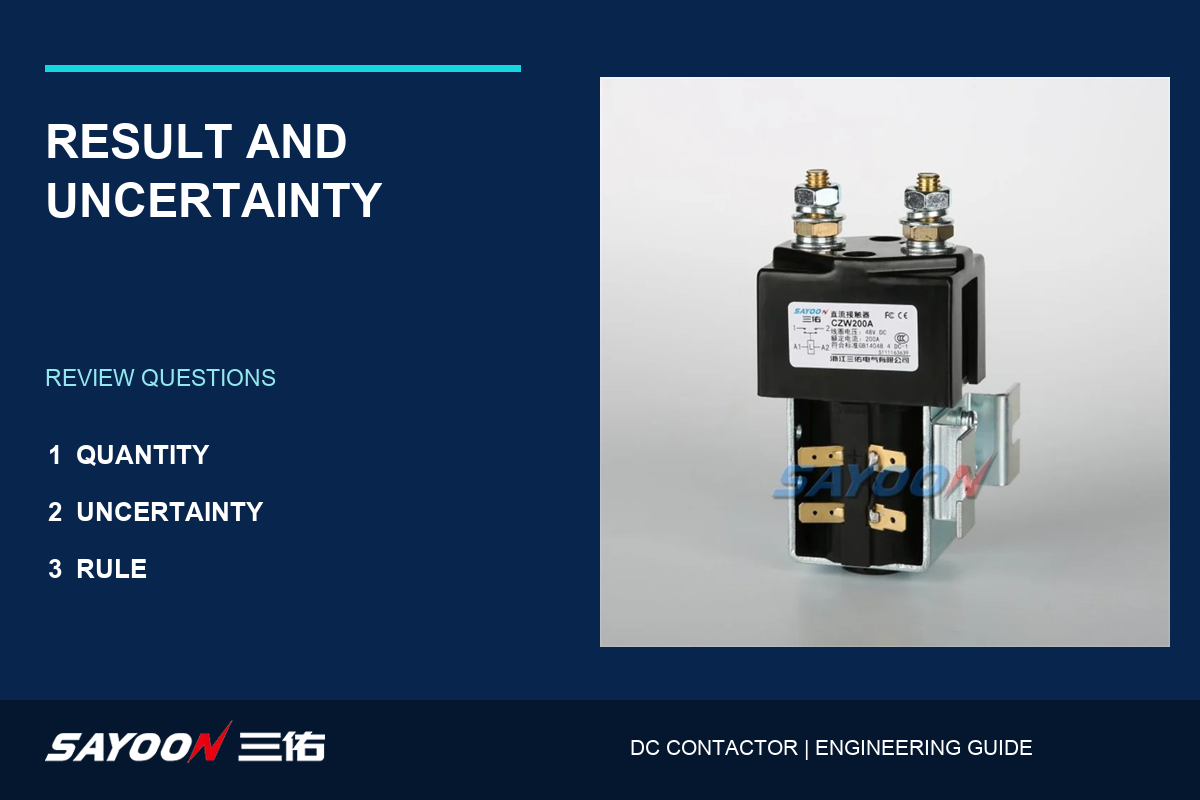
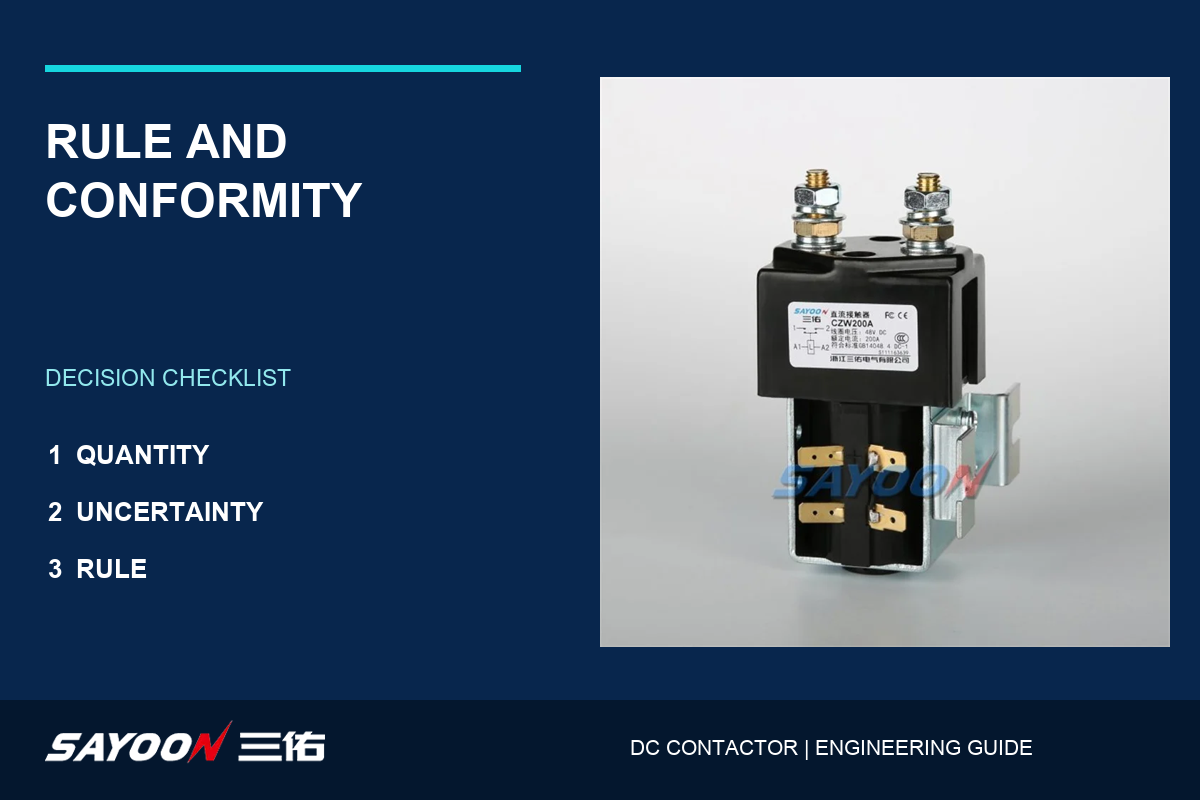
Obtain the exact ordering code and drawing revision from SAYOON before defining the work. Include the coil or driver variant when relevant. Product photographs can help the teams discuss the specimen, but they cannot establish test points, tolerances or an uncertainty budget. Use controlled information to settle those details.
Keep tolerance, uncertainty and resolution separate
A tolerance describes what the requirement permits. Measurement uncertainty describes the dispersion associated with the measured value under the measurement model. Display resolution is one possible contributor to the measurement process. These terms are related but do not replace one another.
A calibration certificate for an instrument is useful supporting evidence, but the contactor test has its own setup. Leads, fixtures, repeatability, environment, timing definitions and other relevant influences may need consideration. The competent laboratory determines the appropriate model and evaluation. Buyers should request an explanation proportionate to the decision rather than assuming that the instrument specification is the complete uncertainty.
NIST calibration policies provide background on reported results, uncertainty and traceability. Traceability is a property supported by a measurement chain and its evidence; invoking a national institute’s name does not approve a contactor or guarantee that a particular test method is suitable for the decision.
Review the report fields together
| Evidence field | Required information | Review purpose |
|---|---|---|
| Requirement | Controlled limit, units and revision | Confirm what the result must meet |
| Measurement | Quantity, boundary and conditions | Match result to the requirement |
| Uncertainty | Applicable evaluation and reporting | Do not substitute instrument resolution |
| Decision | Agreed rule and authorized statement | Retain borderline and conditional outcomes |
This table is a document-review aid. It provides no product acceptance limit or mandatory numerical margin. Apply the actual standard, contract and agreed rule to the reported measurements.
Apply prescribed rules before negotiating alternatives
Check whether the applicable regulation, standard or contractual method already establishes the conformity process. A general guide should not be used to override that process. If the requirement is unclear, ask the responsible engineer and laboratory to resolve it explicitly rather than treating silence as permission to choose a preferred rule.
When the rule is not prescribed, the customer and laboratory need an agreed approach that reflects the intended decision and its risks. Different approaches can lead to different statements for the same reported value. That difference should be transparent before testing, including how borderline results are described.
Record the rule with a version or unambiguous definition. A report saying only pass with uncertainty considered can be difficult to audit. The reader should understand which result the statement concerns and how the rule was applied, without having to guess whether an unstated margin was added.
Use guard bands deliberately
A guard band changes the acceptance boundary relative to a specification limit under a chosen decision rule. It is a tool for managing decision risk, not a universal improvement that can be copied between unrelated tests. Its effect depends on the measurement information, assumptions and the consequences of the decision.
Do not automatically apply one uncertainty multiple to every contactor measurement. A rule suitable for one quantity or contractual setting may be inappropriate for another. Equally, simple acceptance must be understood as a defined choice rather than as evidence that uncertainty has disappeared.
Ask the laboratory to explain the relevant false-accept and false-reject considerations in terms the purchasing and engineering teams can use. The explanation should connect to the actual measurement and requirement. Avoid converting a coverage statement into a claimed probability that the product is safe; product safety and system suitability require a broader assessment.
Work through a borderline result without changing the rules
Consider a hypothetical report with a result close to an upper specification limit. First check that the units, reference points, conditions and specification revision match. Then read the uncertainty statement and the agreed decision rule. Determine whether the report’s conformity statement follows that rule.
Do not make up numerical limits to complete this exercise. The useful questions are procedural: does the result belong to the identified specimen, does the uncertainty apply to this measurement, and is the stated conclusion authorized by the rule? A missing answer is a document or technical clarification, not automatically a product failure or a pass.
If the rule allows a conditional or inconclusive outcome, retain that distinction. Purchasing may need a hold while engineering decides the next action. Rewriting an inconclusive statement as pass to fit an inventory screen destroys information that could matter during a later supplier or field investigation.
Investigate disagreement before repeating tests
When customer and supplier results disagree, compare the methods before comparing the conclusions. Check specimen identity, conditioning, measurement boundary, instrument setup, units, data processing and decision rule. Two reports can be internally consistent while applying different requirements or definitions.
Request original readings and relevant setup information through the agreed review process. Retain the initial result even if a controlled retest is authorized. Repeatedly measuring until one value falls on the preferred side of a limit is not a reliable resolution method and conceals the sequence of evidence.
Any retest should state its purpose. It might investigate repeatability, correct an identified method issue, or evaluate a new specimen under a revised agreement. Those purposes have different implications. The final disposition should explain which evidence governs the decision and why, rather than simply replacing the earlier report with a later date.
Check units, rounding and electronic summaries
The purchasing summary must preserve enough information to reproduce the laboratory’s statement. Converting units or rounding a result near a limit can make a copied table appear inconsistent with the original report. Use the report’s defined decision process and avoid independently rounding values before deciding conformity.
If an internal spreadsheet calculates a status, validate its inputs and logic against the agreed rule. A formula that compares the displayed value with a limit may omit the uncertainty treatment or mishandle a two-sided requirement. Automated status fields need an owner and controlled revisions just as inspection instructions do.
Keep the original issued report linked to the summary. Record any laboratory amendment and identify which version is current. Where a report includes both measured data and separate opinions or interpretations, preserve those distinctions rather than presenting all text as an equivalent accredited conformity statement.
Prepare the test order and supplier handoff
Send the laboratory the exact contactor identification, quantity to test, controlled requirement, measurement boundary, relevant configuration and the desired report output. State whether a conformity decision is required and ask how uncertainty and the decision rule will be reported. Clarify treatment of outside-scope work or subcontracting where applicable.
Ask SAYOON for the current product drawing and available supporting information for the selected variant. Keep that request factual: the photograph, a similar model and a general catalogue statement do not establish the required evidence for the ordered configuration. Resolve any missing acceptance criterion before testing begins.
At review completion, record the result, units, uncertainty statement, applicable rule, specification reference, report revision and disposition authority. Link unresolved questions to a controlled hold or follow-up action. That record helps the next buyer or engineer understand the basis of the decision without reopening an informal chain of messages.
Keep the scope of the conclusion clear
A conforming measurement is evidence about a defined requirement under specified conditions. It is not an approval of every DC switching duty or every installation using that contactor. Other evidence may be needed for load characteristics, thermal performance, protection coordination and expected service conditions.
Use the decision-rule review alongside the broader test-report and instrument-evidence reviews. Each answers a different question: what was tested, how it was measured, and how the result was judged. Keeping those questions connected produces a useful purchasing decision while preserving the limits of what the laboratory actually demonstrated.
Educational video
OT.1x Observation theory: Estimating the Unknown explains measurement errors and measurement quality. This educational background does not assess a particular contactor or approve an equipment design.

Frequently asked questions
Does a calibrated instrument eliminate measurement uncertainty?
No. Calibration supports the measurement process, but the actual test setup and relevant influences still need an appropriate uncertainty evaluation.
Is a reading inside the tolerance always a pass?
The conformity statement depends on the applicable requirement and agreed decision rule. Read those before interpreting a value near a limit.
Must every test use the same guard band?
No. Follow prescribed requirements first. Where a rule must be selected, agree one appropriate to the measurement and decision risks before testing.
Can uncertainty prove a DC contactor is safe for my application?
No. Uncertainty supports interpretation of a defined measurement. Application suitability requires the relevant product and equipment evidence beyond that single result.
Product and related guides
Discuss the application using the CZW200A Normally Open DC Contactor and the DC contactor selection guide. Related reading: DC contactor test equipment calibration: traceability and report review, How to Review a DC Contactor Test Report.
Technical references
Apply each reference within its stated scope. General methods do not establish a product rating or project acceptance.