DC contactor environmentally conscious design evidence should explain the product configuration, the environmental question, the life-cycle boundaries, the supporting data and the design decision. A broad claim that a component is “green” does not provide that evidence. IEC 62430:2019 addresses how environmental considerations enter design and development processes; it does not provide requirements for assessing conformity of individual products. This guide helps B2B buyers request a useful evidence package without inventing an environmental label for a SAYOON contactor. It focuses on design decisions and their basis, rather than supplier management-system certificates or disposal instructions alone.
Begin with a specific design decision
Define what the equipment team is trying to improve. The question might concern material use, maintainability, replacement strategy or another environmental aspect relevant to the application. A defined decision helps the supplier understand which information will be useful. Asking for every environmental document available can create a large package while leaving the actual design trade-off unexplained.
Keep the component’s required function visible. Environmental review does not remove the need for electrical, mechanical and safety suitability. The contactor must still meet the application’s requirements through the applicable selection and verification process. A purchasing team should not accept an undocumented performance compromise simply because an alternative looks lighter, uses less packaging or is described with a favourable environmental adjective.
Understand the scope of the referenced framework
The IEC publication description identifies IEC 62430 as a framework for integrating environmental aspects into design and development. Its scope is organizational design processes, with an explicit distinction from individual-product conformity assessment. This makes it useful for structuring questions about evidence and decisions, but it should not be converted into an unsupported product certification claim.
IEC TS 63428:2024 provides more specific guidance concerning material circularity in environmentally conscious design. Its scope does not cover every environmental, social or economic question. When using multiple references, retain the boundary of each. A supplier’s response on material circularity should not be presented as a complete life-cycle assessment or a verified carbon-footprint result unless separate evidence actually establishes that broader conclusion.
| Evidence field | Required information | Review purpose |
|---|---|---|
| Decision | Specific environmental design question | Focus the evidence request |
| Product | Model, revision and configuration | Match information to the purchased item |
| Basis | Boundaries, data and assumptions | Make comparisons understandable |
| Claim | Conclusion and evidence limitations | Avoid unsupported environmental labels |
Planning checklist based on the scoped technical reference and the applicable purchase documents; no universal acceptance limits are implied.
Identify the product and configuration
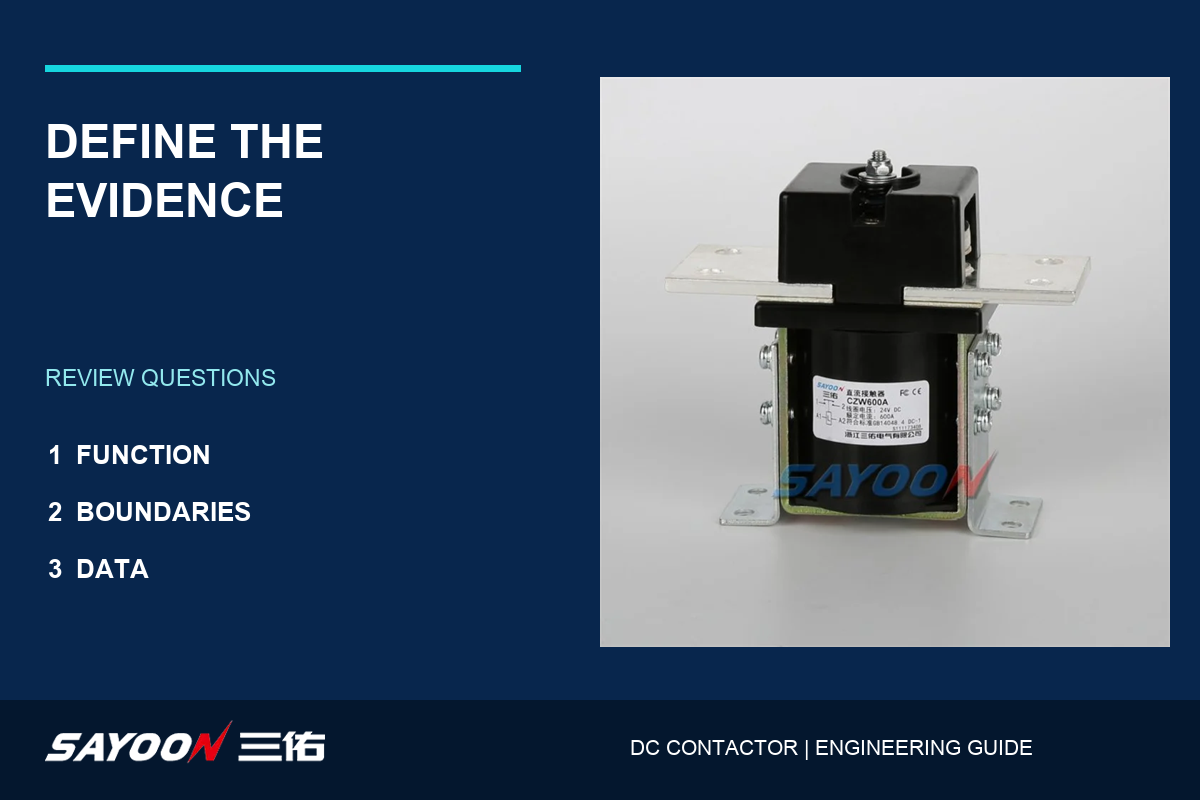
Environmental evidence needs a clear product identity. Record the contactor model, relevant revision and supplied options. A family-level document may be useful, but the reviewer needs to know which configurations it includes. Accessories, packaging and installation arrangements can also matter depending on the question. Do not assume that a photograph establishes all the materials or processes involved in the supplied assembly.
Connect the product identifier in the evidence to the purchasing bill of materials. If an alternative is proposed, identify its differences and the evidence available for each. This prevents a generic family statement from being treated as a measured comparison between specific items. Where information is unavailable, preserve that limitation rather than assigning an assumed value to make the comparison table appear complete.
Define life-cycle boundaries before comparing
A meaningful comparison needs agreed boundaries. Clarify which stages and activities the evidence covers, and which are outside scope. A document describing material production alone does not automatically describe the effect of use, maintenance or end-of-life treatment. Similarly, a packaging improvement should not be presented as proof that every environmental aspect of the contactor has improved.
Define the functional basis of the comparison as well. Two contactors may differ in ratings, expected duties or the equipment arrangements they require. Comparing only their physical mass can miss these differences. The responsible design team should determine whether alternatives provide the required function over the relevant operating context before drawing a broader environmental conclusion from a simple component-level metric.
Separate measured data from assumptions
Create a record that identifies where each important input came from. Supplier measurements, material declarations, engineering estimates and scenario assumptions offer different types of evidence. They can all have a role, but they should remain distinguishable. A buyer should be able to tell which figures were supplied for the exact product and which were introduced by the equipment team’s model.
Avoid presenting estimated values with a level of precision the evidence cannot support. If a decision is sensitive to an uncertain input, identify the need for better information or a suitable sensitivity review. This article supplies no default environmental score or universal conversion factor. The relevant method and competent reviewer should determine how the evidence can support the intended claim or design choice.
Review material information without overclaiming
Material declarations can support an understanding of the product’s substance and material information within their stated scope. They do not automatically provide all the inputs needed for every environmental calculation. Ask which product identifiers, data versions and coverage apply. If the design question needs further information, describe that gap rather than treating a declaration’s existence as a complete answer.
Similarly, a statement about restricted substances should not be rewritten as a broad environmental superiority claim. Compliance information and comparative environmental performance answer different questions. Keep the source wording and intended use connected so the marketing team does not inherit an exaggerated conclusion from a technical purchasing file. Product claims should remain proportional to the evidence actually reviewed.
Consider use and maintenance in the actual system
Where operating energy is relevant, evaluate the installed duty and supporting system rather than relying on an isolated description. A component’s contribution can depend on how equipment is controlled and used. Request the product-specific electrical information needed for the system assessment, and keep hypothetical scenarios labelled as scenarios. This guide provides no measured energy-saving claim for a SAYOON model.
Maintenance arrangements can also affect design choices. Ask what is replaceable, what information supports servicing and what the manufacturer permits. A proposed repair strategy must remain compatible with the equipment’s technical and safety requirements. Environmental intentions do not authorize disassembly, modification or reuse of a contactor beyond the relevant manufacturer’s instructions and the responsible engineering assessment.
Evaluate durability and replacement evidence carefully
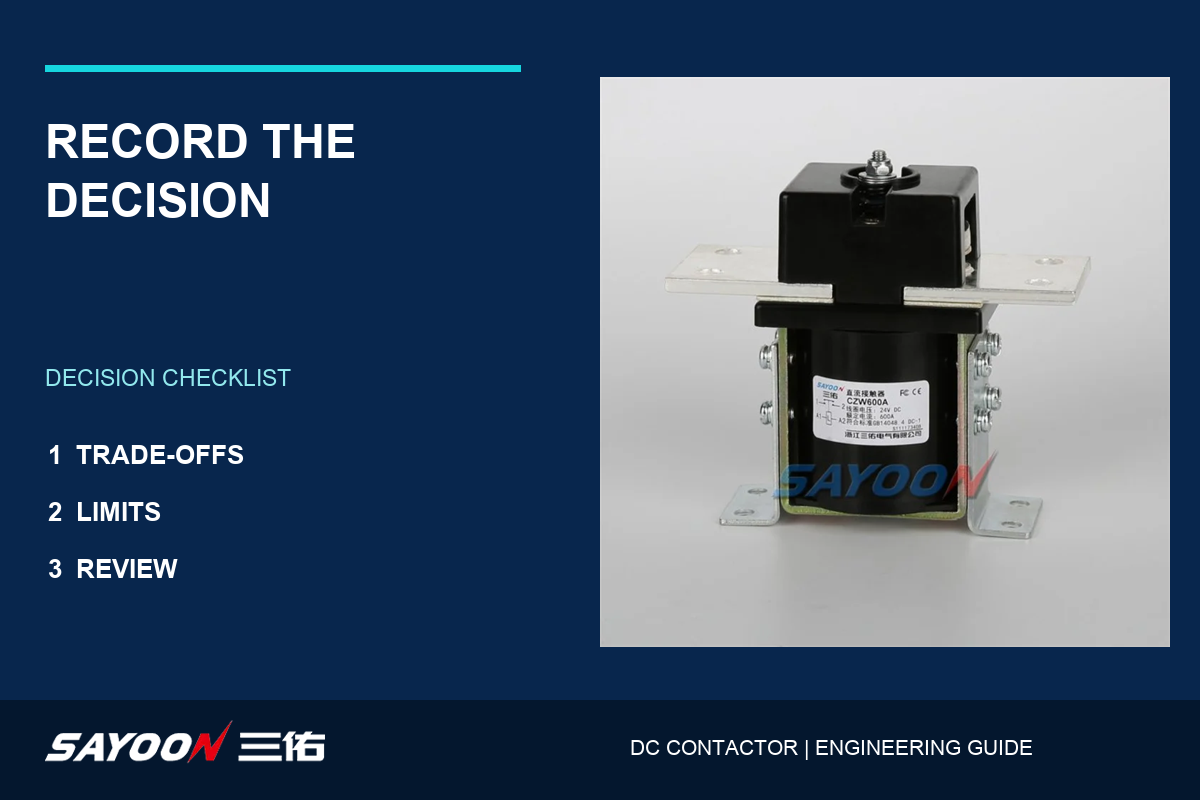
A durability statement should identify the conditions and meaning of the underlying data. Mechanical endurance, electrical endurance and field service experience are not interchangeable descriptions. If a design comparison assumes fewer replacements, document the basis and limitations of that assumption. Do not invent an operating life simply to produce a favourable environmental result.
The wider equipment can influence replacement needs and consequences. Access, downtime and assembly changes may matter to the design decision, even when those factors are not part of a narrow material-circularity assessment. Identify what the chosen framework includes and keep other considerations visible separately. A clear boundary is more useful than combining unrelated factors into a single unsupported sustainability score.
Ask practical questions about material circularity
The IEC TS 63428 publication overview discusses material flows, durability and possibilities such as disassembly and material separation. These are useful prompts for supplier questions. Ask what information exists for the supplied product, which operations are permitted and what limitations apply. Do not assume that theoretical separation in a workshop means that an industrial collection or recycling route is available in the customer’s market.
Distinguish design potential from a confirmed recovery outcome. A material identification can help a downstream decision, but it does not guarantee that a particular facility will accept the assembled contactor. Likewise, recycled-content information needs a defined scope and evidence basis. Avoid claiming that the complete product is recyclable or contains a specific recycled percentage when the documentation covers only a limited part or material.
Make trade-offs visible in the decision record
Environmental design can involve choices that improve one aspect while changing another. Record the alternatives considered and the reason for the selected option. A smaller package might affect protection during transport; a different mounting arrangement might alter service access. These examples are questions for a project review, not claims about a particular SAYOON design or measured outcomes.
Assign responsibility for resolving trade-offs. Procurement can gather supplier evidence, while the appropriate engineering and environmental specialists assess its significance. A design review should explain which requirements remain mandatory and which preferences can be balanced. This prevents an attractive environmental proposal from moving forward without anyone checking its effect on the equipment’s primary function and acceptance requirements.
Control changes to the evidence and claim
When the product, supply arrangement or assessment method changes, determine whether previous conclusions still apply. An old evidence package can remain useful historically without supporting every new statement. Keep the product revision and assessment basis with the decision, and identify the conditions that trigger review. The goal is to preserve a defensible connection between the supplied item and the environmental conclusion.
Before releasing customer-facing language, compare it with the evidence scope. Words such as certified, carbon-neutral or universally recyclable need their own substantiation and should not be inferred from participation in a design process. A precise statement about the reviewed question is more credible than a broad label. This guide does not establish any such label or verification status for a contactor.
Prepare a focused enquiry and review package
For a SAYOON enquiry, identify the model, application and specific environmental design question. Request available product information, its coverage and the responsible contact for clarification. Explain whether the data will support an internal design comparison, a customer questionnaire or another defined purpose. This helps the supplier answer the real need and identify where additional work may be required.
Close the review by recording the evidence received, assumptions retained, unresolved questions and decision owner. If the package is insufficient, state what information would change the decision. A transparent limitation lets the design team choose its next step without turning incomplete evidence into a favourable claim. The result should be a usable purchasing and design record that another reviewer can understand later.
Educational video
IEC – International Electrotechnical Commission explains environmental standards supporting circular-economy approaches. This educational background does not assess a particular contactor or approve an equipment design.
Frequently asked questions
Does IEC 62430 certify an individual DC contactor?
The publication addresses integration of environmental aspects into design and development processes. Its scope does not provide requirements for assessing conformity of individual products, so a product certification must not be inferred.
Does a material declaration prove lower environmental impact?
Not by itself. It supplies information within its stated scope. A comparative claim needs an appropriate method, comparable boundaries and evidence supporting the particular conclusion.
Can buyers compare contactors only by mass?
Mass can be one input, but a meaningful design comparison also needs a defined function, configuration and scope. Different ratings or operating arrangements can make a simple mass comparison misleading.
What should a supplier evidence request contain?
Identify the exact model and configuration, the environmental design question, the intended use of the data and the required scope. Ask the supplier to state available evidence and its limitations.
Product and related guides
Discuss the application using the CZW600A Normally Open DC Contactor and the DC contactor selection guide. Related reading: DC Contactor IMDS Material Data Sheet Review, DC contactor REACH and SVHC declarations: document scope before approval.
Technical references
- IEC 62430:2019 environmentally conscious design scope
- IEC TS 63428:2024 material circularity guidance
Apply each reference within its stated scope. General methods do not establish a product rating or project acceptance.