DC contactor MTBF versus service life is a distinction between a statistical reliability measure and the period for which a particular application can use a product within its requirements. A large MTBF figure does not establish a replacement interval, electrical switching endurance, warranty period or guaranteed life of one contactor. Before comparing quotations, identify whether the figure describes a repairable assembly, a replaceable component, a prediction or observed field experience. Then assess contact wear, operating cycles and environmental limits separately. The useful purchasing question is not simply which number is larger, but whether the evidence matches the ordered configuration and its actual duty.
Start with the item and failure definition
A contactor inside a serviceable control cabinet can be replaced when it fails; that does not necessarily make the contactor itself a repairable item. A cabinet availability model and a component time-to-failure study therefore need different boundaries. Ask whether a supplier’s MTBF label belongs to the whole cabinet, an electronic coil module, a product family or the exact ordered contactor. Preserve the original definition rather than silently treating all these figures as interchangeable.
Define failure before looking at results. Failure to close, failure to open, excessive resistance and an unacceptable insulation result may be different endpoints. An operating record that counts only complete loss of function can miss degraded performance that another project regards as failure. The comparison register should record the acceptance criteria, measurement method and action required when a limit is reached.
Separate four kinds of evidence
| Evidence field | Required information | Review purpose |
|---|---|---|
| MTBF / rate estimate | Population, failure definition, exposure and model | Reliability calculation within its assumptions |
| Electrical endurance | Configuration and loaded switching test conditions | Application duty and wear review |
| Mechanical endurance | Unloaded operating test conditions | Mechanical operation review |
| Service-life plan | Environment, duty, inspection and approved limits | Equipment maintenance and replacement decision |
These categories can inform the same selection decision, but they should remain separate columns. A contactor with a strong endurance result may still require investigation of its coil supply or installation environment. Conversely, a useful statistical model cannot validate interrupting a load outside the manufacturer’s permitted conditions. Request the relevant evidence for each engineering question instead of asking one headline number to answer every question.
What the constant-rate model actually says
The NIST reliability handbook describes an exponential model with constant failure rate. Its reliability expression is R(t) = exp(-lambda × t), where time and failure-rate units must agree. Within that specific model, the reciprocal of the rate is the mean time parameter. This is a mathematical description of a population under assumptions; it is not a physical explanation of contact erosion or a permission to ignore ageing.
For a hypothetical population with lambda = 0.00001 failures per operating hour, the reciprocal is 100,000 operating hours. At a mission duration of 1,000 hours, the model gives R = exp(-0.01), approximately 0.99005. That result means about 99.0% survival over the stated mission under the model assumptions. It does not mean a particular contactor is promised 100,000 hours. These inputs are teaching values, not SAYOON test data, a field estimate or a product specification.
At a mission duration equal to the mean parameter, the same expression gives exp(-1), approximately 0.368. This illustrates why a mean must not be presented as an assured minimum. It also explains why a purchasing specification should ask for a probability, mission and confidence basis when those are actually needed, rather than accepting an unexplained average.
Check whether a constant rate is defensible
A constant-rate assumption requires justification. Contactors can encounter changing duty, contact wear, installation problems and environmental deterioration. A mixed fleet can also contain several configurations or operating conditions. Combining the records into one number can hide those differences, even if the arithmetic is correct. Ask what period the model covers and whether the data show a changing failure pattern.
A low apparent rate during an initial observation window does not show that wear-out never occurs. Equally, a few early installation failures need analysis before they are treated as representative of normal service. Keep commissioning, steady operation and later-life records distinguishable. A competent reliability review should explain exclusions and sensitivity to those choices rather than reporting only the most favourable estimate.
Review switching duty independently
For a contactor, calendar time alone is incomplete. Record the expected operating schedule, switching frequency, load conditions during making and breaking, and any exceptional operations. A device that mostly carries current has a different duty record from one that repeatedly switches a difficult load. The application review must also cover the actual voltage, current direction, circuit characteristics and manufacturer’s installation requirements.
Use the electrical-endurance information applicable to that configuration and load. Do not convert a mechanical operation count into loaded electrical life. Do not divide an endurance number by a daily cycle count and call the result a guaranteed service period. Such a division can provide a planning scenario only when the test conditions and real duty are compatible and the manufacturer’s limits remain satisfied.
Ask how a reliability figure was obtained
An observed result should identify the population, total exposure, failures and observation dates. Request the treatment of removed units, units still operating and incomplete records. A prediction should identify its model, component scope, temperature assumptions and evidence inputs. A supplier should be able to distinguish a calculated estimate from a demonstrated result without presenting either as the other.
Zero observed failures does not establish infinite reliability. The exposure and statistical confidence matter, and the appropriate calculation depends on the study design. Likewise, a rate derived from a small number of failures can have considerable uncertainty. Ask for the uncertainty statement when a numerical requirement drives acceptance. Avoid inventing a confidence level from a brochure or extrapolating a short bench run into years of field performance.
Keep system availability in its own review
A failed contactor may be replaced quickly if access, spare parts and isolation procedures were planned. The same component failure can cause much longer downtime in an inaccessible cabinet without a qualified spare. Availability planning therefore needs restoration arrangements alongside failure evidence. A component MTBF figure does not include every delay experienced by the equipment owner.
Specify who diagnoses the fault, what evidence is required, which replacement is approved and how safe return to service is confirmed. Where the application is safety-related, use the applicable system safety process and configuration-specific manufacturer evidence. Ordinary MTBF information is not automatically a dangerous-failure rate, diagnostic-coverage value, B10d value or functional-safety approval.
Build a maintenance decision from actual conditions
NASA’s facilities reliability-centred maintenance guide provides useful context on matching maintenance to failure behaviour. Its facilities scope is not a contactor-specific replacement instruction. For a DC switching assembly, use the approved equipment maintenance plan, supplier instructions and actual operating evidence to choose inspections or replacement actions. An arbitrary interval copied from an average reliability number may address neither the dominant failure mechanism nor the application consequence.
Track information that can support a decision: operating history, abnormal events, inspection findings and any approved condition measurements. Measurements must use safe, suitable procedures and meaningful baseline conditions. An unexplained increase in resistance or an opening problem calls for engineering evaluation; it is not a reason to keep operating until the MTBF number has elapsed.
A quotation review example
Suppose two quotations describe the same equipment function. One includes an MTBF prediction without a configuration list; the other includes an electrical-endurance report at a stated load. Neither document alone completes the review. First match both offers to the required circuit, coil supply, mechanical interface and environment. Then ask the first supplier for the prediction scope and the second for the other relevant reliability and installation information.
Record each unresolved issue with an owner and a required document. Keep an application validation activity separate from paperwork completion. If the project must compare expected downtime, build that comparison at equipment level using consistent assumptions and restoration arrangements. If it needs a switching replacement plan, investigate duty and wear evidence. These are different decisions and should have separate acceptance records.
What to include in a supplier enquiry
Send the exact order code and option list, circuit description, normal duty, exceptional switching events, environment and intended equipment lifetime. Identify whether the project needs endurance data, field reliability information, a prediction report or safety-related inputs. Ask for document revisions and a clear statement of unsupported assumptions. A complete request makes it easier to discover an evidence gap before samples are installed.
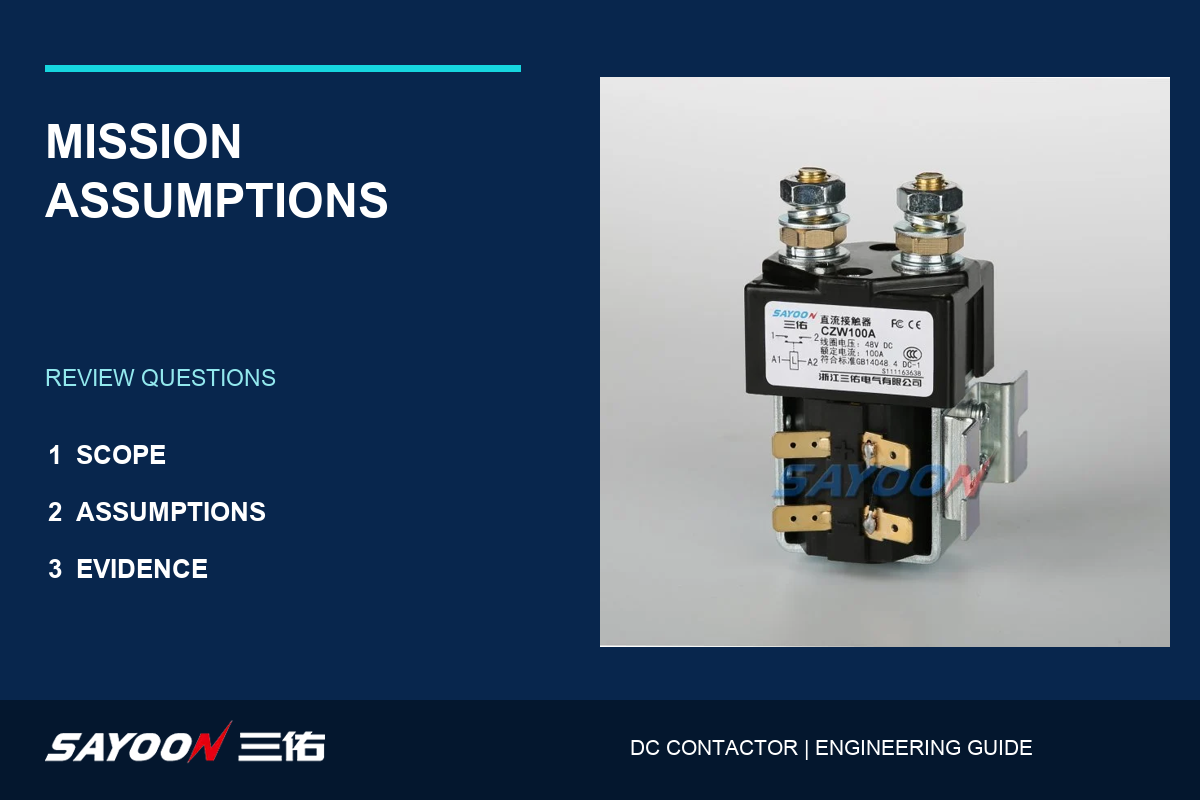
For SAYOON selection, begin with the relevant product page and ask for the current, configuration-specific documentation. Product photographs help identify the discussion subject but do not establish MTBF, internal construction or suitability for a particular mission. Keep model identification, electrical selection and reliability assessment connected in the enquiry while preserving their separate evidence requirements.
Educational video
CQE Academy explains reliability measures and lifetime models. This educational background does not assess a particular contactor or approve an equipment design.

Frequently asked questions
Does MTBF specify when every contactor should be replaced?
No. It describes a reliability quantity under a defined model and boundary. Replacement planning also needs the applicable manufacturer instructions, switching duty, operating conditions, inspection evidence and consequences of failure.
Can mechanical life replace electrical endurance evidence?
No. Unloaded operation and switching an electrical load address different stresses. Use evidence that matches the actual application and ordered configuration, and confirm any proposed extrapolation with the responsible engineer and supplier.
What should I do when a supplier provides no MTBF?
Identify whether MTBF is necessary for the actual decision. Request relevant endurance, application and reliability evidence without inventing a figure. If a contractual model requires it, document the gap and obtain an agreed technical resolution before approval.
Is the numerical example a SAYOON product rating?
No. It demonstrates the constant-rate equation using hypothetical inputs. No MTBF, service-life promise, warranty term or safety performance is assigned to any SAYOON product by that calculation.
Product and related guides
Discuss the application using the CZW100A Normally Open DC Contactor and the DC contactor selection guide. Related reading: DC Contactor Electrical Life Calculation for Repetitive Switching, Mechanical Life vs Electrical Life of a Contactor.
Technical references
- NIST: exponential lifetime model
- NIST: constant repair-rate estimation
- NASA: facilities reliability-centred maintenance guide
Apply each reference within its stated scope. General methods do not establish a product rating or project acceptance.