A vacuum contactor wins when the duty is medium-voltage AC motor and transformer switching, where the arc is quenched at natural current zeros inside a vacuum interrupter; an epoxy sealed electromagnetic DC contactor wins on HV DC battery, PV, and drive paths, because DC interruption and sealed bidirectional switching are what published SEV-class tables are specified for — and SAYOON’s published catalog covers the electromagnetic side only.
This comparison untangles two technologies that keep colliding in OEM search sessions. Engineers who learned vacuum vocabulary on medium-voltage AC gear now specify battery and DC-link paths, so this guide separates the physics first and then maps the DC side onto the published SEV series HV DC contactors.
Part 1. When does a vacuum contactor question really belong to a DC path decision?
Search results for vacuum contactor mostly describe medium-voltage AC switchgear: motor starters, transformer feeders, and capacitor banks in the kilovolt class. Yet many engineers land on those pages while actually designing a 400 V or 800 V DC battery disconnect, a PV combiner path, or a DC-link precharge circuit.
The first decision is therefore not brand but duty type. If the circuit is DC, the natural-current-zero mechanism that makes vacuum interruption elegant on AC is absent, and the shortlist should move to devices specified with DC voltage and DC-1 current lines.
| Signal in your project | Points toward vacuum technology | Points toward sealed electromagnetic DC |
|---|---|---|
| System type | Medium-voltage AC (kV class) | HV DC battery, PV, or drive bus |
| Current interruption | Arc quenched at AC current zero | DC arc must be stretched and cooled by design |
| Typical vocabulary | AC-3 motor duty, vacuum bottle | DC-1 load current, sealed contact chamber |
| Catalog examples | MV switchgear vendors | SEV series HV DC contactors |
For the DC-side selection method that follows this article, keep the HV contactor selection for EV battery disconnect guide open in a second tab.
Part 2. How does vacuum switching differ from sealed electromagnetic DC switching?
A vacuum contactor opens its contacts inside an evacuated ceramic bottle. On AC circuits the arc extinguishes at a natural current zero, and the vacuum gap recovers dielectric strength quickly — the mechanism behind the vacuum interrupter heritage in medium-voltage motor switching.
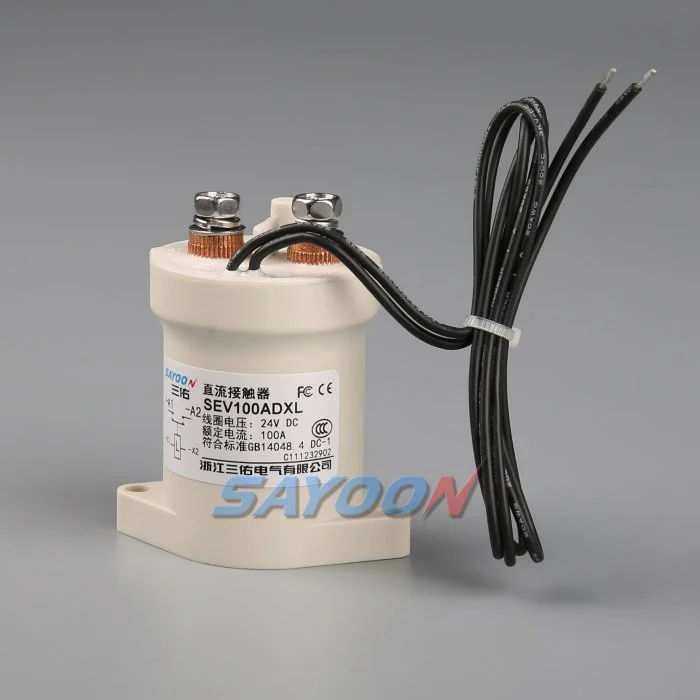
An epoxy resin sealed electromagnetic DC contactor works differently. Its contacts sit in a sealed chamber, the drive is a DC coil, and the device is specified against DC voltage and current tables because a DC arc never crosses zero on its own.
Neither design is universally better. They answer different interruption problems, which is why catalog tables — not technology labels — should close the argument.
| Comparison line | Vacuum contactor (generic) | Epoxy sealed electromagnetic DC contactor |
|---|---|---|
| Arc handling | Quenched at AC current zero in vacuum | DC arc managed by contact and chamber design |
| Typical voltage home | Medium-voltage AC classes | Published DC spans such as 5–1000 V on SEV pages |
| Sealing story | Vacuum bottle around contacts | Epoxy resin sealed chamber, IP68 on cited SKUs |
| Duty vocabulary | AC motor and transformer switching | Battery disconnect, precharge, PV and drive paths |
Part 3. Why do HV DC programs default to sealed electromagnetic contactors?
EV, BESS, and industrial DC programs buy switching devices against DC-specified lines, and the published SEV tables carry exactly those lines. The SEV100AD high voltage epoxy resin sealed DC contactor page states contact voltage 5–1000 V DC, corriente de carga nominal 100 A DC-1, protection IP68, and ambient -40 a +85 °C.
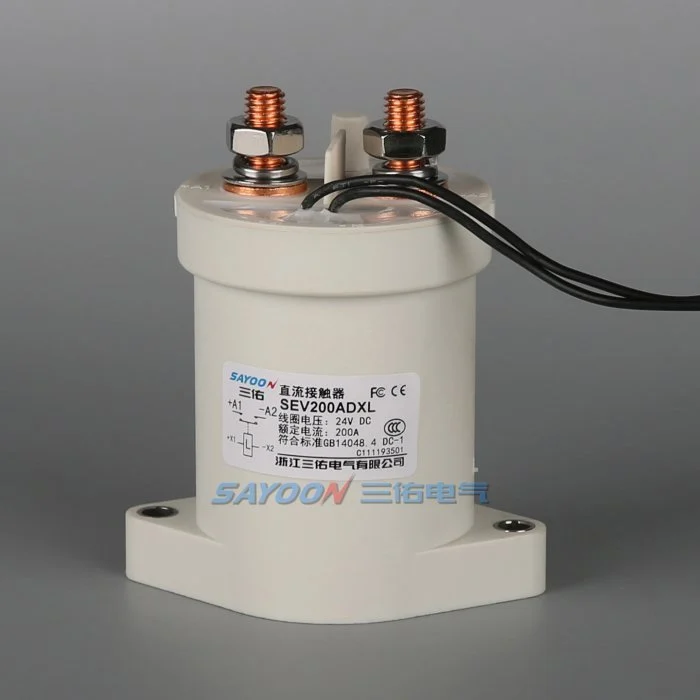
Those fields answer real integration questions. A sealed chamber tolerates dust and washdown environments, the wide ambient band survives vehicle and container installs, and DC-1 current lines can be audited against thermal duty without AC-to-DC conversion guesswork.
One catalog fact must stay explicit for honest comparison: SAYOON lists no vacuum contactor SKUs. The published high-voltage line is the epoxy resin sealed electromagnetic SEV and HEV family, so any vacuum-side requirement in your project belongs with a vacuum technology supplier.
| Published SEV integration field | SEV100AD value | Why DC teams care |
|---|---|---|
| Voltaje de contacto | 5–1000 V DC | Covers 400 V and 800 V architectures with headroom review |
| Cargar corriente | 100 A DC-1 | Auditable continuous class |
| Protección | IP68 | Sealed chamber for harsh installs |
| Ambiente | -40 a +85 °C | Vehicle and outdoor container bands |
| Corriente máxima de conmutación | 1000 A 320 VDC (more than once) | Abnormal-event context, not continuous rating |
Part 4. Which published SEV fields answer the HV DC side of the comparison?
When the comparison lands on the DC side, quote table rows rather than technology slogans. Three published SEV classes show how the electromagnetic family scales.
| Campo publicado | SEV100AD | SEV200FD | SEV800AH |
|---|---|---|---|
| Voltaje de contacto (CC) | 5–1000 V | 5–1000 V | 5–1000 V |
| Carga actual (CC-1) | 100 A | 200 A | 800 A |
| Formulario de contacto | 1 NA o 1 NC | 1 NO con auxiliar | 1 NA o 1 NC |
| Línea de alimentación de la bobina | 4–10 W | 8–20 W | H: Iniciar 30–60, Mantener 4–10 |
| Corriente máxima de conmutación | 1000 A 320 VDC | 2000 A 320 VDC | 3000 A 320 VDC |
| Protección / ambiente | IP68 / -40 a +85 °C | IP68 / -40 a +85 °C | IP68 / -40 a +85 °C |
Two reading rules keep the audit honest. Load current is the continuous DC-1 line, while maximum switching current is an abnormal-event capability, and every value belongs to its own SKU page — re-read before freezing a BOM.
The sealing rationale behind these tables is expanded in the epoxy resin sealed contactor use cases artículo.
Part 5. Which duties still point toward vacuum technology suppliers?
An honest comparison protects buyers from forcing one technology everywhere. Vacuum contactors remain the natural answer for medium-voltage AC switching rooms, and this site does not attempt to serve those duties.
- Medium-voltage AC motor starting and stopping in the kilovolt class.
- Transformer and capacitor bank switching specified with AC utilization categories.
- Retrofit programs standardized on vacuum bottles with existing MV spare pools.
- Protection duty in fault-clearing roles, which belongs to circuit breakers rather than any contactor.
If your project mixes both worlds — an MV AC feeder and an HV DC battery yard — split the RFQ by duty and send each half to the catalog that publishes matching fields.
Part 6. Which SAYOON models carry the electromagnetic side of an RFQ?
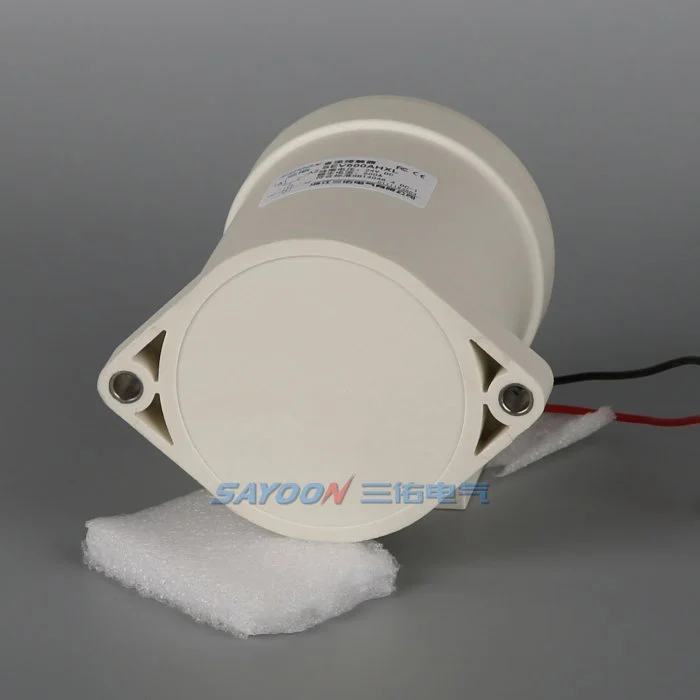
Recomendación de producto: anchor the DC half of the comparison on the SEV100AD high voltage epoxy resin sealed DC contactor when the path fits its published 5–1000 V and 100 A DC-1 lines. Step to the SEV800AH high voltage epoxy resin sealed DC contactor for 800 A class programs.
¿Por qué no otras líneas sin revisión? intermediate SEV classes fit between those anchors only after their own tables are read; HEV models suit programs standardized on that code family. No vacuum recommendation is possible from this catalog because SAYOON lists no vacuum SKUs.
Ajustar Límite these electromagnetic models are not suitable for medium-voltage AC motor switching, for protection duty that belongs to breakers, or for circuits outside the published contact voltage and DC-1 current lines. Panel-level verification steps live in the SEV series buyers guide for panel builders.
To move from comparison to shortlist, send your HV DC duty profile with system voltage, current class, load type, and sealing needs.
Part 7. What comparison mistakes cost OEM teams time on HV paths?
- Sending a DC battery-path RFQ to a medium-voltage vacuum catalog because the word contactor matched.
- Comparing a contactor against a circuit breaker instead of pairing switching and protection roles.
- Reading maximum switching current as a continuous rating on any technology.
- Ignoring sealing and ambient rows that decide field survival in vehicles and containers.
- Assuming one supplier must cover both MV AC and HV DC halves of a mixed project.
- Freezing a technology label in the specification before any datasheet table is audited.
- Forgetting auxiliary feedback contacts when the PLC needs positive state confirmation.
Referencias
Preguntas frecuentes
What is a vacuum contactor used for?
Vacuum contactors switch medium-voltage AC loads such as motors, transformers, and capacitor banks. The arc is extinguished inside a vacuum interrupter at a natural AC current zero.
Can a vacuum contactor switch DC circuits?
DC has no natural current zero, so vacuum interruption loses its core advantage there. HV DC paths are normally specified with DC-rated sealed electromagnetic contactors whose tables publish DC voltage and DC-1 current lines.
Does SAYOON sell vacuum contactors?
No. The live SAYOON catalog lists epoxy resin sealed electromagnetic HV DC contactors — the SEV and HEV series — and no vacuum contactor SKUs. Vacuum requirements belong with vacuum technology suppliers.
What is inside a sealed electromagnetic DC contactor?
Main contacts operate inside an epoxy resin sealed chamber driven by a DC coil. Cited SEV pages publish IP68 protection and -40 to +85 C ambient bands for that sealed construction.
Which SEV fields should an HV DC RFQ quote?
Quote contact voltage span, DC-1 load current, contact form, coil power line, maximum switching current, and the IP and ambient rows — each from the exact SKU page, such as SEV100AD or SEV800AH.
When should a buyer stay with vacuum technology?
Stay with vacuum when the duty is genuinely medium-voltage AC switching or when an existing MV switchgear standard and spare pool is built around vacuum bottles.
Where should an HV DC contactor shortlist start on this site?
Start at the SEV series pillar, shortlist by published voltage and current lines, then send the duty profile through the contact page for datasheet-level confirmation.