A 1 pole contactor is most commonly searched as a definite-purpose AC device used in residential HVAC equipment. It switches one power conductor while the other conductor may remain connected through a permanent shunt, depending on the approved equipment design. It is not the same thing as every product described as a “single-pole DC contactor.” Before replacing one, verify the pole and shunt arrangement, coil voltage, load voltage, motor ratings, terminals, mounting and the condenser or equipment wiring diagram. Sayoon manufactures DC contactors; it does not offer an automatic replacement for a one-pole HVAC contactor.
Scope: The dominant search intent is AC HVAC service. This guide explains identification and safe specification boundaries. Qualified personnel must follow the equipment manufacturer’s instructions and applicable electrical-safety procedure.
What one pole means
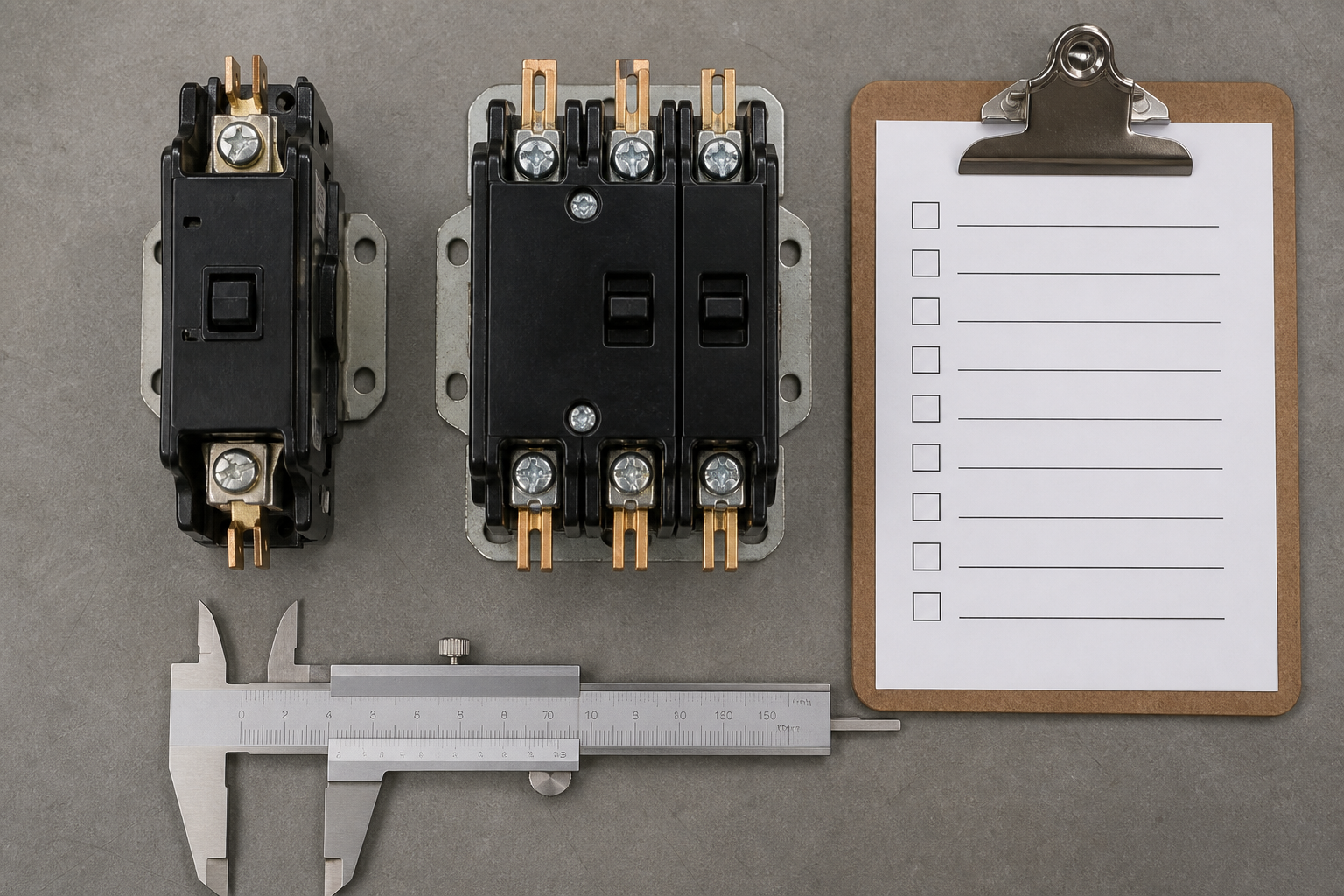
The pole count tells how many separate main circuits the contactor opens and closes. In a common one-pole HVAC arrangement, one leg passes through a controlled contact while the other leg is connected through a fixed shunt. The contactor coil is a separate control circuit. The visible number of screws is therefore not a reliable way to identify the pole count without the diagram and terminal markings.
One-pole and two-pole contactors can look similar from the front and may share a mounting frame. They are not interchangeable merely because the coil voltage and ampere label match. Changing the number of switched conductors changes the equipment circuit.
| Feature | 1-pole HVAC contactor | 2-pole HVAC contactor | What to verify |
|---|---|---|---|
| Switched paths | One | Two | Equipment schematic and terminal diagram |
| Second leg | May use a permanent shunt | Opened by second contact | Original topology; never infer from appearance |
| Coil | Often low-voltage AC in HVAC | Application dependent | Exact voltage, frequency and range |
| Selection | Motor/definite-purpose ratings | Motor/definite-purpose ratings | FLA, LRA, load voltage and equipment approval |
Why HVAC systems use one-pole designs
Equipment manufacturers select the switching topology as part of the complete design. A one-pole contactor can provide the required control function in a particular split-phase or single-phase HVAC circuit, while the fixed shunt carries the other conductor. That does not mean one-pole switching is universally appropriate or that the unswitched leg is safe to touch when the contactor is open.
A contactor is a control device, not necessarily the service disconnect. Opening the thermostat circuit or seeing the armature released does not prove that the equipment terminals are de-energized. Use the approved disconnecting and verification procedure.
Identify the coil separately
The coil voltage is often different from the condenser supply voltage. Many residential systems use a low-voltage control transformer, but the exact value must be read from the wiring diagram and original coil marking. Installing a coil with the wrong rating can cause chatter, overheating or failure to close.
Chatter is not always a bad contactor. Low control voltage, a failing transformer, loose low-voltage connection, damaged thermostat cable or control-board problem can prevent stable pull-in. Diagnose the control circuit before replacing parts repeatedly.
Match motor and compressor duty
The main contact rating must be suitable for the actual load. Record the equipment voltage, compressor and fan-motor data, full-load current, locked-rotor current and any horsepower rating required by the manufacturer. A general resistive-current number is not enough for a compressor starting circuit.
Frequent cycling increases mechanical and electrical operations. If the old contactor has heavy pitting or welded contacts, investigate short cycling, control faults, low voltage and load condition. The replacement should correct the failed component and the condition that caused it.
Mechanical and terminal checks
Compare mounting-hole centers, frame dimensions, terminal orientation, conductor range, quick-connect tabs, coil-terminal position and cover clearance. Confirm that the existing wires can reach without tension or sharp bends. Do not drill the enclosure, cut barriers or force a conductor onto an incompatible terminal simply to fit a different frame.
Inspect lugs and insulation for heat damage. Replace damaged connection hardware under the equipment maker’s procedure. Use the specified conductor preparation and terminal torque; both under-tightening and over-tightening can damage the joint.
Safe inspection boundary
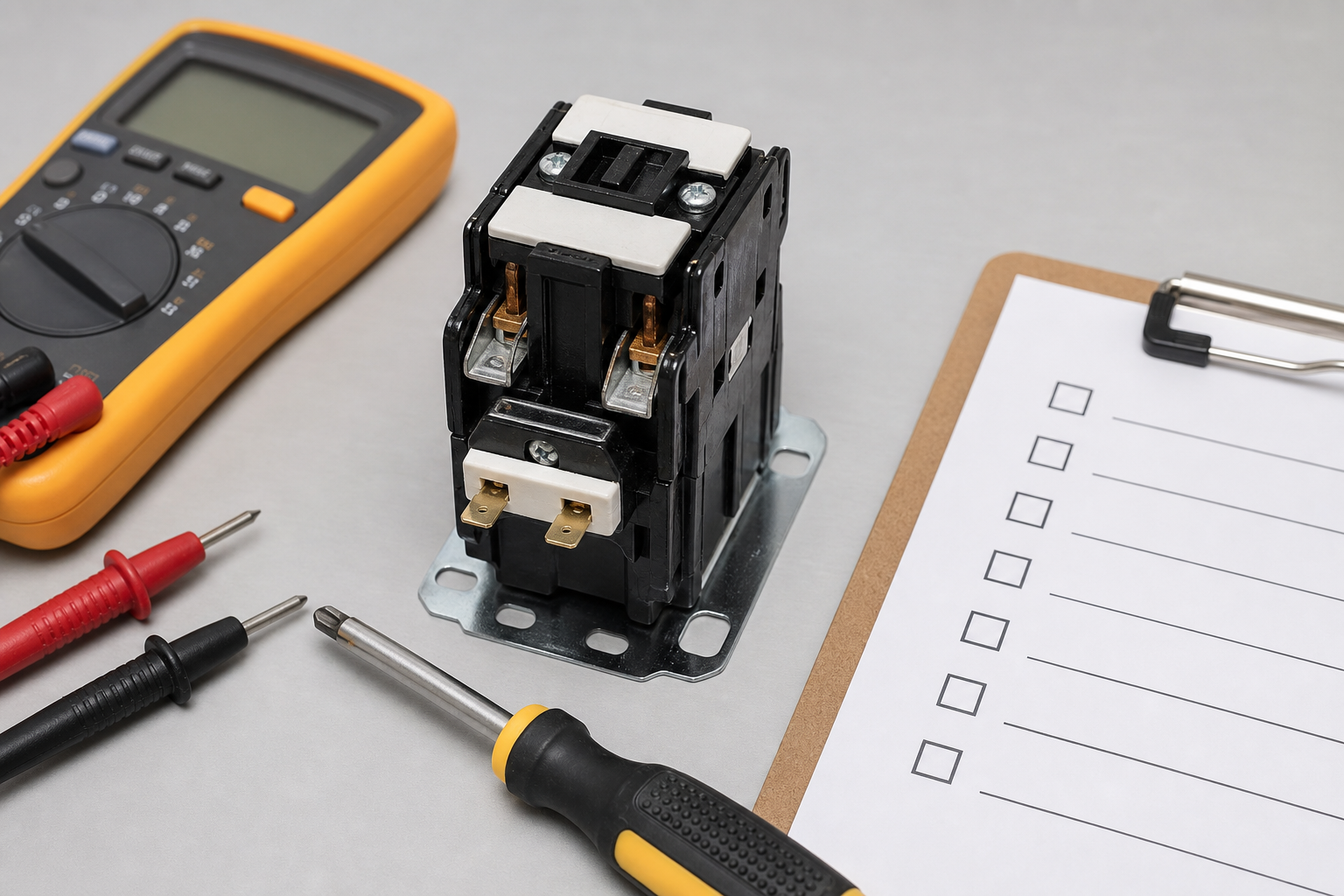
Service work must begin with hazardous-energy control, not with pressing the contactor armature. OSHA 1910.333 addresses de-energizing exposed live parts, while OSHA 1910.147 covers energy-control practices during servicing. The applicable site rules and manufacturer instructions determine the exact process.
After installation, qualified personnel should restore barriers and covers and complete the approved functional test. Confirm stable pull-in and release, correct equipment sequence, no abnormal noise or heat and normal compressor and fan operation.
One-pole AC versus single-pole DC contactors
The words “one pole” describe contact count, not current type. An AC HVAC contactor and a single-pole DC contactor can both have one main contact but use different coil systems, contact geometry and arc-control methods. A DC arc does not naturally cross zero each cycle as AC does, so the device must have a documented DC switching rating.
Sayoon’s SDC Series DC contactors are for documented DC applications. The SDC15-200A is not a replacement for a one-pole HVAC contactor. Readers comparing terminology can use the existing article on single-pole DC contactor roles, the guide to AC versus DC contactors and the explanation of AC and DC coils.
Replacement decision checklist
- Exact equipment model, serial number and approved wiring diagram.
- One switched pole and any fixed-shunt arrangement.
- Coil voltage, frequency and control range.
- Load voltage, compressor/fan ratings, FLA and LRA.
- Terminal size, wire range and mounting dimensions.
- Required approvals and equipment-maker cross-reference.
- Cause of original failure and post-installation test record.
Keep the old and new data sheets with the service record. If any field is unclear, stop and obtain an approved cross-reference instead of using physical resemblance as evidence.
Common mistakes
Do not select by ampere rating alone, assume the condenser line voltage equals coil voltage, replace a one-pole unit with a two-pole unit without approval, or reuse heat-damaged lugs. Do not use manual armature movement as proof that a contactor is safe or electrically sound. Avoid bypassing pressure switches, overloads or control delays to force operation.
Also avoid treating an online marketplace title as the complete specification. A proper record includes the manufacturer drawing, ratings for the actual motor load, coil data and equipment authorization.
How to diagnose the reason for replacement
A contactor that does not close may have an open coil, but it may also be receiving no control command. A contactor that buzzes may have low coil voltage, contamination, a loose mounting surface or a damaged magnetic assembly. Contacts that close but do not carry the load may be badly worn, or the failure may be at a loose terminal rather than inside the device. Diagnose the symptom under the approved service procedure before ordering the replacement.
Record whether the failure is intermittent, temperature-related or associated with compressor startup. Check the condition of upstream controls and the downstream load. If the compressor is locked or the supply voltage is outside the equipment limits, a new contactor will not solve the underlying problem.
What purchasing should request from the supplier
Ask for the complete manufacturer part number, current data sheet, dimensional drawing, coil designation, pole diagram, motor-load ratings, conductor range and approvals. Require the supplier to state whether the proposed item is the original part, an authorized manufacturer cross-reference or only a physically similar alternative.
For repeat maintenance, create an approved-parts record tied to the equipment model and serial-number range. Include photographs of the terminal layout and note the fixed shunt where present. This prevents a future buyer from selecting a two-pole or different-coil device because a marketplace search grouped them under the same “30 amp contactor” phrase.
Documentation after the work
Retain the installed part number, rating label, terminal-torque record, measured control voltage and functional results. Note whether damaged lugs or conductors were replaced and whether the cause of the original failure was corrected. A short but complete service record reduces repeat failures and makes later troubleshooting safer.
Include the equipment serial number and data-sheet revision so future technicians can distinguish an approved part from a merely similar frame.
Store the record with the service history and approved replacement list for later purchasing.
Video: contactor basics
This educational video explains the internal operating principle but does not replace HVAC service documentation.
Watch on YouTube — Electrician U
Frequently asked questions
What does one pole mean on a contactor?
It means one main circuit is opened and closed by the contactor.
Why does a one-pole HVAC contactor have several terminals?
The device also has coil terminals and may include a fixed shunt path; use its diagram for identification.
Can a two-pole contactor replace a one-pole contactor?
Only with explicit equipment-manufacturer or engineering approval of the changed circuit topology.
Is a one-pole contactor safe when open?
No assumption is safe. One conductor may remain connected, and the contactor is not necessarily the service disconnect.
Can a Sayoon DC contactor replace it?
Not in an AC HVAC circuit. Sayoon products require a documented DC application.