A 36V DC contactor duty in AGVs and light EVs maps comfortably onto published classes: 36 V is a listed discrete coil value across CZW, SZJ, and QZJ lists, and a 36 V bus sits inside the ≤60 V SZJ, ≤80 V CZW, and ≤150 V QZJ contact classes with headroom — so selection reduces to documenting maximum system voltage, choosing the amp class per branch, and ordering the coil code explicitly from the published list.
These application notes serve AGV builders, pallet-truck manufacturers, and fleet maintenance teams on 36 V battery systems. The application map starts at the Página de soluciones de carretillas elevadoras eléctricas y AGV, and every device claim below quotes a published row.
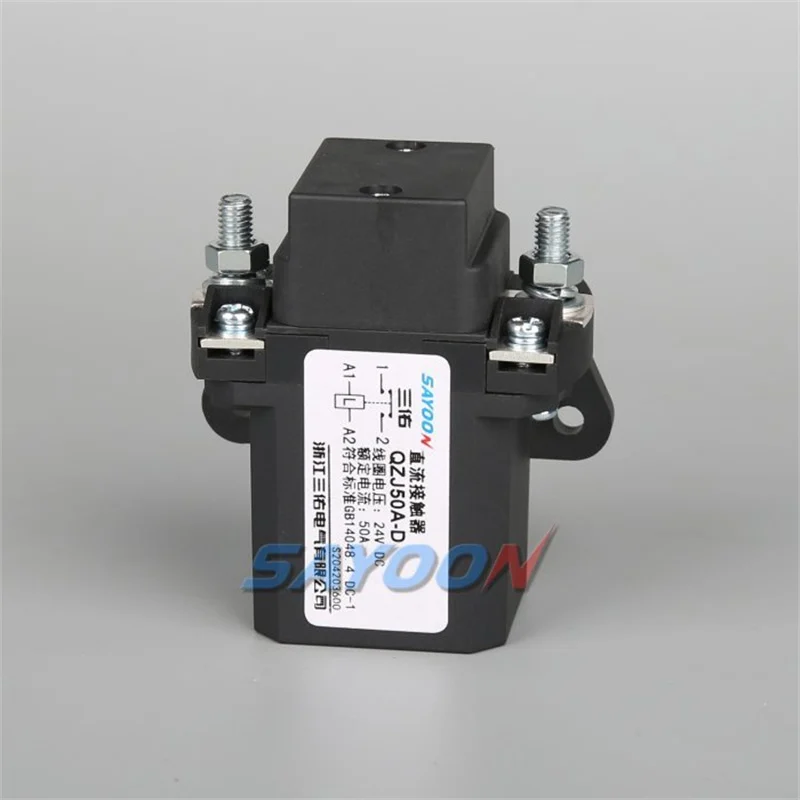
Part 1. Where do 36V DC contactor duties appear in AGV and light EV systems?
A 36V DC contactor duty belongs to the middle rung of the material handling voltage ladder — above 24 V tooling, below the 48 V trucks covered in the live Contactores de 48 V CC para aplicaciones de montacargas guide. Pallet trucks, smaller automated guided vehicles, golf and utility cars, and light EV conversions all run 36 V packs.
Inside each vehicle the duties repeat: a battery connect point, a traction branch, and auxiliary branches for pumps, steering, and electronics. The published AGV solution mapping assigns LV DC contactors to battery and load switching and magnetic latching lines to energy-saving control.
| 36 V system duty | What the contactor does | RFQ field it generates |
|---|---|---|
| Battery connect | Isolates pack from vehicle bus | Continuous current + cycle count |
| Traction branch | Switches drive controller feed | Peak and continuous branch current |
| Pump / steering branch | Cycles with hydraulics | Duty cycle per shift |
| Electronics feeder | Always-on small branch | Coil watts on the standby budget |
Part 2. How does a 36 V bus map onto published contact voltage classes?
The 36 V number lives comfortably inside every LV class this site publishes, which turns the class review into a headroom bookkeeping exercise rather than a family change.
| Clase publicada | Evidencia familiar | 36 V verdict |
|---|---|---|
| ≤60 V | SZJ100A-D contact voltage row | Contains 36 V with margin |
| ≤80 V | CZW100A contact voltage row | Contains 36 V with wide margin |
| ≤150 V | QZJ50A-D contact voltage row | Contains 36 V with the widest margin |
One documentation rule keeps the mapping safe: record the documented maximum system voltage — charging and regeneration included — and require the chosen class to contain that maximum, not just the nominal 36 V label. The number comes from the vehicle design file, not from guesswork.
Part 3. Which published SKUs carry 36 V traction and auxiliary branches?
Three published SKUs frame the 36 V shortlist across branch sizes.
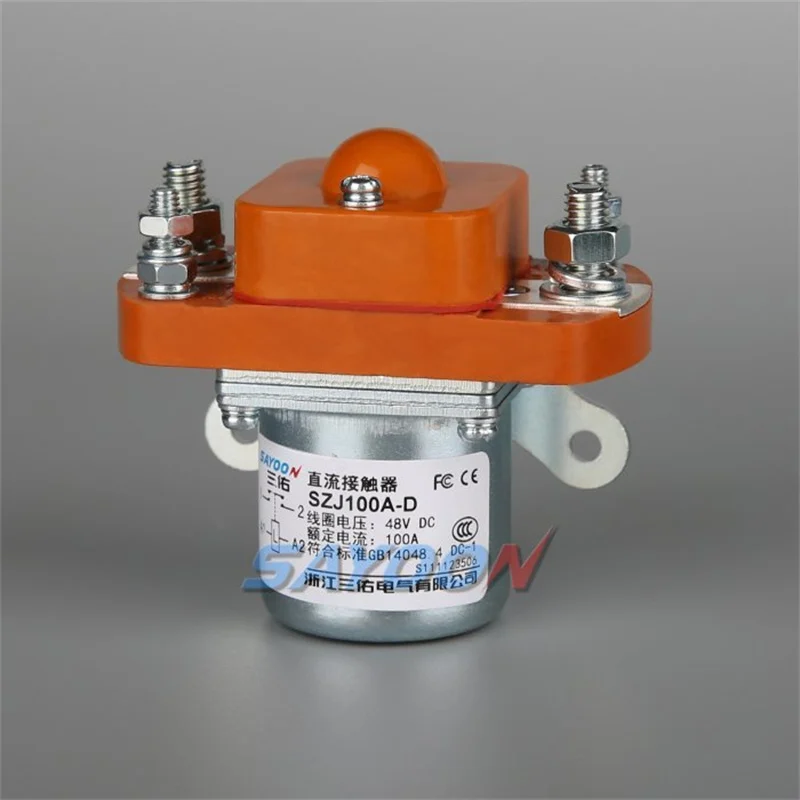
| Campo publicado | SZJ100A-D | QZJ50A-D | CZW100A |
|---|---|---|---|
| Voltaje de contacto | ≤60 V | ≤150 V | ≤80 V |
| Cargar corriente | 100 A | 50 A | 100 A |
| Potencia de la bobina | 5–10 W | 5–9 W | 8–13 W |
| Cargar terminal | Tornillo M6 | M5 screw | Tornillo M8 |
| La vida rema | 20.000 / 300.000 ops | 20.000 / 300.000 ops | 20.000 / 300.000 ops |
The branch logic writes itself. Hundred-amp traction and battery branches point at the 100 A SKUs; smaller pump and electronics branches fit the 50 A class; and all three publish 36 V on their coil lists, so the control side stays native to the pack voltage.
Part 4. How should builders order 36 V coils from published lists?
Unlike some odd voltages, 36 V is a published discrete value — the CZW, SZJ, and QZJ coil lists all include it between 24 V and 48 V. Ordering is therefore a code exercise, not an engineering negotiation.
- Write the coil voltage explicitly in the final code slot, following the published /24V pattern — here /36V.
- Keep the published working range row (0.8–1.2 Us) in the design file for supply-tolerance questions between charge and discharge states.
- Budget coil watts across always-on branches from the published lines — 5–10 W per SZJ100A-D class device.
The off-nominal question — running a 48 V coil part on a 36 V system — is exactly what the published range row exists to answer, and the clean solution is simply ordering the listed 36 V coil instead. The 24 V DC contactor versus relay guide covers the equivalent logic one rung down.
Part 5. How do AGV duty patterns shape the 36 V shortlist?
AGV fleets punish switching hardware differently from manually driven trucks. Autonomous cycles repeat identically all shift, so cycle counts climb fast and predictably — which makes the published life rows a primary selection field rather than a footnote.
| AGV duty pattern | Field consequence | Published row to audit |
|---|---|---|
| Repetitive shift cycles | Cycle budget per year | Electrical life 20,000 ops |
| Opportunity charging stops | Connect events multiply | Battery-connect cycle count |
| Always-on electronics | Standby coil watts stack | Coil power lines |
| Compact chassis bays | Mounting and terminal access | Bracket and terminal rows |
Fleets that outgrow 36 V move up the ladder; the Dimensionamiento de contactor AGV de 72 V CC guide covers the higher rung where the ≤60 V class exits and higher classes take over.
Part 6. Which SAYOON models anchor a 36 V fleet RFQ?
Recomendación de producto: anchor 36 V traction and battery branches on the SZJ100A-D normally open DC contactor — its published ≤60 V class contains the bus with margin, the 100 A line covers light traction, the single-coil 5–10 W build is battery-friendly, and 36 V sits on its published coil list.
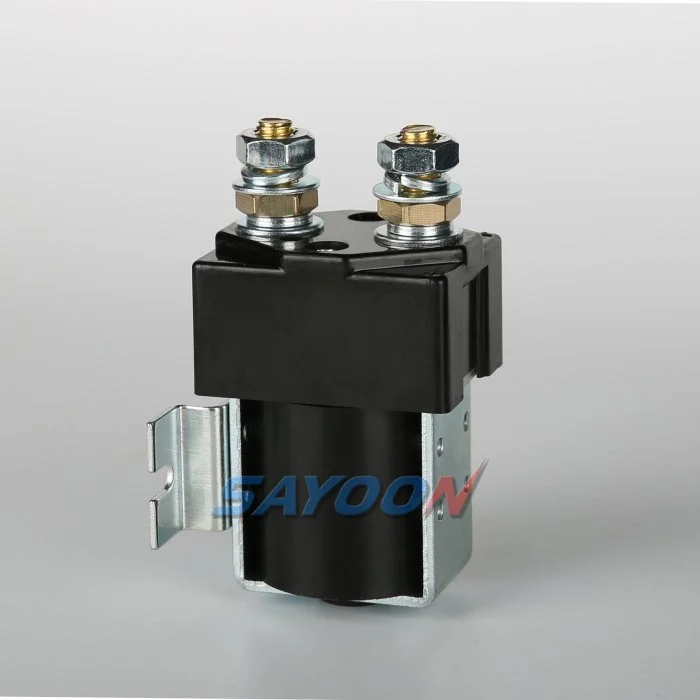
¿Por qué no otras líneas sin revisión? el QZJ50A-D normally open DC contactor fits smaller branches and brings the widest class margin at ≤150 V; CZW100A suits platforms standardized on CZW hardware within its ≤80 V class; larger SZJ classes take over when traction current exceeds 100 A.
Ajustar Límite every choice holds only while the documented maximum system voltage stays inside the chosen published class; none of these parts perform fault clearing; and branch amp classes must come from measured duty, not vehicle nameplates.
To turn the map into a quotation, send your 36 V fleet worksheet with bus voltages, branch currents, and cycle counts.
Part 7. What 36 V system mistakes cost fleet uptime?
- Selecting by nominal 36 V and never documenting the maximum system voltage.
- Reusing the traction amp class on every small branch and overpaying across the fleet.
- Ordering default coils instead of writing /36V in the code slot.
- Ignoring cycle-count budgets on autonomous vehicles that repeat identical shifts.
- Stacking always-on coil watts without a battery standby budget.
- Forgetting terminal torque rows during compact-bay maintenance.
- Asking the contactor to clear faults instead of coordinating fuses.
Referencias
Preguntas frecuentes
What is a 36V DC contactor used for?
Battery connect points, traction branches, and pump or electronics feeders in 36 V vehicles — pallet trucks, smaller AGVs, golf and utility cars, and light EV conversions.
Is 36 V a published SAYOON coil option?
Yes. The cited CZW, SZJ, and QZJ coil lists all include 36 V as a discrete value, so the coil is ordered by writing /36V in the published code slot.
Which contact class should a 36 V bus use?
Any of the published LV classes contains 36 V: SZJ at ≤60 V, CZW at ≤80 V, QZJ at ≤150 V. Verify the documented maximum system voltage stays inside the chosen class.
Can a 48 V coil part run on a 36 V system?
That is a working-range question framed by the published 0.8–1.2 Us row, and the clean answer is ordering the listed 36 V coil instead of running a neighbor voltage off-nominal.
What amp class does an AGV traction branch need?
Measure continuous and peak branch current in real duty, then match the published load line — 100 A classes such as SZJ100A-D cover light traction, larger classes take heavier vehicles.
Do auxiliary branches need the same class as traction?
No. Pump and electronics branches usually fit smaller published classes such as the 50 A QZJ50A-D, which trims cost and standby watts across the fleet.
Where should a 36 V fleet RFQ start on this site?
Start at the AGV and electric forklift solution page, map branches onto published classes, then send the fleet worksheet through the contact page.