A marine DC contactor should be shortlisted only after the team separates maximum contact voltage from coil supply, documents the installed exposure and terminal strategy, and requests evidence for every corrosion or approval requirement. Neither a marine application page nor an ingress phrase proves vessel-class acceptance or a salt-spray duration.
For application context, review marine shipbuilding DC contactor applications. This guide is an engineering and RFQ checklist, not a statement that a particular SAYOON part is approved for a vessel.

Part 1. What does a marine DC contactor decision actually cover?
A marine DC contactor is a DC switching component assessed for a defined shipboard or marine-adjacent path. The decision begins with the circuit role, but it cannot end with an ampere label: exposure, contact voltage, coil control, terminals, service access, and contract evidence all affect fit.
| Review layer | Question to answer | Decision owner |
|---|---|---|
| Circuit | What maximum DC voltage and continuous duty reach the contacts? | Electrical engineering |
| Control | What coil supply and command logic are installed? | Controls engineering |
| Medio ambiente | What moisture, salt, cleaning, and condensation reach the location? | Vessel / enclosure engineering |
| Evidencias | What document is required for the project? | Quality and procurement |
Utiliza el HV contactor specification audit alongside this checklist when a project has several candidate models.
Part 2. Where should corrosion exposure be checked before component selection?
Corrosion risk is a system question. A contactor can be inside a cabinet while terminals, cable entries, fasteners, and drain paths experience a different exposure. Record the installation zone before requesting a model recommendation.
| Exposure observation | What to document | Por qué importa |
|---|---|---|
| Salt-laden air or spray | Location and expected exposure route | Helps define evidence needed for terminals and enclosure |
| Condensation cycles | Venting, drains, and cold surfaces | Prevents a sealed-component assumption from masking cabinet moisture |
| Wash-down or cleaning | Fluid, direction, frequency, and access panels | Separates a procedure requirement from a generic ingress phrase |
| Service access | Inspection interval and replacement method | Supports maintainability planning |
Importante: A corrosion-resistant description is not equivalent to a project test result. The AMPP resource library is useful for corrosion terminology; it does not certify a SAYOON product or replace the vessel programme’s specified evidence.
Part 3. Why must contact voltage and coil supply be reviewed separately?
The contact path and the coil control circuit answer different questions. Contact voltage describes the DC path the switching contacts must withstand. Coil supply describes the voltage used to energize the actuator. A coil value must never be copied into the contact-voltage field.

| Campo | Belongs to | Common error | RFQ action |
|---|---|---|---|
| Maximum working DC voltage | Contactos principales | Listing nominal source voltage only | State the maximum operating value |
| Continuous current and duty | Contactos principales | Treating interruption information as carry duty | Provide load profile |
| Voltaje nominal de la bobina | Circuito de control | Treating coil voltage as contact class | State supply tolerance and command method |
| Auxiliary contact need | Feedback circuit | Assuming feedback is included | Identify monitoring logic |
El epoxy-sealed HV contactor use-case guide explains why environmental language and electrical ratings must remain separate decisions.
Part 4. Which enclosure and ingress claims require separate evidence?
Ingress protection, enclosure construction, corrosion exposure, and marine approval are separate evidence categories. An IP value—when published for a particular item—addresses a defined ingress test; it does not automatically establish salt-spray duration, terminal corrosion performance, vessel acceptance, or a classification approval.
| Evidencia solicitada | Supports | Does not by itself support |
|---|---|---|
| SKU datasheet | Published electrical and construction fields | Unpublished environmental performance |
| IP test statement | Defined ingress scope for the cited SKU | Corrosion or class approval |
| Material or coating record | Identified material scope | Whole-vessel approval |
| Project test report | Specific agreed test | Transfer to another programme |
Keep any requested corrosion test method, duration, acceptance criterion, and sample configuration on the RFQ. Do not replace those lines with a general “marine grade” label.
Part 5. How do class and customer requirements change the review path?
Ship projects can introduce class-society, flag-state, owner, yard, or customer requirements. Those rules apply in a project context. Whether a component requires a particular document depends on the circuit, installation, vessel scope, and contract—not merely the product family name.
| Requirement source | Ask before nomination | Result |
|---|---|---|
| Classification body | Is a named certificate or witness test required? | Traceable document request |
| Shipyard | Is there an approved-vendor or drawing process? | Procurement route |
| Owner specification | Are corrosion, maintenance, or redundancy criteria listed? | Design input |
| System integrator | What interface and feedback constraints exist? | Electrical integration review |
El IEC 60092 overview provides shipboard electrical-installation context. It is not a basis for claiming compliance by a contactor without the applicable project evidence.
Part 6. Which RFQ fields make a marine DC contactor comparison reviewable?
A useful RFQ lets engineering, quality, and procurement evaluate the same facts. Start with the public HEV Series HV DC Contactor information, then compare only published model fields against the project record.
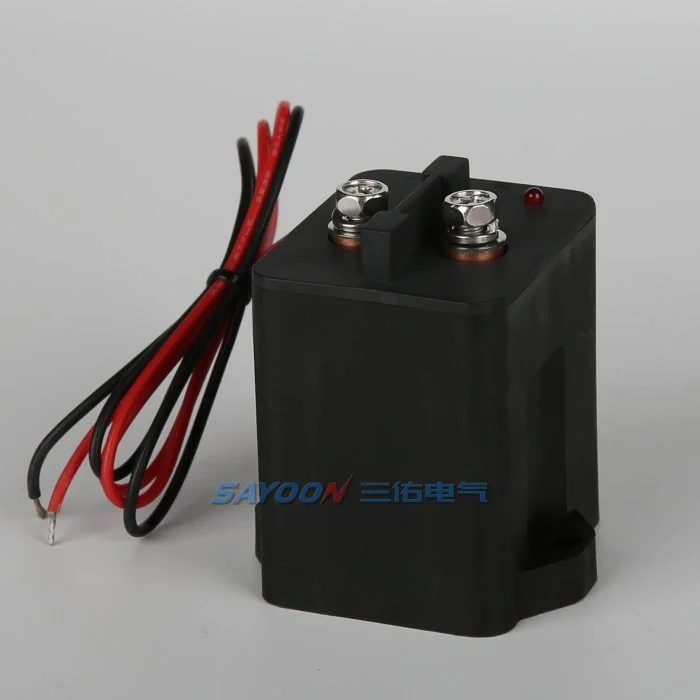
| Campo de RFQ | El comprador debe proporcionar | Supplier should document |
|---|---|---|
| Papel del circuito | Disconnect, precharge, branch, or other defined role | Suitable published model fields |
| Maximum contact voltage | Maximum operating DC value | Published contact-voltage field |
| Current and duty | Continuous current, cycles, and switching scenario | Published carry / switching information where listed |
| Coil and feedback | Coil supply, tolerance, and auxiliary requirement | Published coil and auxiliary options |
| Exposure | Salt, condensation, wash-down, and enclosure description | Evidence available for the specific request |
| Project approvals | Named certificate or test requirement | Certificate scope or an explicit gap |
Ajustar Límite This checklist can organize a request for a SAYOON DC contactor. It cannot approve the vessel design, prove an unlisted salt-spray result, or imply class-society acceptance. Contact SAYOON with the complete project inputs when a model-specific review is needed.
Part 7. Which claims should a marine team refuse to infer?
Avoid short cuts that turn a component description into an unsupported marine claim.
| No infieras | Why it is unsafe | Better action |
|---|---|---|
| “IP-rated means corrosion-proof” | Ingress and corrosion evidence are different | Request the relevant environmental evidence |
| “Marine application means class-approved” | Application context is not certificate scope | Name the required certificate |
| “Coil voltage proves contact class” | Control and power paths are different | Record both fields |
| “One model serves every vessel path” | Duty and enclosure conditions vary | Review each circuit role |
Hold BOM release whenever a required document, voltage value, or exposure condition remains blank. That protects the vessel programme from an assumption that cannot be traced to evidence.
Referencias
- DNV Maritime — project and classification context
- AMPP corrosion resources — corrosion terminology and prevention context
Preguntas frecuentes
What is a marine DC contactor?
It is a DC switching component considered for a defined marine electrical path. Selection should include electrical duty, coil control, exposure, terminals, service access, and the project’s evidence requirements.
Does a marine DC contactor need a salt-spray rating?
Only the vessel specification or installation environment can determine that requirement. If it is required, put the test method, duration, configuration, and acceptance criteria on the RFQ rather than assuming a rating.
How does contact voltage differ from coil voltage?
Contact voltage applies to the DC power path the contacts handle. Coil voltage applies to the control circuit that actuates the contactor; it cannot be substituted for the main-path voltage class.
Can an IP rating prove marine suitability?
No. An IP rating applies to a defined ingress test for the stated item. It does not, by itself, prove corrosion performance, salt-spray duration, vessel integration, or class approval.
What belongs in a marine contactor RFQ?
Include circuit role, maximum contact voltage, current and duty, coil supply, auxiliary needs, enclosure exposure, terminal strategy, and every required project certificate or test.
Do all contactors include marine-class approval?
No. Do not make that assumption from a series name or application page. Ask for the named certificate and verify its scope against the project requirement.
When should a project hold the BOM for review?
Hold the BOM when the maximum voltage, exposure definition, electrical duty, or required certificate is not documented. Releasing a part with those gaps transfers an engineering decision into an unverified purchasing assumption.