DC contactor laboratory sample receipt handling should establish what arrived, its condition, the work requested and the identity that will follow it through testing. Inspect and document the item before preparation changes its condition. Resolve a missing label, damaged terminal or mismatch with the request before treating the sample as ready for the agreed activity. This guide helps engineering and procurement teams organize that handoff; it does not prescribe electrical test settings, authorize energizing a damaged contactor or turn one received sample into evidence for an entire production lot.
Agree the sample request before dispatch
Identify the contactor model, ordered configuration, drawing revision where relevant and purpose of the evaluation. State the number of items and what each is intended to undergo. A functional check, a failure investigation and a destructive evaluation may require different handling. Send the laboratory the approved work request and a contact who can resolve questions when the shipment arrives.
Ask about the laboratory’s own shipping and intake instructions. NIST publishes instructions for its domestic calibration customers, illustrating that a service provider can have specific arrangements for shipment and documentation. Those instructions govern that NIST service; they are not automatically requirements for a contactor laboratory. Obtain the actual recipient’s instructions and confirm any restrictions on batteries, accessories or other items included in the package.
Make identity understandable without guessing
Use an identifier that connects the physical contactor with the request and accompanying documentation. A model name may describe a family rather than the exact ordered variant. Where serial or lot references exist, record them accurately; where they do not, use an agreed sample identifier without inventing manufacturer traceability. Avoid labels that conceal the original identification or interfere with the intended examination.
If several samples look alike, give each a separate identity or a clearly controlled grouping appropriate to the task. Record the relationship between the customer’s identifier and the laboratory’s intake number. Retain that cross-reference through photographs, observations, calculations and the report. A later reviewer should be able to establish which result belongs to which item without relying on the memory of the receiving technician.
Inspect and record the as-received condition
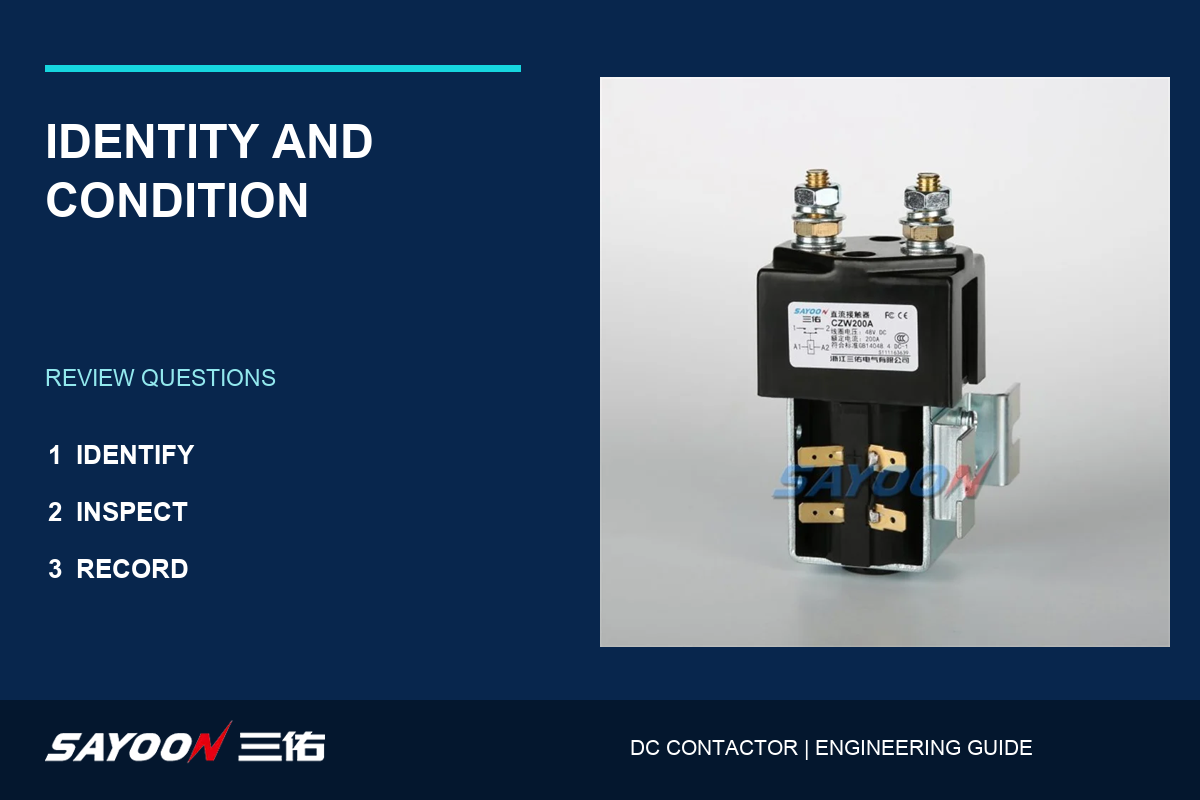
Record the date and relevant receipt details, package identity, item count and visible condition. For a contactor, observations may include a bent terminal, cracked enclosure, loose accessory or a label that differs from the request. Describe what is actually visible. A photograph can preserve appearance, but it should be associated with the sample identifier and accompanied by a useful written observation when a discrepancy matters.
Do not clean, tighten, straighten or disassemble the item before recording a condition that could affect the investigation. A well-intentioned repair can remove evidence about shipping damage or the reported failure. UNIDO’s ISO/IEC 17025 implementation guide discusses handling of test and calibration items, including identification and relevant deviations. Apply the receiving laboratory’s controlled procedure and the agreed work scope to decide what happens next.
Use a receipt and disposition checklist
| Campo di evidenza | Informazioni richieste | Scopo della revisione |
|---|---|---|
| Identità | Customer reference, laboratory ID and variant | Connect the physical item with the request |
| Condizione | Count, visible damage and relevant photographs | Preserve the as-received evidence |
| Discrepancy | Mismatch, technical effect and authorized instruction | Decide whether the requested work can proceed |
| Disposizione | Location, transfers, return or retention | Maintain custody through the agreed activity |
Planning checklist based on the scoped technical reference and the applicable purchase documents; no universal acceptance limits are implied.
This checklist is a proposed communication tool rather than a mandatory universal laboratory form. Add the fields needed for the actual method and remove unrelated details. If the task requires specified storage or conditioning, link the requirement to its source. Do not invent a temperature, waiting period or humidity range merely because such a field appears in a generic intake template.
Keep receipt acceptance distinct from test acceptance. A laboratory may accept custody of an item while holding the technical activity pending clarification. Conversely, a package that appears intact does not establish that the contactor meets its electrical requirements. Record the intake disposition in language that makes this distinction clear, especially if purchasing uses the receipt confirmation to track an urgent shipment.
Resolve mismatches before work changes the evidence
If the request names one variant and the sample label shows another, contact the authorized customer representative. Preserve the request, photographs and discrepancy note. Determine whether the item is wrong, the paperwork is wrong or additional identification is needed. Do not choose whichever description makes the booking proceed fastest. The resulting instruction should identify the correct sample and the approved scope.
For damage, assess whether the requested work can still produce useful evidence. A bent terminal may be central to a failure investigation but unacceptable for an evaluation intended to represent an undamaged production unit. The laboratory and customer need a documented decision about proceeding, replacing the sample or changing the purpose of the work. Any resulting limitation should follow the evidence into the report and purchasing conclusion.
Maintain custody and location through preparation
Record movements sufficiently to find the item and explain who controlled it when relevant. The required detail depends on the task, contract and quality procedure. A receiving area, preparation bench and test fixture may each use different local records. Connect them with the stable identifier so that a sample cannot become anonymous after the outer packaging is removed.
Keep accessories and removed parts associated with the correct item. If a contactor arrives with mounting hardware or a customer-supplied harness, list what was supplied and whether it is part of the intended configuration. Do not assume a supplied cable is approved for the contactor merely because it was in the same carton. Ask the responsible engineer to resolve compatibility questions before the setup relies on those parts.
Protect the condition required by the method
Obtain the relevant storage, handling and preparation instructions from the manufacturer, method or agreed test plan. Avoid applying a convenient generic procedure when it could affect the characteristic under review. For example, an as-received condition assessment has a different purpose from a measurement made after an approved conditioning stage. Document both stages when both matter to interpretation.
The accompanying Eurachem educational video introduces validation of measurement procedures including sampling. Its analytical-measurement examples help explain why events before the measurement can influence the result. They do not prescribe how to test an electrical contactor. Use the general lesson to ask whether selection, transport, receipt or preparation changed what the sample can represent, while retaining the electrical method’s own requirements.
Plan the sequence when several activities share samples
Agree which work occurs first and whether it alters the item. A destructive evaluation cannot be followed by an independent check of the same undamaged condition. Even work described as routine may leave a relevant history. Ask the laboratory to identify preparation or testing that affects later activities, and allocate separate items where the agreed plan requires them.
Record substitutions and sample transfers. If one item is unavailable and another is used, obtain the necessary technical agreement and update the identifier mapping. A report should not quietly retain the original sample number after a replacement. Clear sequence planning is particularly valuable when multiple laboratories share items, because each organization otherwise sees only its own portion of the evidence history.
Control return, retention and disposal decisions
Agree whether the contactor and packaging will be returned, retained or disposed of after the work. Define who can authorize an irreversible change to an investigation item. A purchasing team may need the failed sample for comparison with production evidence, while the laboratory may have a standard retention policy. Resolve that difference before the standard period expires or the item is discarded.
Keep the final disposition associated with the intake record. If parts were removed or the sample was altered during testing, identify that condition when returning it. A tested contactor should not be placed back into normal service on the strength of a return label. The responsible equipment owner must evaluate suitability under the applicable instructions and the known history of the item.
Close the handoff with a scoped receipt confirmation
cURL Too many subrequests by single Worker invocation. To configure this limit, refer to https://developers.cloudflare.com/workers/wrangler/configuration/#limits.
cURL Too many subrequests by single Worker invocation. To configure this limit, refer to https://developers.cloudflare.com/workers/wrangler/configuration/#limits.
Video educativo
cURL Too many subrequests by single Worker invocation. To configure this limit, refer to https://developers.cloudflare.com/workers/wrangler/configuration/#limits.

Domande frequenti
Does an intact package prove the sample is suitable for testing?
cURL Too many subrequests by single Worker invocation. To configure this limit, refer to https://developers.cloudflare.com/workers/wrangler/configuration/#limits.
Should a damaged terminal be straightened before receipt photographs?
cURL Too many subrequests by single Worker invocation. To configure this limit, refer to https://developers.cloudflare.com/workers/wrangler/configuration/#limits.
Can one received contactor represent an entire shipment?
cURL Too many subrequests by single Worker invocation. To configure this limit, refer to https://developers.cloudflare.com/workers/wrangler/configuration/#limits.
Which record connects the intake number to the final report?
cURL Too many subrequests by single Worker invocation. To configure this limit, refer to https://developers.cloudflare.com/workers/wrangler/configuration/#limits.
Prodotto e guide correlate
Discutere l'applicazione utilizzando il Contattore CC normalmente aperto CZW200A e il Guida alla scelta dei contattori in corrente continua. Letture correlate: DC Contactor Shipping: Package Performance Test Review, DC Contactor Inspection Records: Retention and Retrieval.
Riferimenti tecnici
- UNIDO: ISO/IEC 17025 implementation guide
- cURL Too many subrequests by single Worker invocation. To configure this limit, refer to https://developers.cloudflare.com/workers/wrangler/configuration/#limits
Applicare ogni riferimento nel suo ambito dichiarato. I metodi generali non stabiliscono una valutazione del prodotto o l'accettazione del progetto.