DC contactor traceability should connect the delivered device or production lot to its ordering code, construction revision, supplier release record and location in your equipment. The practical goal is to identify which units may be affected when a defect, substitution or document discrepancy appears. Agree on lot boundaries, labels, records and change notifications before production starts. A barcode is useful only when the record behind it is reliable; it does not itself prove quality, certification or electrical performance. Treat the following framework as a purchasing and record-control checklist, with project-specific requirements confirmed by your supplier.
Define what you need to trace
Start with the question your records must answer. A purchasing investigation may need to locate all devices from one supplier lot. A service campaign may need to connect each device to an equipment serial number. A construction change may require identifying units assembled before and after the change. These situations need different detail.
State whether identification is required at unit, package or lot level and how long records must remain available. Do not assume that every supplier already provides serial numbers or a complete material genealogy. Ask what records actually exist, which can be shared and how gaps will be resolved before accepting a claimed traceability capability.
Keep product identity separate from lot identity
A model name describes a product design or family; a lot number identifies a bounded production group under the supplier’s system. Neither should replace the other. Record the full ordering code, coil option, contact arrangement, terminal option and drawing revision alongside the lot identifier. Similar-looking devices may belong to different approved configurations.
If the supplier’s lot includes several variants, ask how records distinguish them. If a lot is split across deliveries, keep the original identifier and add shipment references. Your internal stock code should link back to the supplier identity rather than hide it behind an unrelated warehouse label that nobody can decode after installation.
Agree on lot boundaries and change events
The supplier should explain what creates a new lot or other controlled boundary in its records. Relevant events might include production timing, a construction revision, an approved material change or another defined process transition. These are questions to agree with the manufacturer, not assumed practices at Sayoon or universal rules for contactor production.
Request a clear response when rework, relabeling or mixed production occurs. A repaired unit should remain connected to its original identity and the authorized rework record. If a new identifier is assigned, retain the relationship between the old and new records. Otherwise a search based on the original shipment may miss the very units that require attention.
Use a traceability record that survives handoffs
This table is a recommended information map. It describes which relationships a buyer should request or maintain; it does not claim that every field is already available from the illustrated product. Assign an accountable record owner and a way to retrieve the data before relying on the field for containment.
| Controlla | Documenti richiesti | Decisione o documento |
|---|---|---|
| Approved identity | Ordering code, options and drawing revision | Keep the accepted configuration linked to purchase orders and later changes. |
| Production boundary | Supplier lot identifier and documented lot definition | Identify what the lot includes, its limits and any rework relationship. |
| Delivery | Packing list, box identifiers and received quantities | Connect each receipt to the original supplier lot without erasing mixed-lot information. |
| Release evidence | Applicable lot inspection or release record | Match procedure revision and results to the identified production group. |
| Internal movement | Warehouse location, issue record and quantity | Retain the lot link when stock is repacked, split or transferred. |
| Equipment use | Build record and equipment or assembly identifier | Locate devices in delivered equipment when the project requires unit-level containment. |
| Service history | Replacement, returned unit and investigation record | Preserve both installed and replacement identities rather than overwriting the history. |
| Controllo dei cambiamenti | Approval, effective boundary and supplier notification | Identify which units belong to each approved construction and who accepted the change. |
Choose labels for the real handling environment
Decide where identification will be placed and how it will be read after unpacking and installation. A carton label is easy to scan at receiving but may be discarded before assembly. A device label may be difficult to see after mounting. The required identification method should match the point at which your team must retrieve it.
Agree on legibility, data format and handling conditions without inventing a durability requirement that the product has not met. If a barcode is used, retain a human-readable fallback and test the internal lookup process. Check that a scanner retrieves the correct record rather than simply displaying a string that has no controlled meaning.
Use external guidance for the information structure
Il GS1 Global Traceability Standard offers a framework for traceability information and supply-chain events. It is useful when designing record relationships; it does not certify the electrical characteristics of a contactor. Select the identifiers and events that fit the agreed supply process.
Document data ownership and access. A buyer may not need proprietary manufacturing detail to achieve useful containment, but it does need a reliable way to associate a delivered lot with relevant release and change records. Define how a request will be answered and what supporting references will be returned when an investigation is urgent.
Distinguish lot traceability from measurement traceability
Production lot traceability follows a product through manufacturing, delivery and use. Measurement traceability concerns how a measurement result relates to a reference through calibrations. The two can interact in a test record, but a well-maintained lot code does not make a resistance reading reliable.
Le linee guida NIST sulla tracciabilità metrologica addresses calibration chains and uncertainty. Keep relevant instrument and method records linked to the lot test evidence when required. Avoid describing every product label as “NIST traceable”; that phrase does not explain which measured quantity, result or calibration relationship is being claimed.
Preserve identity when stock is split or repacked
Warehouse operations are a common place to lose useful information. If one supplier lot is divided among bins, each resulting quantity needs a connection to the original lot. If several lots share a storage location, the issue process must retain the distinction instead of recording only a total number of contactors.
When parts move to an assembly line, record the required lot or unit identification before labels become inaccessible. For a project requiring equipment-level containment, link the issue record to the equipment build. A later search should show where the stock went, not merely that the warehouse balance reached zero.
Run a practical retrieval exercise
Choose one recent receipt and ask an authorized reviewer to trace it forward to stock or equipment use. Then choose an equipment build or returned device and trace it backward to the supplier lot and accepted configuration. Compare the answers with physical labels and original records rather than assuming that the database is correct.
Record missing links, ambiguous identifiers and lookup failures as process issues with owners. The exercise can use a small scope, but it should cross the actual handoffs between purchasing, receiving, warehouse, production and service. Set any retrieval-time expectation in the project agreement; do not present an invented deadline as an industry requirement.
Use traceability to contain problems accurately
When a field concern appears, separate confirmed affected units from potentially affected units and unrelated stock. Start with the evidence you have: observed symptom, device identity, equipment conditions and supplier record. Ask whether the issue follows a lot, construction revision, installation condition or another boundary.
Traceability helps locate the population for review, but it does not establish root cause on its own. Keep the original investigation record, add new findings and update containment decisions with approval. Avoid broad conclusions based only on a matching date code, especially when different operating conditions could explain the failure.
Keep changes visible during repeat orders
A repeat purchase should verify the approved configuration and applicable revisions. Ask the supplier to identify substitutions affecting contacts, coil arrangements, terminals, insulation or other agreed characteristics. Define what requires notice and what requires renewed approval, using the project’s own engineering and quality process.
Preserve the effective boundary of an accepted change and the evidence supporting it. If old and new constructions may be shipped together, require clear identification so receiving and production can apply the right record. Deleting the earlier drawing or replacing every history field with the latest revision makes later investigations much harder.
Request the available evidence from Sayoon
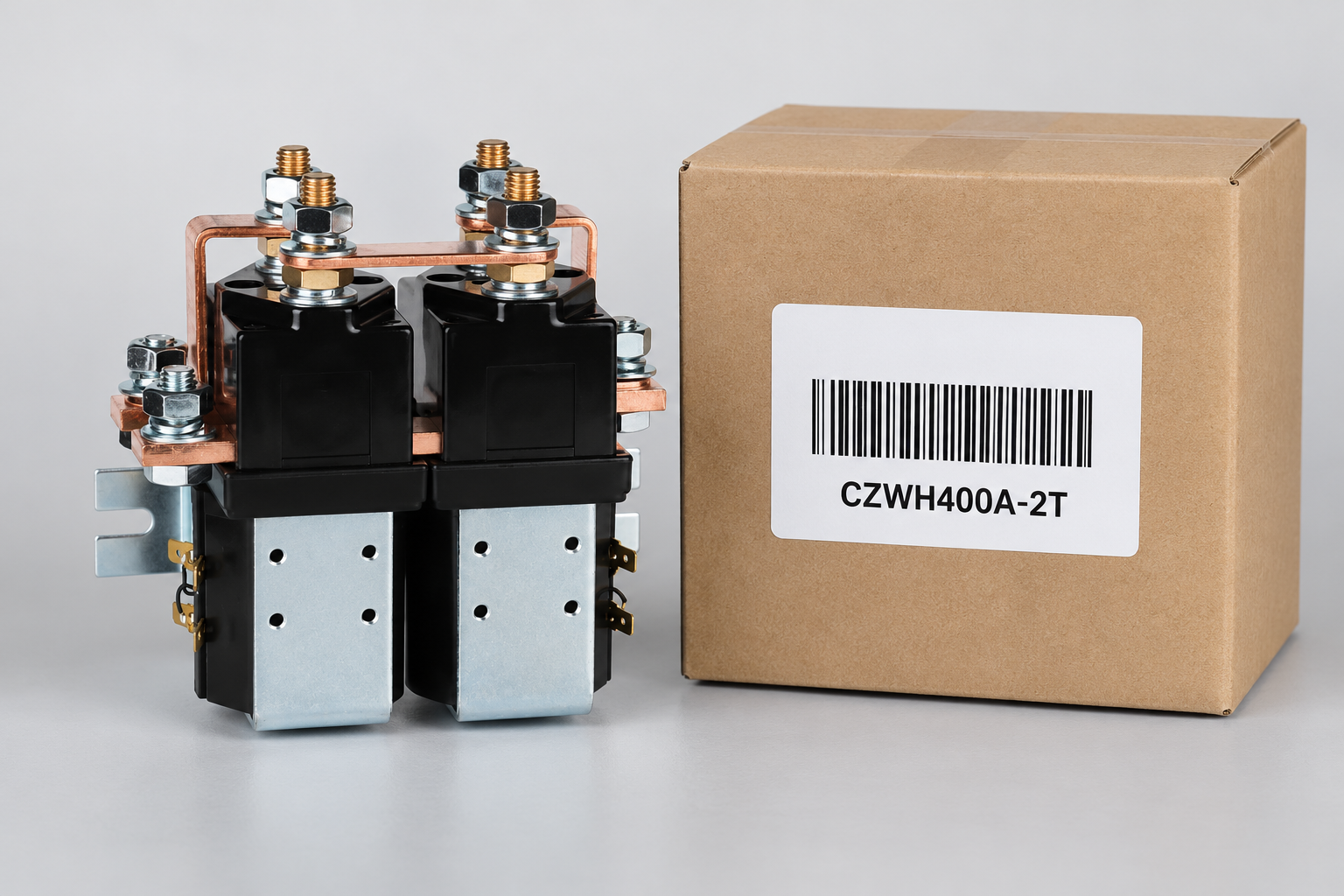
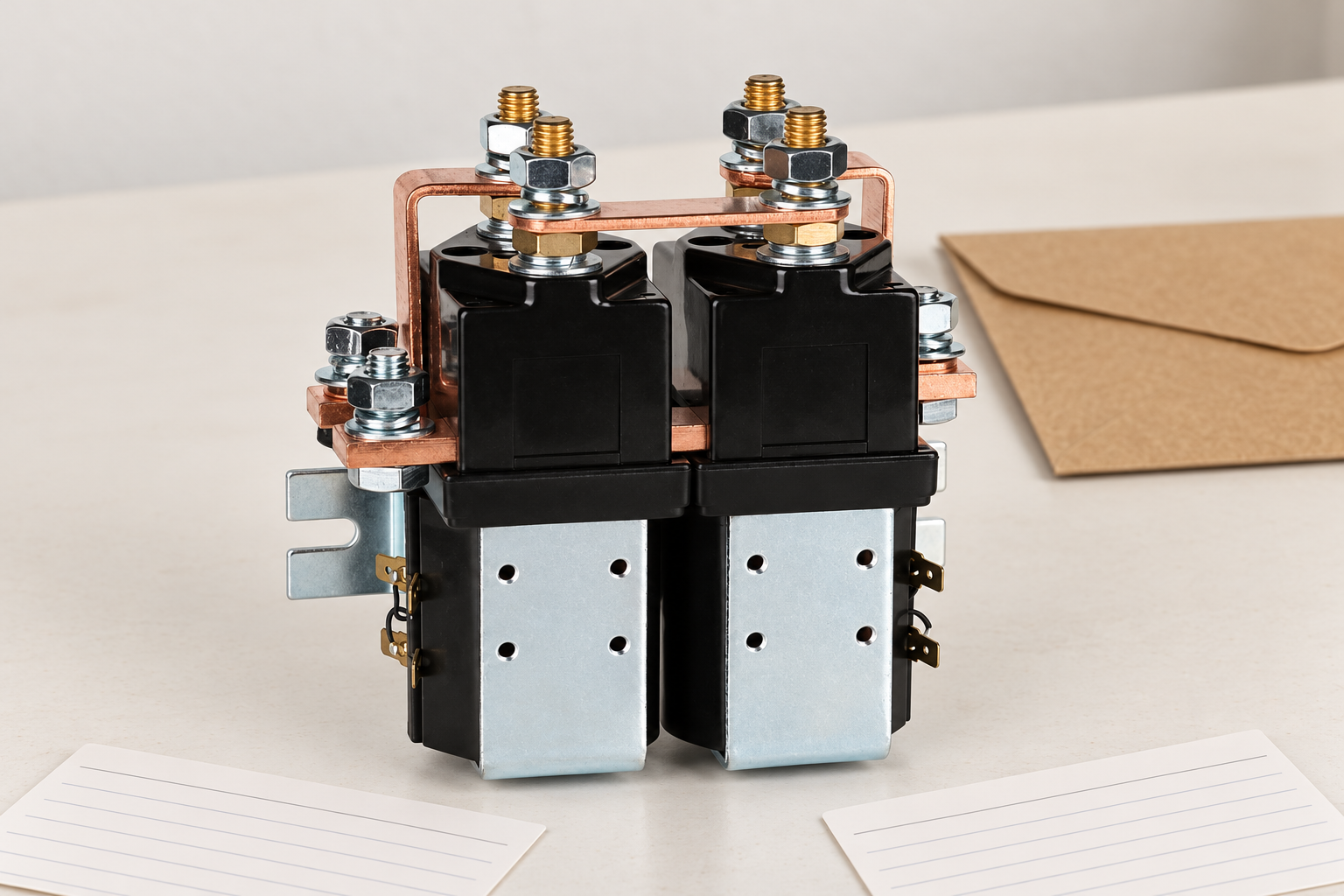
Il Contattore CC di inversione DPDT CZWH400A-2T shown here is a construction example. Ask Sayoon which lot labels, release records and change notifications are available for the exact order. Do not infer factory record capabilities from the photograph.
Usa il Hub di selezione dei contattori DC for application inputs, the test-report review checklist for evidence scope, and the sample request and RFQ record guide to connect the first approved sample with purchasing. Keep these documents linked rather than creating independent records with conflicting model names.
Video educativo: capire l'organizzazione del contatto
La spiegazione elettrica U di seguito illustra come funziona un circuito di contatto per un contattore. Utilizzatela per comprendere la distinzione tra il circuito di controllo e quello principale prima di leggere il disegno di ispezione. Offre una formazione generale, anziché una procedura di prova o l’approvazione del modello illustrato di Sayoon.
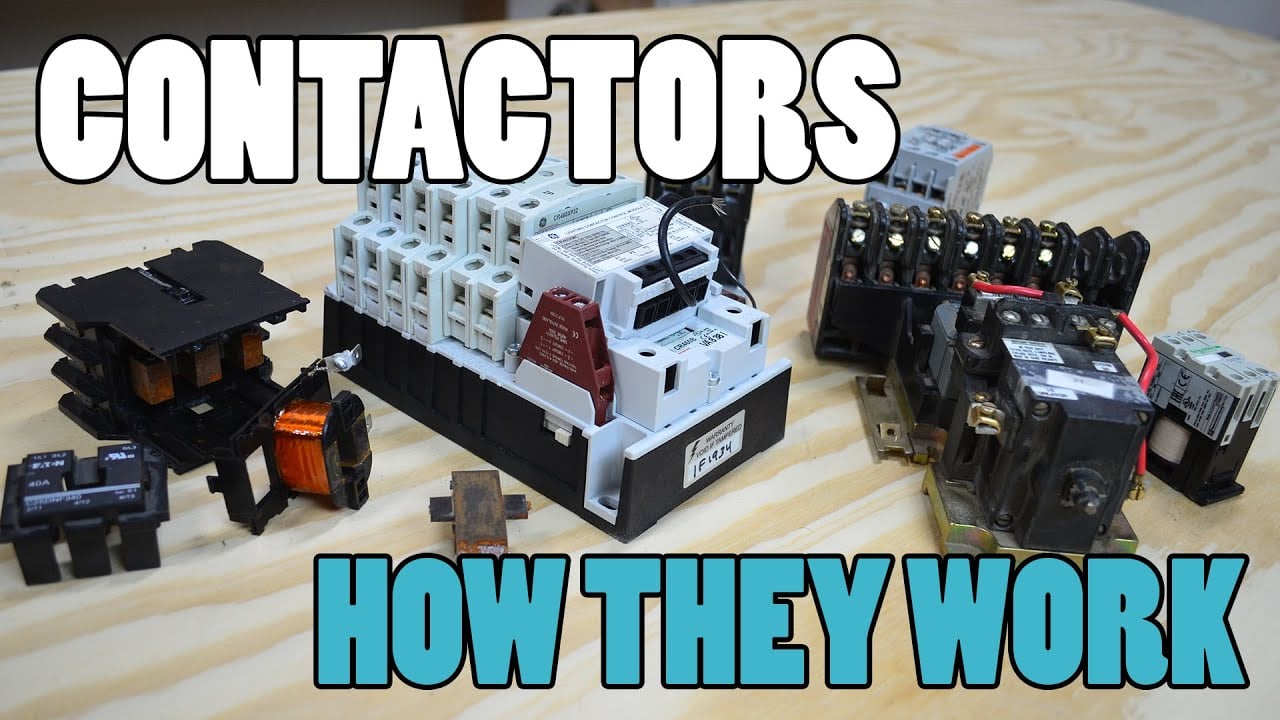
Guarda la spiegazione didattica dell'Elettricista U.
Domande frequenti
Does a lot number prove that a contactor is qualified?
No. A lot identifier connects records and units; electrical suitability and conformity require the applicable supporting evidence.
Are unit serial numbers always necessary?
No. Choose unit, package or lot identification according to the containment and service requirements of the project.
What happens when a supplier lot is split between deliveries?
Retain the original lot identifier and link each delivery and internal movement to it, with quantities and relevant configuration records.
Is product traceability the same as calibration traceability?
No. Product traceability follows units and lots, while measurement traceability concerns a measurement result and its calibration relationship to references.