A mining equipment DC contactor must match both the electrical duty and the machine’s approved installation. Start with the exact circuit, operating voltage, current, interruption requirement, coil supply, vibration, contamination and enclosure conditions. Establish whether the machine operates on the surface, underground or in a location with a specific permissibility requirement. An ordinary industrial contactor does not become approved mining equipment because it is installed inside a metal box or described as heavy duty.
This guide is for OEM engineers, maintenance planners and purchasing teams comparing contactors for electrically powered mining machinery and associated equipment. It is a requirement and evidence checklist, not permission to modify an approved machine or a universal energized troubleshooting procedure. The applicable mine rules and machine documentation govern each installation.
Establish the approval boundary before comparing products
Record the jurisdiction, mine type, working location and equipment classification. These determine which approval and installation requirements apply. Do not assume that a component used on a surface service vehicle can replace a component on underground equipment. Two machines may share a battery voltage while facing very different environmental and regulatory constraints.
그 MSHA archived Electrical Safety Division overview describes electrical testing and compliance work for mining equipment as technical background. Current rules and the specific machine documents govern acceptance. For a project under U.S. mine rules, identify the relevant approval documents and responsible authority. For other markets, establish the equivalent requirements rather than applying U.S. terminology indiscriminately.
For equipment subject to 30 CFR Part 18, review the actual scope and machine approval requirements with qualified personnel. A catalog ingress-protection claim is not a substitute for the complete approval evidence. If a contactor substitution changes an approved construction, resolve the required review before installing it.
Describe the contactor’s task in the machine
Mark the contactor on a complete circuit drawing. It might connect a battery to a drive, switch a pump branch, enable a charger or control an auxiliary load. Name that task precisely. Traction and pump circuits can have different current profiles and switching frequency, even when supplied by the same battery. A spare selected only by nameplate amperage can miss those differences.
Identify every source feeding the switched boundary, including chargers, converters, energy-storage capacitors and possible regenerative paths. Then establish what remains energized when the contactor opens. A command to stop a motor is not necessarily a disconnect, and a disconnect of one branch does not establish that the complete machine is safe for maintenance.
Record whether a contactor normally opens after current has reduced or must interrupt an operating load. Include credible abnormal events, such as loss of the coil supply or a stalled mechanism. The machine designer must decide which device clears faults and which device provides controlled switching. Do not assign circuit-breaker duties to a contactor without supporting evidence.
Build the load profile from actual operating events
A useful current profile separates idle, routine work, acceleration, transient load and abnormal operation. Record duration as well as magnitude, and note how often the contactor operates during a shift. Ask whether the published rating assumes intermittent operation, a particular ambient temperature or a particular conductor arrangement. These conditions belong in the comparison, not in a footnote discovered after purchase.
For motor branches, request the required DC making and breaking duty at the actual circuit conditions. Motor acceleration, converter capacitance and inductive energy can affect switching. A contactor rated to carry a steady current does not automatically have an equivalent capability when opening that current at the highest bus voltage.
For battery-fed machines with regenerative operation, investigate current direction separately. Confirm whether reverse flow can occur at this contactor location and what happens during a fault or control failure. The bidirectional contactor selection guide explains the evidence needed when current-direction assumptions cannot be guaranteed. Do not infer direction-independent interruption from symmetric terminals.
Assess heat, contamination and mechanical installation together
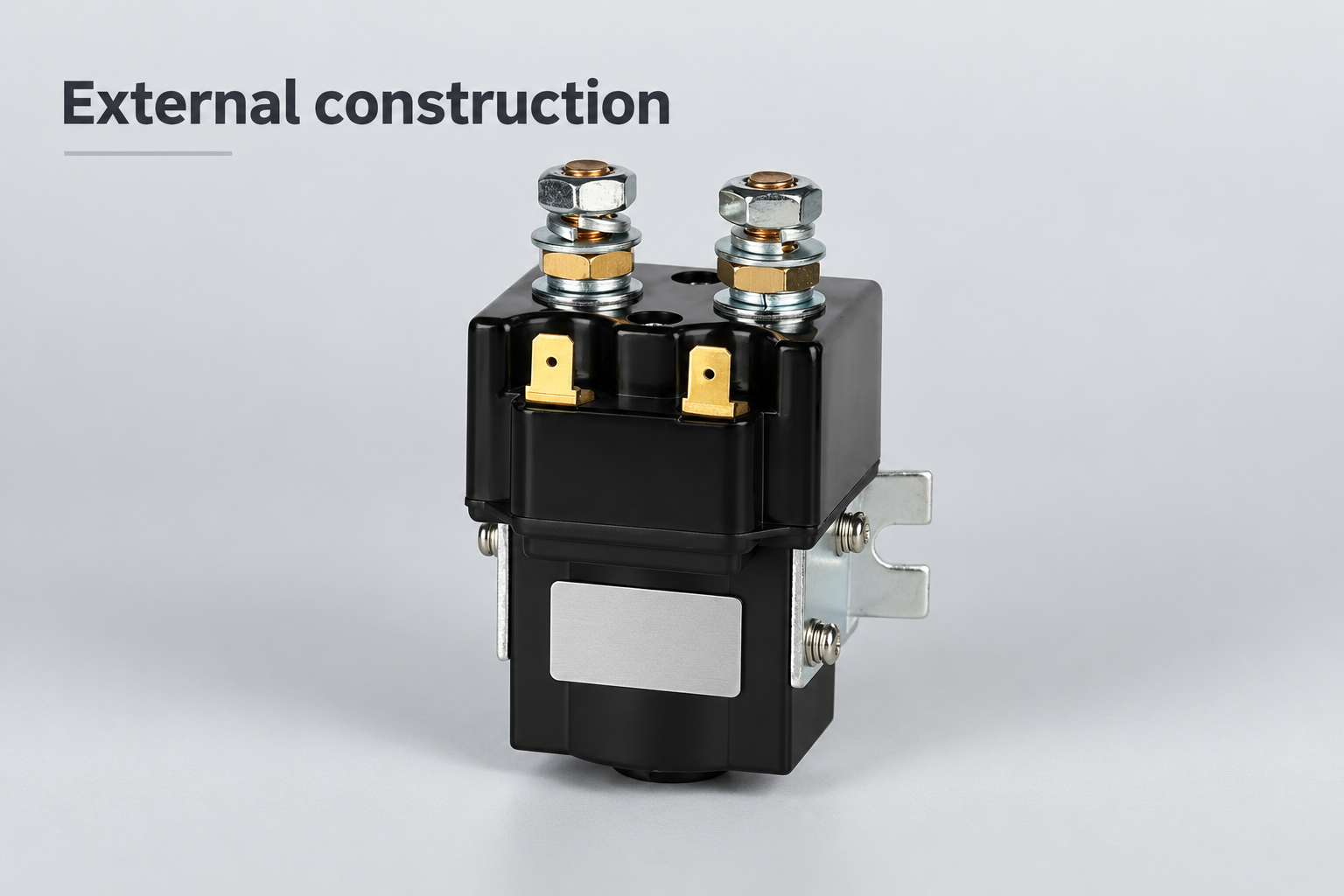
Evaluate the temperature near the contactor inside the completed enclosure. Nearby power electronics, hot conductors and restricted ventilation can raise local temperature above the outside ambient. Check the main terminals, coil and connected joints under the actual work cycle. Record the conductor material and termination arrangement used during testing so production assemblies reproduce the validated configuration.
Dust, conductive contamination, water and cleaning practices create different risks. Determine what protection comes from the contactor and what comes from the enclosure. A sealed product description does not establish that the installed terminals or cable entries are protected. The machine’s approved enclosure and maintenance requirements must remain effective after any component change.
Mounting deserves a separate inspection. Verify the permitted orientation, bracket support, clearances and cable strain relief. Heavy or stiff cables should not apply uncontrolled force to the terminal studs. Review vibration and shock evidence appropriate to the machine installation, and follow the documented tightening instructions rather than adopting a generic torque value from another model.
Check the control supply during difficult starts and stops
Record the voltage range actually available at the coil terminals, including long control cables, shared loads and low battery conditions. A nominal coil voltage is only the center of the requirement. Repeated undervoltage can cause unstable operation, so include pickup, holding and release behavior in the review. Do not attempt to solve chatter merely by increasing a fuse rating.
Check the driver and coil suppression circuit as one system. Suppression can influence release behavior, and the control output must tolerate the relevant electrical conditions. Ask the supplier for the exact coil-code information and restrictions. Changing suppression during a spare-parts substitution may change shutdown timing even when the new coil has the same nominal voltage.
Determine what happens when the control supply disappears. A normally open electrically held contactor can open under load; a magnetic-holding device has a different control dependency. Choose the intended behavior through the machine safety assessment. Neither construction is universally safer without understanding the load, protection and approved stop architecture.
Use a procurement table with evidence, not adjectives
This qualitative table organizes a technical RFQ. The project must supply the actual limits; no row provides a universal mining-equipment specification. Require the vendor to state exceptions clearly, especially where a quoted industrial device has no evidence for a regulated mining installation.
| 검토 항목 | Information from the machine | Evidence before acceptance |
|---|---|---|
| Approval boundary | Jurisdiction, mine location and machine classification | Applicable approval documents and change-review decision |
| Electrical role | Traction, auxiliary, charger or converter boundary | Annotated drawing with all source paths |
| Current duty | Carry, making and breaking events with duration | Applicable ratings and switching qualification |
| Direction | Normal and abnormal current paths | Permitted terminal orientation and reverse-duty limits |
| 온도 | Enclosure conditions and conductor installation | Thermal test and derating information |
| Control | Coil voltage range, driver and suppression | Exact coil-code documentation |
| 기계적인 | Mounting, cable loads, shock and vibration | Installation instructions and relevant test evidence |
| 서비스 | Inspection access and controlled replacement process | Maintenance instructions and traceable spare specification |
Plan maintenance around observable conditions
Use the machine manufacturer’s maintenance instructions to establish inspection intervals and limits. Record signs such as loose supports, damaged insulation, discoloration, abnormal noise and inconsistent feedback. These observations identify items for investigation; they do not authorize energized adjustment or establish an arbitrary replacement interval for every mine.
For U.S. work within its scope, 29 CFR 1910.333 provides electrical work-practice requirements. Determine the rules actually applicable to the mine and task. Qualified personnel must control all relevant energy sources and verify the required safe state. An open control switch is not a substitute for the applicable isolation procedure.
Maintain a traceable spare-parts record: exact ordering code, approved drawing revision, coil option, terminal configuration, installation instructions and acceptance evidence. A replacement that fits the mounting holes can still have different release behavior, directional limits or switching capability. Resolve these differences before the machine returns to service.
Qualify the complete installation and close the RFQ
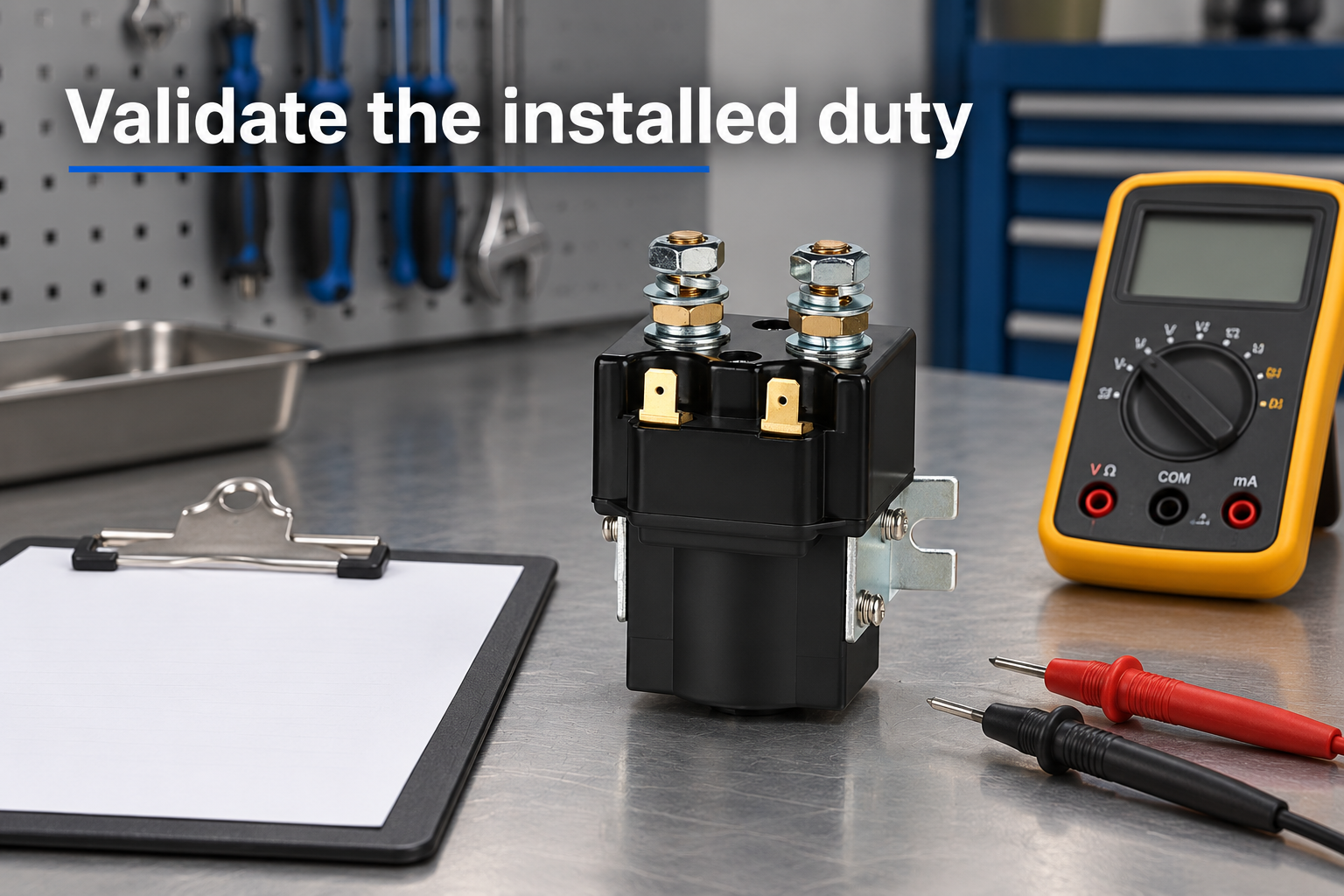
Define a validation matrix for routine load, maximum permitted load, normal stop, control undervoltage, failed feedback and protection operation. Record expected responses and acceptance evidence before testing. Inspect the complete terminal arrangement and enclosure, not only an isolated contactor on a cool bench. Manage any later changes to cables, brackets or control suppression.
그 CZWp100A product page can begin a device discussion; the reference image is not a recommendation for every mining machine. Compare relevant options through the DC contactor current-rating guides, and use the ambient-temperature guide to prepare thermal questions. Request written limitations together with the quotation and keep regulatory acceptance separate from purchasing approval.
Further learning: how a mechanical contactor operates
Electrician U’s neutral educational explanation introduces the mechanical operating principle. It does not demonstrate mining approval, load qualification or a procedure for working on a mining machine. Use it as background alongside the actual machine and supplier documents.
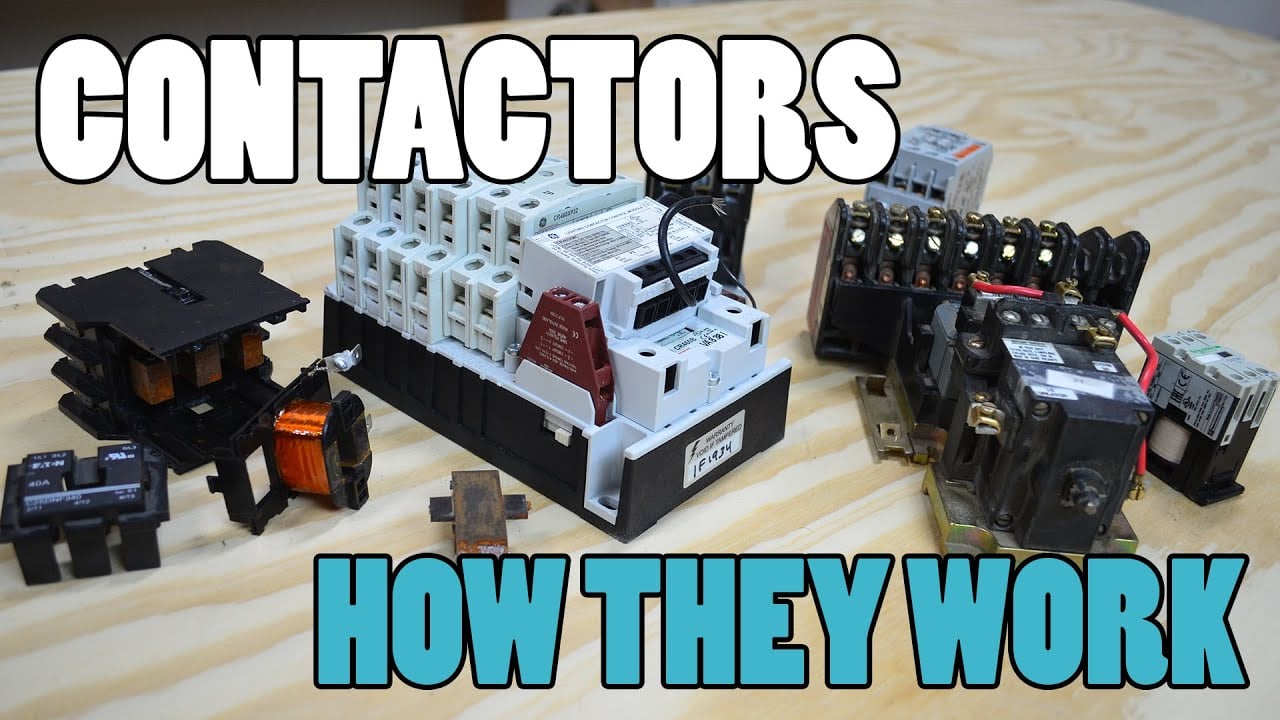
Watch the educational contactor explanation.
자주 묻는 질문
Can a general industrial contactor be used on underground mining equipment?
Only when the device and complete installation satisfy the applicable machine approval and electrical requirements. Industrial ratings or enclosure appearance alone do not establish permissibility.
Is continuous current enough to choose a mining contactor?
No. Evaluate making and breaking duty, voltage, current direction, installed temperature, control supply, mechanical conditions and the approved machine construction separately.
Can a matching coil voltage make two contactors interchangeable?
No. Pickup and release behavior, suppression, terminal arrangement, switching evidence and approval constraints can differ. Check the exact ordering code against the approved spare specification.
What should purchasing request before ordering a replacement?
Request the approved drawing and device code, applicable duty evidence, coil and installation instructions, environmental limits and a documented decision on any required approval review.