The 784-1221-210 12 volt high performance plastic DC contactor can be replaced only after its electrical duty, coil circuit, terminals, mounting, and environment are matched—not simply because another contactor is labeled 12 V and 200 A. The original reference is a Trombetta HP Plastic normally open contactor with a 12 VDC coil and intermittent-duty rating. If the exact OEM part is unavailable, buyers can evaluate a documented aftermarket cross-reference or an engineered alternative. This guide records the reference specification, explains the differences that block a blind swap, and shows how to qualify a candidate such as a configured Sayoon SDC15-200A/12V without claiming it is a drop-in replacement.
Trademark and compatibility notice: Trombetta and 784-1221-210 identify a third-party product. Sayoon is not affiliated with Trombetta. Any alternative must be approved from drawings, samples, and application testing before use.
What Is the 784-1221-210 Reference Part?
The clearest reference is the manufacturer’s HP Plastic family data sheet. It identifies 784-1221-210 as a 12 VDC, normally open, ungrounded-coil contactor using copper contacts and a flat-on-base bracket. The model is listed at 200 A intermittent duty. The family sheet also lists 10-32 coil studs, 5/16-24 contact studs, an unsealed construction, and an operating-temperature range of −40°C to +60°C.
Those details matter because the phrase “12 volt high performance plastic DC contactor” does not define interchangeability. Two devices can share the same nominal coil voltage while using different coil currents, pull-in limits, duty cycles, terminal threads, contact materials, mounting holes, or environmental protection.
| Reference field | 784-1221-210 published value | Why it matters |
|---|---|---|
| Coil voltage | 12 VDC | The controller must deliver the candidate’s required pickup and holding conditions. |
| Contact state | Normally open | The power path must remain open when the coil is de-energized. |
| Published model rating | 200 A, intermittent | A continuous-duty rating and an intermittent rating are not interchangeable labels. |
| Coil duty | Intermittent, 15% at 25°C | The maximum on-time and cooling interval must fit the machine sequence. |
| Coil circuit | Ungrounded | The existing control wiring may expect two isolated coil terminals. |
| Контактный материал | Copper | Material changes can affect voltage drop, wear, welding behavior, and life under the real load. |
| Power terminals | 5/16-24 studs | Cable lugs, nuts, torque, clearance, and thread engagement must be checked. |
| Coil terminals | 10-32 studs | The harness may require different ring terminals or an approved adapter. |
| Environmental construction | Unsealed; −40°C to +60°C | Moisture, dust, washdown, temperature, and mounting location affect the replacement decision. |
Reference values above are taken from the Trombetta HP Plastic family data sheet. Confirm the revision and the markings on the removed unit before relying on them.
Three Legitimate Replacement Paths
1. Buy the exact OEM reference
If the equipment documentation requires 784-1221-210 and genuine stock is available through an authorized source, the exact reference is the lowest-change path. It still requires a check of the received part, revision, terminal arrangement, and condition. A matching number on a marketplace listing is not the same as traceable manufacturer documentation.
2. Use a documented aftermarket cross-reference
An aftermarket supplier may state that its part replaces 784-1221-210. Treat that claim as the start of a review. Request the replacement drawing, electrical ratings, coil data, duty definition, environmental limits, warranty, and written cross-reference basis. Fitment lists alone are weak evidence because the same machine family can use different harnesses or starter circuits across model years.
3. Qualify an engineered alternative
An engineered alternative does not need to duplicate the original construction, but every difference must be understood and accepted. This route is common when an OEM redesigns a bracket, changes cable lugs, improves environmental protection, or needs a stable production source. It requires the most disciplined validation and must not be described as a direct replacement before approval.
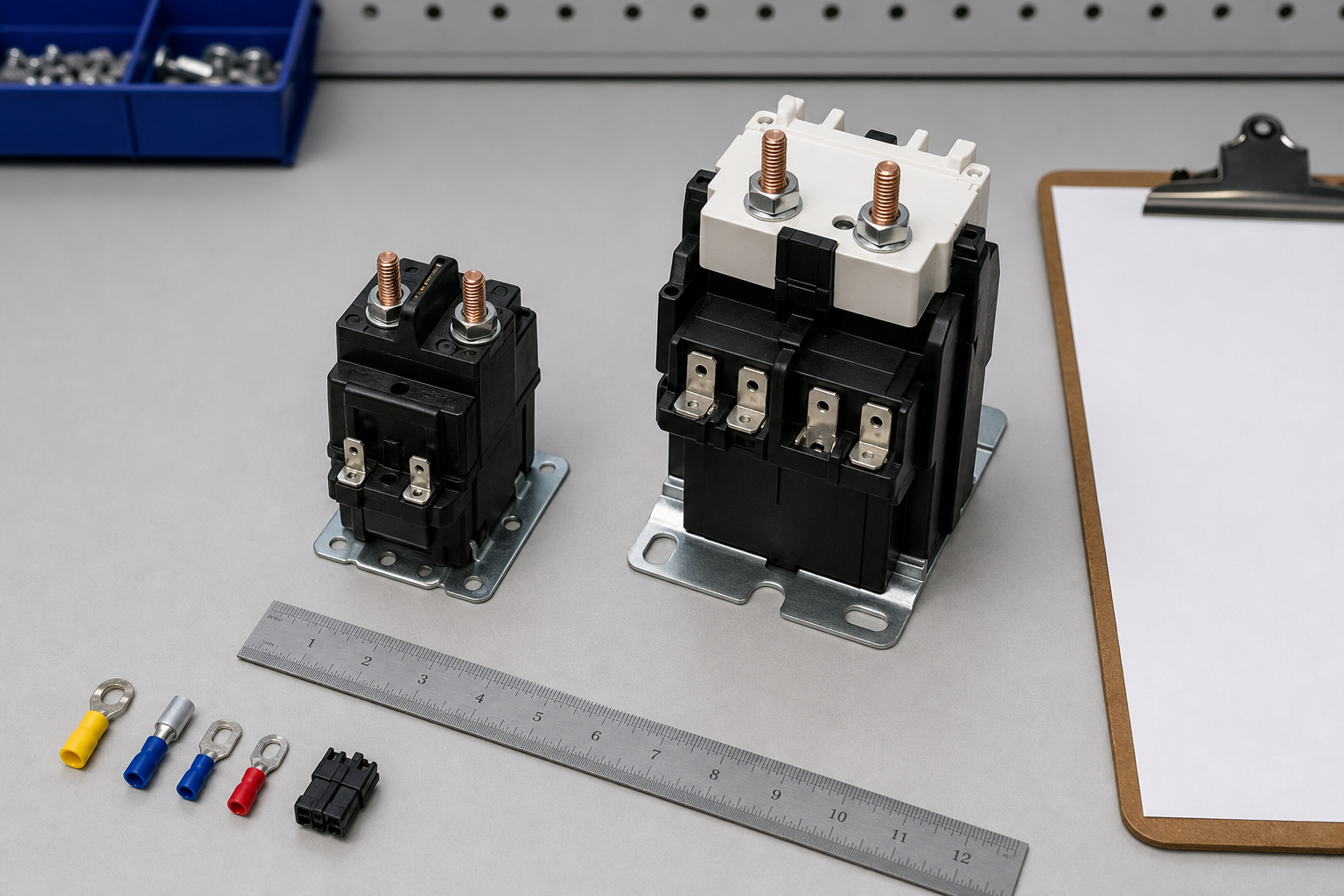
Could a Sayoon SDC15-200A/12V Be Evaluated?
Yes—as an engineering candidate, not as a declared drop-in replacement. The current Sayoon SDC15-200A starter DC contactor page lists a 12 V coil option, one normally open contact, a 200 A rated load current at a 48 V DC-1 circuit, and intermittent or continuous work configurations. That places it in a relevant functional class for a technical comparison.
Important differences are visible in the published information. The Sayoon candidate uses M8 power terminals and M5 screw or 6.3 mm spade coil terminals, while the 784 reference uses 5/16-24 power studs and 10-32 coil studs. The published contact materials also differ, and the candidate’s dimensions and mounting bracket must be compared from controlled drawings. These differences prevent an automatic compatibility claim.
| Check | 784-1221-210 reference | SDC15-200A/12V published candidate | Decision |
|---|---|---|---|
| Nominal coil | 12 VDC | 12 V option | Potential match; verify pickup, hold current, suppression, and polarity. |
| Форма обратной связи | 1 НЕТ | 1 НЕТ | Functionally aligned. |
| Current statement | 200 A intermittent | 200 A at 48 V DC-1 | Not directly comparable until load, voltage, inrush and timing are defined. |
| Техническое задание | Intermittent; family sheet states 15% at 25°C | Intermittent default or continuous option | Order code and machine cycle must be confirmed. |
| Power terminals | 5/16-24 studs | M8 screws | Different thread systems; cable hardware review required. |
| Coil terminals | 10-32 studs | M5 screws or 6.3 mm spades | Harness termination change is likely. |
| Контактный материал | Copper | Silver alloy | Validate voltage drop, heating, make/break duty and life. |
| Environmental statement | Unsealed; −40°C to +60°C | Product page lists IP55 and −25°C to +70°C | Review actual installation, connectors, bracket and qualification evidence. |
This comparison does not establish interchangeability. It identifies questions for a sample and drawing review. Ask Sayoon to confirm the offered revision and application-specific data because product configuration can change with coil, bracket, duty and terminal options.
Ten Checks Before Ordering Any Alternative
- Confirm the original identity. Photograph the label and record the complete part number, terminal layout, bracket and any suffix.
- Define the load. Record system voltage, normal current, locked-rotor or inrush current, load type and whether the contactor makes or breaks current.
- Record the operating cycle. Include maximum energized time, off-time, operations per hour and worst-case ambient temperature.
- Check the coil driver. Measure available voltage at pickup, identify the driver type, and document suppression devices and polarity requirements.
- Verify contact form and coil isolation. A normally open power contact and an ungrounded two-terminal coil must remain correct for the control logic.
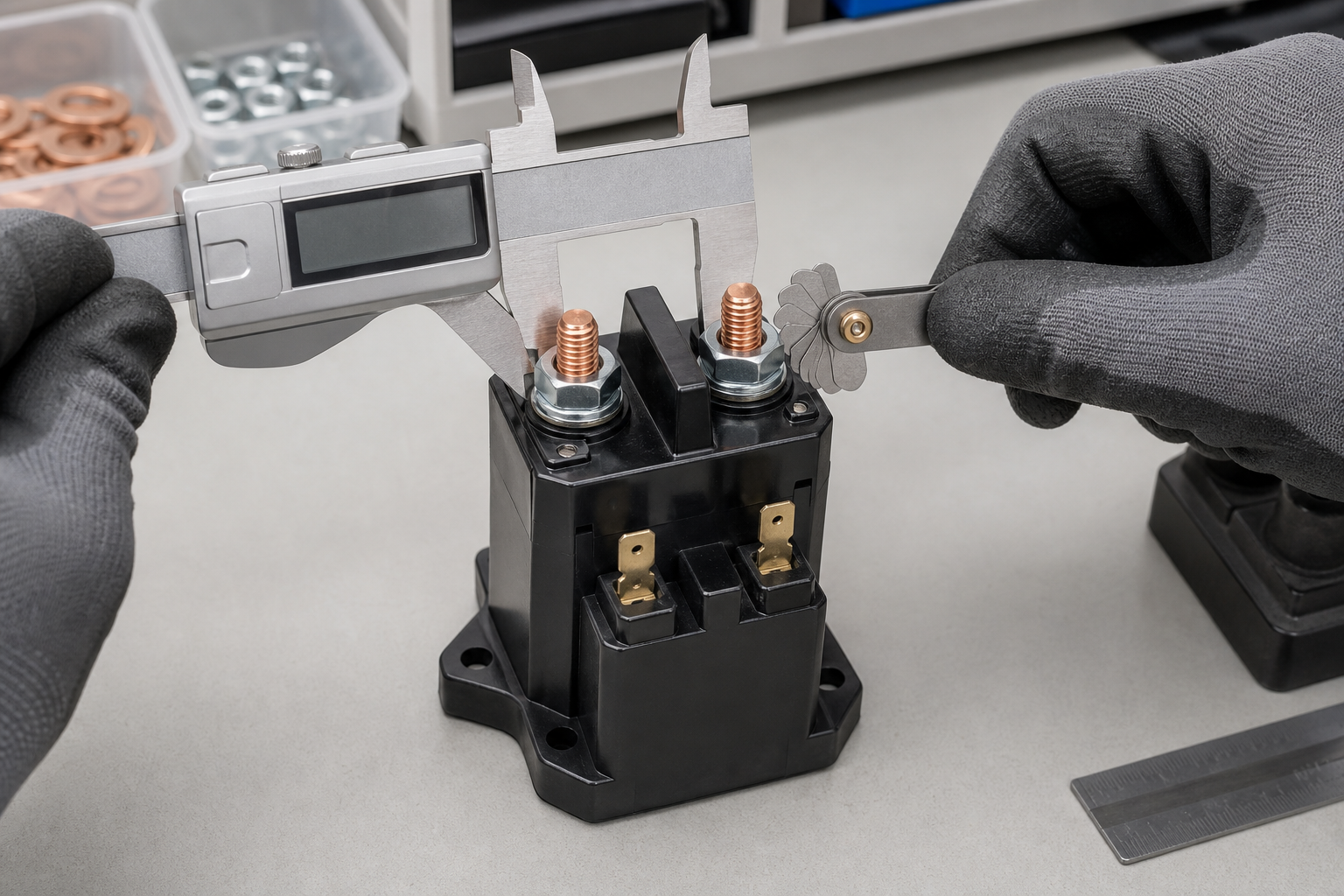
- Compare terminal hardware. Check thread system, stud diameter, nut engagement, cable-lug hole, washer stack, torque and tool access.
- Compare mounting geometry. Use dimensioned drawings for hole centers, bracket orientation, body envelope and clearance to nearby conductive parts.
- Review the environment. Consider temperature, vibration, moisture, dust, washdown, altitude and corrosive exposure.
- Define failure behavior. Decide what happens if the contactor fails to pull in, drops out, overheats or welds closed.
- Approve with evidence. Complete drawing review, sample inspection, bench testing and application validation before releasing a production substitute.
What to Put in the Replacement RFQ
A useful RFQ should let an engineer reject a poor match before samples are shipped. Attach the original data sheet if available, but also provide evidence from the machine. Older equipment may have field modifications or a different revision from the document found online.
- Original manufacturer and complete part number
- Photos of the label, terminals, bracket, wiring and installation space
- System voltage, load type, normal current and measured inrush
- Coil voltage at the contactor during pickup and hold
- On-time, off-time and switching frequency
- Ambient temperature, vibration, moisture and contamination
- Dimensioned mounting and cable-clearance limits
- Required approvals, test reports and change-control documents
- Sample quantity, validation owner and production forecast
For a broader RFQ framework, use Sayoon’s guide to recording a DC contactor sample request. If the old component is available, the nameplate replacement review helps preserve traceable evidence. The site’s DC contactor testing guide provides additional test-planning context.
A Practical Validation Sequence
Begin with a paper comparison. Mark every field as matched, intentionally changed, unknown, or not applicable. Do not allow an unknown field to become an assumed match. Next, inspect the sample for dimensions, bracket, terminal access and workmanship. Then perform controlled coil and contact checks using approved procedures and equipment.
Application testing should reproduce the real load and duty cycle, not only a no-load click test. Review pickup and dropout behavior at expected voltage limits, terminal heating, voltage drop, repeated cycling, and the effect of the intended suppression circuit. Where the application includes a motor or starter, capture the inrush waveform and confirm that the candidate is rated for the switching task.
Finally, install the candidate in a controlled pilot unit. Check cable strain, fastener retention, enclosure clearance, temperature and behavior across realistic operating conditions. Record the approved model configuration so purchasing cannot later substitute a different coil, bracket or duty option under the same abbreviated description.
Electrical Safety Boundary
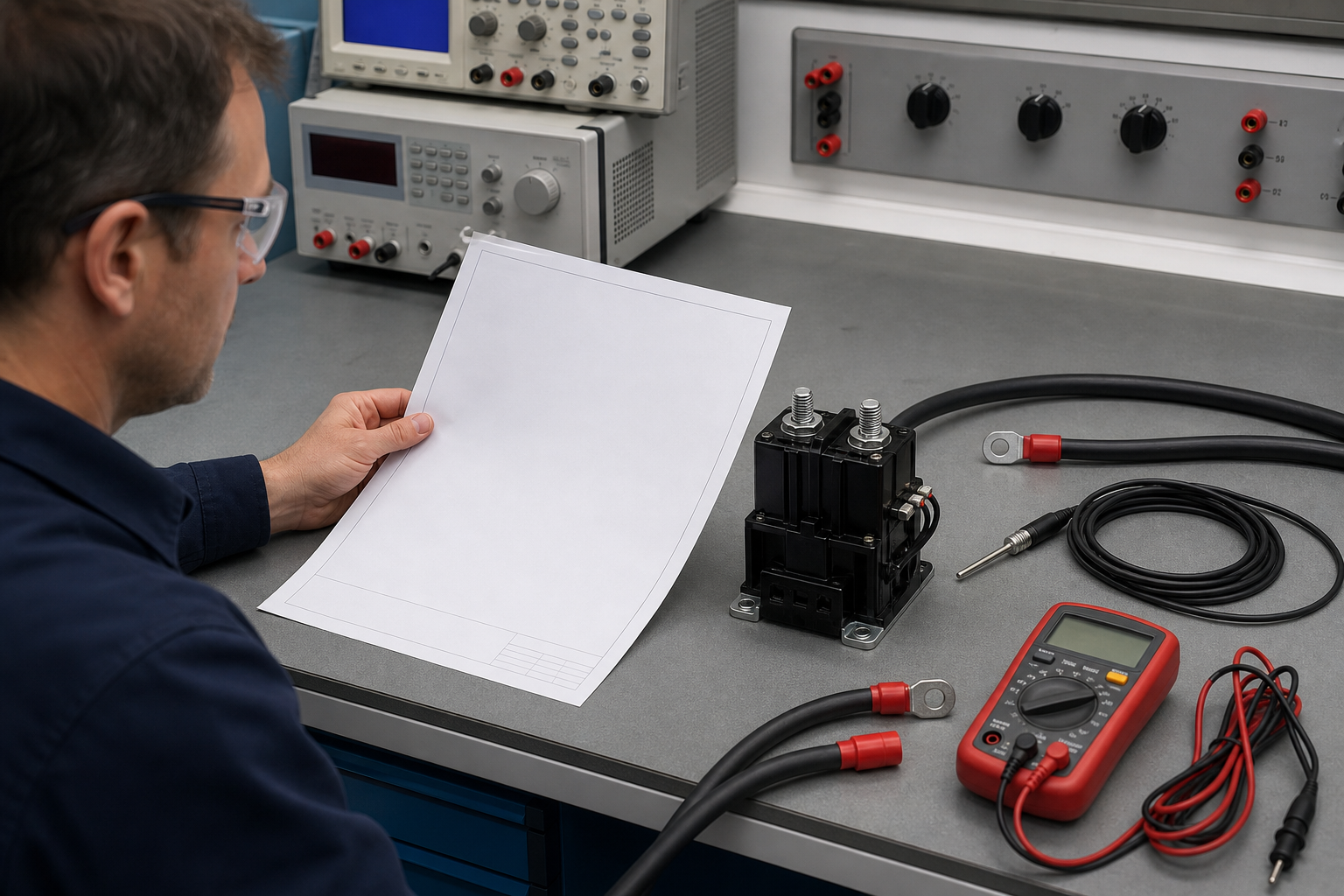
Replacement work can expose personnel to battery fault current, stored energy and unexpected machine movement. Follow the equipment manufacturer’s procedure and the rules that apply at the worksite. OSHA’s electrical work-practice requirements state that circuits should be de-energized when required, stored electrical energy must be addressed, and a qualified person must verify the de-energized condition with test equipment. OSHA’s isolation and verification interpretation also emphasizes effective isolation, control of stored energy and verification before work starts.
This article is a sourcing and engineering-review guide, not a wiring instruction. Do not energize a candidate merely to see whether it “clicks” unless the test setup, protection, instruments and personnel are appropriate for the available energy.
How a Contactor Works
The following Electrician U lesson provides a neutral visual introduction to the coil, armature and power-contact action. It supports the operating-principle discussion but does not determine whether two specific contactors are interchangeable.
Watch “What is a Contactor and How Does it Work?” on YouTube.
Часто задаваемые вопросы
Is the 784-1221-210 a continuous-duty contactor?
No. The published HP Plastic family sheet identifies 784-1221-210 as an intermittent-duty model and lists the intermittent coil duty as 15% at 25°C. Confirm the actual application cycle and the latest manufacturer documentation.
Can any 12 V 200 A contactor replace it?
No. Nominal voltage and current are only two fields. Coil circuit, pickup behavior, duty, load type, terminals, bracket, dimensions, contact material and environment must also be verified.
Is the Sayoon SDC15-200A/12V a direct replacement?
It should be treated only as an engineering candidate. Published values show relevant functional similarities, but terminal systems, contact material, mechanical fit and application ratings require drawing, sample and test approval.
What information should I send for a replacement review?
Send the original part number, label and installation photos, dimensions, wiring context, system voltage, load and inrush, coil measurements, duty cycle, environment and required documentation.
Should I reuse the existing cable lugs and nuts?
Only if their thread, hole size, material, current capacity, stack-up, torque requirement and clearance are approved for the new terminal. The reference and the Sayoon candidate use different published terminal systems.
Request an Engineering Comparison
If you need an alternative to 784-1221-210, send Sayoon the original unit photographs, drawing, electrical duty and installation limits. The team can compare an SDC Series starter contactor configuration and state which items match, which require changes and which still need testing. A recommendation should be tied to the submitted application—not to the part number alone.