A 60V DC contactor selection in material handling is a class-edge decision: SZJ SKUs publish contact voltage ≤60 V, so a circuit whose documented maximum — charging included — stays at or below 60 V fits that class, while any documented maximum above it escalates to the published ≤80 V CZW or ≤150 V QZJ classes; 60 V itself is a listed discrete coil value, so control-side orders write /60V in the published code slot.
This selection guide serves forklift, tow-tractor, and warehouse-equipment teams whose fleets touch the 60 V number on either the coil or the circuit side. The application frame comes from the AGV and electric forklift solution page, and every device claim quotes a published row.
Part 1. Where does a 60V DC contactor requirement appear in material handling?
A 60V DC contactor requirement reaches material handling desks from two directions. Fleet electrification pushes some trucks and tow tractors past the classic 48 V rung, and service teams inherit machines whose control coils were ordered at 60 V.
Material handling equipment concentrates the usual DC switch points: battery connect, traction branch feeding the traction motor controller, hydraulic pump branches, and auxiliary feeders. Each point carries its own current class, but all share the 60 V class question.
| Where 60 V appears | What it actually names | Selection consequence |
|---|---|---|
| Truck bus between 48 V and 72 V rungs | Circuit voltage | Class-edge review below |
| OEM coil spec on legacy parts | Coil rated voltage | Published list ordering |
| Charger-side branch | Circuit voltage during charge | Documented maximum rules |
The neighboring rungs have live guides — 48 V DC contactor forklift applications below and 72 V DC contactor AGV sizing above.
Part 2. Why is 60 V a class-edge decision on published tables?
The SZJ family publishes contact voltage as ≤60 V, which places a 60 V circuit exactly on the class boundary. Boundary cases are where field failures cluster, because battery systems do not sit at nominal: charging states push the bus above the label.
The published-table discipline resolves it without guesswork. Document the maximum voltage the switch point sees across all operating states — the number lives in the vehicle design file or a service measurement, not in a rule of thumb — then compare that documented maximum against the published class.
| Documented maximum at the switch point | Published class verdict | Family answer |
|---|---|---|
| At or below 60 V | Inside ≤60 V class | SZJ rows apply |
| Above 60 V, up to 80 V | Needs ≤80 V class | CZW100A-class rows |
| Above 80 V, up to 150 V | Needs ≤150 V class | QZJ rows |
Part 3. Which published SZJ rows carry verified ≤60 V circuits?
Once the documented maximum verifies inside the class, the SZJ ladder covers branch sizes from light auxiliaries to heavy traction feeds.
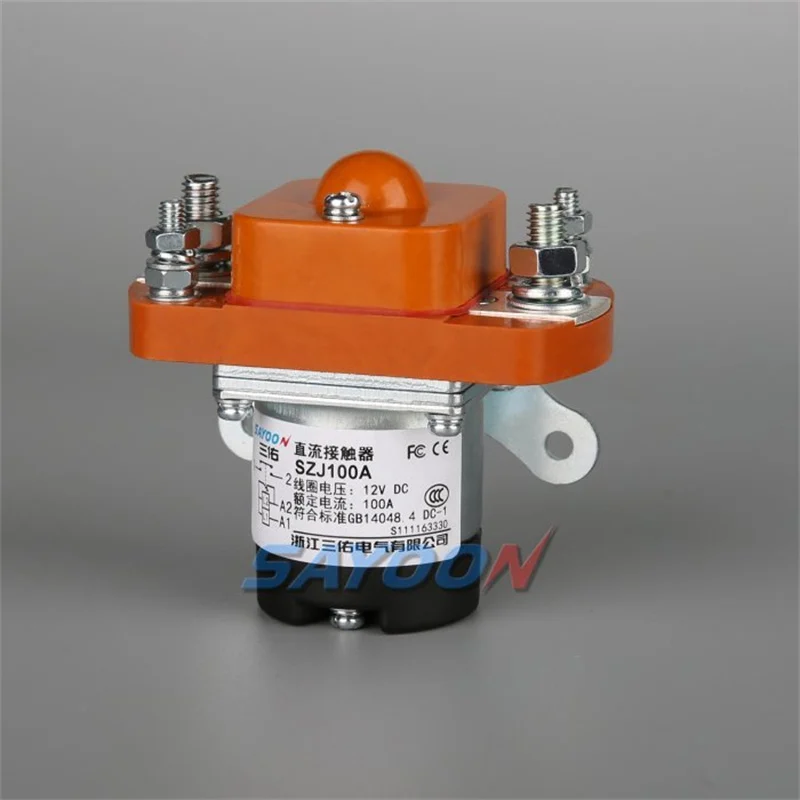
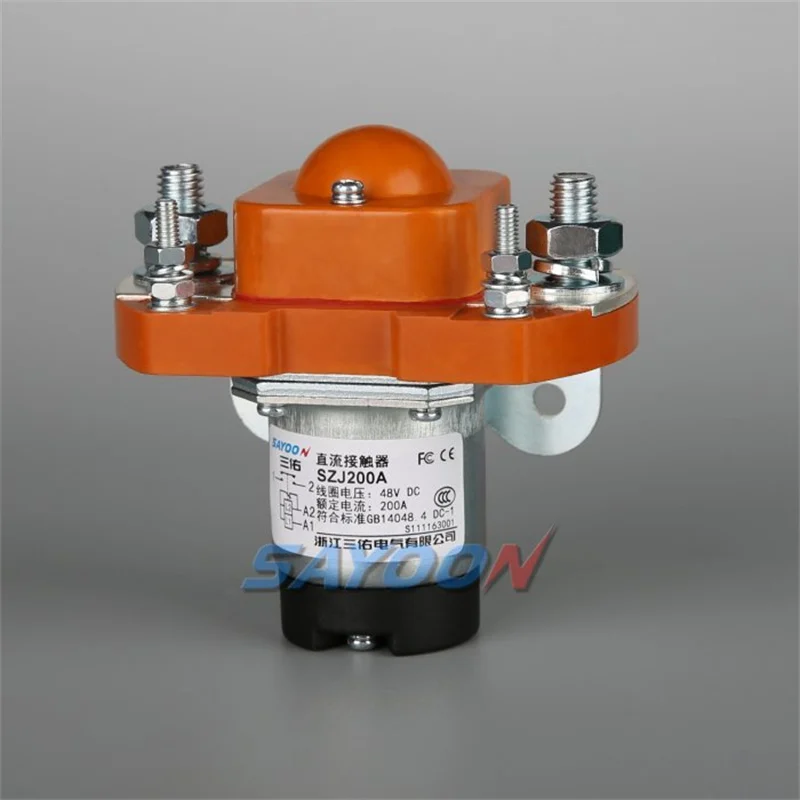
| Published field | SZJ100A | SZJ200A | SZJ400A |
|---|---|---|---|
| Contact voltage | ≤60 V | ≤60 V | ≤60 V |
| Load current | 100 A | 200 A | 400 A |
| Coil power | Start: 120–170, Keep: 3–8 | Start: 120–170, Keep: 4–10 | Start: 120–170, Keep: 5–11 |
| Load terminal | M6 screw | M8 screw (≤9.0 N.m) | M10 screw (≤20.5 N.m) |
| Fault rupture line | 800 A / 5 ms | 1000 A / 5 ms | 1500 A / 5 ms |
| Life rows | 20,000 / 300,000 ops | 20,000 / 300,000 ops | 20,000 / 300,000 ops |
The Start/Keep coil architecture matters for battery-powered fleets: a strong pull-in stage followed by keep watts in single digits keeps the standby drain small, but the control supply must survive the 120–170 W start surge, so multi-device panels stagger their close commands.
Part 4. When must the selection escalate to ≤80 V or ≤150 V classes?
Escalation is a published-row change, not a safety-factor debate. When the documented maximum exceeds 60 V, two published classes stand ready.
| Escalation trigger | Published answer | Example rows |
|---|---|---|
| Maximum ≤80 V | CZW100A class | ≤80 V; 100 A; coil 8–13 W |
| Maximum ≤150 V | QZJ family | QZJ100A: ≤150 V; 100 A; Start 35–65, Keep 2–5 W |
| Maximum above 150 V | Sealed HV families | SEV/HEV published classes |
Fleet standardization often prefers one class up for mixed depots: a ≤150 V QZJ spare covers both the 60 V trucks and higher-voltage tow tractors, simplifying the spare shelf. That is an inventory decision the published rows support — each machine still gets its class verified individually. The general method sits in the DC contactor selection key factors guide.
Part 5. How should 60 V coils be ordered from published lists?
On the control side, 60 V is a listed discrete coil value — the cited CZW, SZJ, and QZJ coil lists all include it between 48 V and 72 V. Ordering follows the published code grammar.
- Write /60V in the final code slot following the published /24V pattern.
- Keep the published working range row (0.8–1.2 Us) in the file for supply-tolerance questions.
- Note the pull-in voltage row (≤70% on cited SKUs) when control supplies sag during traction surges.
Replacement matching deserves its own discipline: an OEM part labeled 60 V might be a 60 V coil on a 48 V circuit or a 60 V circuit device, and the published rows — not the housing shape — decide the correct successor.
Part 6. Which SAYOON models anchor a material handling RFQ?
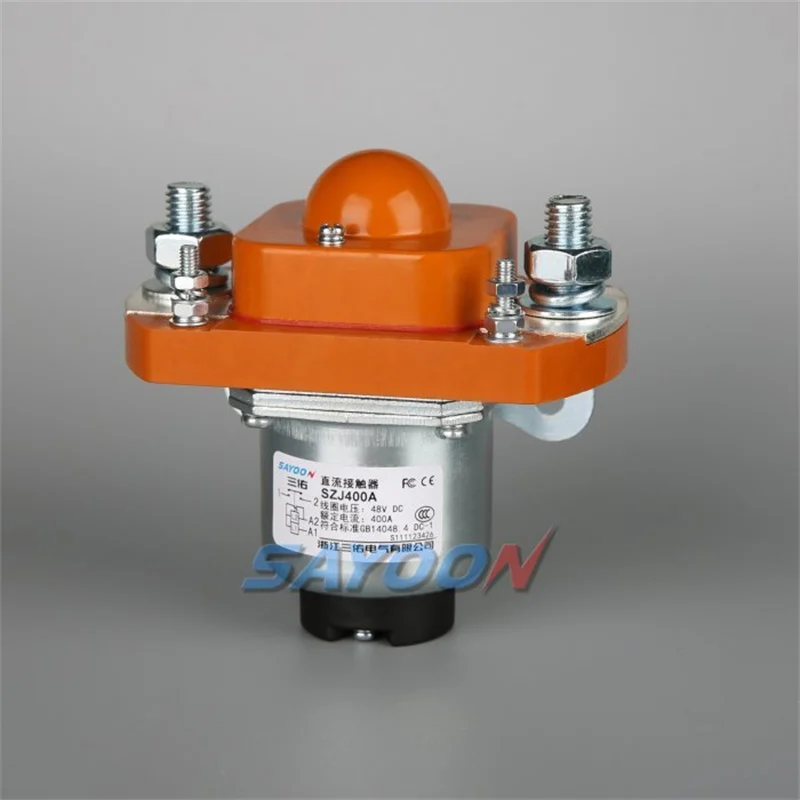
Product recommendation: anchor heavy verified-≤60 V branches on the SZJ400A normally open DC contactor — the published 400 A line, Start 120–170 / Keep 5–11 W coil, M10 hardware row, and 1500 A / 5 ms rupture window give the fleet RFQ every number it needs.
Why not other lines without review: SZJ100A and SZJ200A carry lighter branches in the same verified class; the QZJ100A normally open DC contactor takes over when the documented maximum exceeds 60 V under its published ≤150 V class; CZW100A serves platforms standardized on CZW hardware within ≤80 V.
Fit Boundary: every SZJ answer is invalid the moment the documented maximum exceeds 60 V; none of these parts clear faults; and replacements must re-verify class and coil rows rather than matching housings.
To confirm a fleet plan, send your fleet voltage worksheet with nominal and maximum voltages, branch currents, and duty cycles.
Part 7. What 60 V selection mistakes strand equipment?
- Selecting on nominal 60 V and never documenting the charging-state maximum.
- Keeping a ≤60 V part on a circuit whose measurements show above-60 V peaks.
- Matching replacements by housing shape instead of published class and coil rows.
- Closing several Start/Keep coils simultaneously and browning out the control supply.
- Ordering default coils instead of writing /60V in the code slot.
- Skipping torque rows during depot maintenance on M8 and M10 terminals.
- Standardizing spares without verifying each machine’s class individually.
References
FAQs
What is a 60V DC contactor?
Either a contactor switching a circuit whose class must contain 60 V, or a contactor whose coil is ordered at the listed 60 V value. The two meanings route to different published rows.
Can a ≤60 V class part switch a 60 V battery circuit?
Only when the documented maximum voltage — charging included — verifiably stays at or below 60 V. Battery circuits that exceed the label during charge escalate to higher published classes.
Is 60 V a published SAYOON coil value?
Yes. The cited CZW, SZJ, and QZJ coil lists include 60 V as a discrete value, ordered by writing /60V in the published code slot.
Which class covers a documented maximum above 60 V?
The published ladder continues at ≤80 V (CZW100A class) and ≤150 V (QZJ family), then moves to the sealed SEV and HEV families above that.
What amp classes do SZJ 60 V parts publish?
The cited ladder runs 100 A (SZJ100A), 200 A (SZJ200A), and 400 A (SZJ400A), with 600 A and 800 A classes above them — each with its own terminal and rupture rows.
What happens if system voltage exceeds the published class?
The published class is an engineering boundary: exceeding it risks interruption failures the table never promised to survive. The fix is a class change, not a derating argument.
Where should a material handling RFQ start on this site?
Start at the AGV and electric forklift solution page, verify the class from documented maxima, then send the fleet voltage worksheet through the contact page.