An 800A DC contactor choice for BESS and charger interfaces starts with the voltage class, not the amp label: the CZW800A and SZJ800A publish 800 A DC-1 with contact voltage ≤60 V — fitting 48 V-class containers, telecom plants, and low-voltage charger sides — while DC buses above that class escalate to the sealed SEV800AH published at 5–1000 V, and every integration file must freeze terminals, coil watts, and rupture rows from the exact SKU table.
These integration notes serve BESS container engineers and charging-plant designers working at the top of the low-voltage amp range. The class lives inside the CZW series DC contactors pillar, and each claim below quotes a published SKU row.
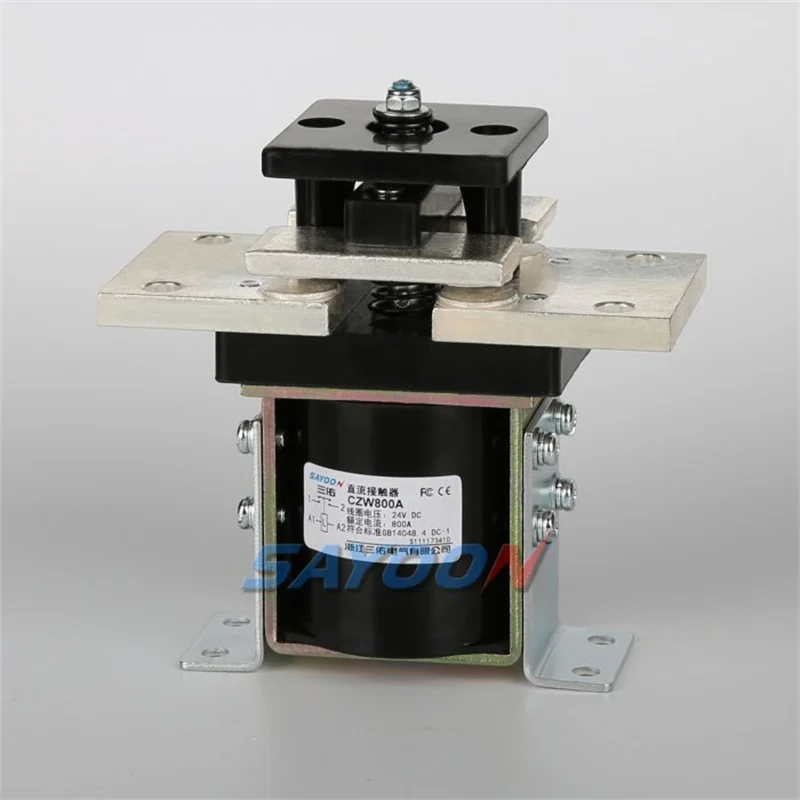
Part 1. Where does an 800A DC contactor sit in BESS and charger interfaces?
An 800A DC contactor appears where aggregated DC current approaches the kiloamp frontier: battery-container distribution points, telecom 48 V plants feeding stacked rectifier shelves, and the DC side of charging equipment. The battery energy storage system literature describes exactly this aggregation pattern — strings combine, and the combined bus needs a switch point.
Charger interfaces add a second pattern. Between rectifier stages, battery buffers, and dispensers, low-voltage high-current branches need remotely controlled connect and isolate points that a properly classed contactor provides.
| Interface duty | Where 800 A appears | First row to audit |
|---|---|---|
| Container DC distribution | Combined string bus | Contact voltage class |
| Telecom 48 V plant | Rectifier and battery feeders | 800 A DC-1 line |
| Charger DC side | Buffer and dispenser branches | Bus class vs published lines |
| Service isolation | Maintenance switch points | Terminal hardware row |
The sizing arithmetic that leads here is covered in battery contactor sizing for storage containers.
Part 2. Which voltage class decides between LV and HV 800 A families?
Two 800 A families exist on this site, split by published contact voltage. Getting this split wrong is the costliest mistake in the class.
| Published field | CZW800A / SZJ800A (LV) | SEV800AH (HV pointer) |
|---|---|---|
| Contact voltage (DC) | ≤60 V | 5–1000 V |
| Load current (DC-1) | 800 A | 800 A |
| Sealing | IP40 | IP68 sealed chamber |
| Natural home | 48 V containers, telecom, LV charger side | HV BESS main circuits, HV charger buses |
The decision rule is mechanical: a 48 V-class bus with headroom lands on the LV SKUs, while anything above the published 60 V line — 96 V, 400 V, 800 V architectures — escalates to the sealed SEV class covered in the HVDC contactor integration checklist.
Part 3. Which published integration fields matter at 800 A?
Once the class is settled, integration runs on a handful of published rows. The two LV SKUs differ mainly in terminal hardware and coil architecture.
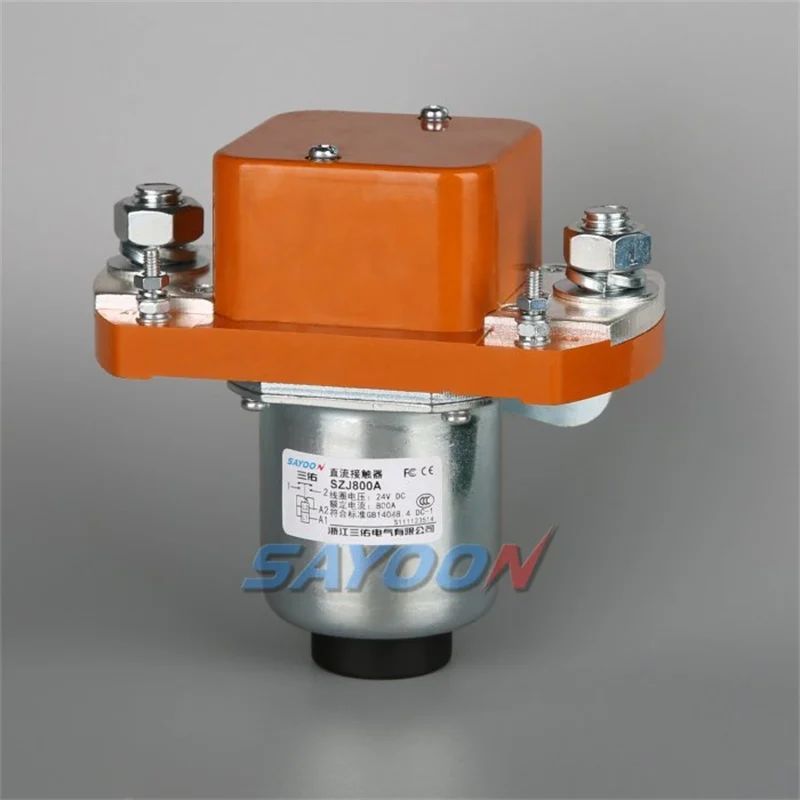
| Published field | CZW800A | SZJ800A |
|---|---|---|
| Contact voltage / current | ≤60 V; 800 A DC-1 at 48 V | ≤60 V; 800 A DC-1 at 48 V |
| Coil power line | 20–45 W | Start: 120–170, Keep: 6–12 |
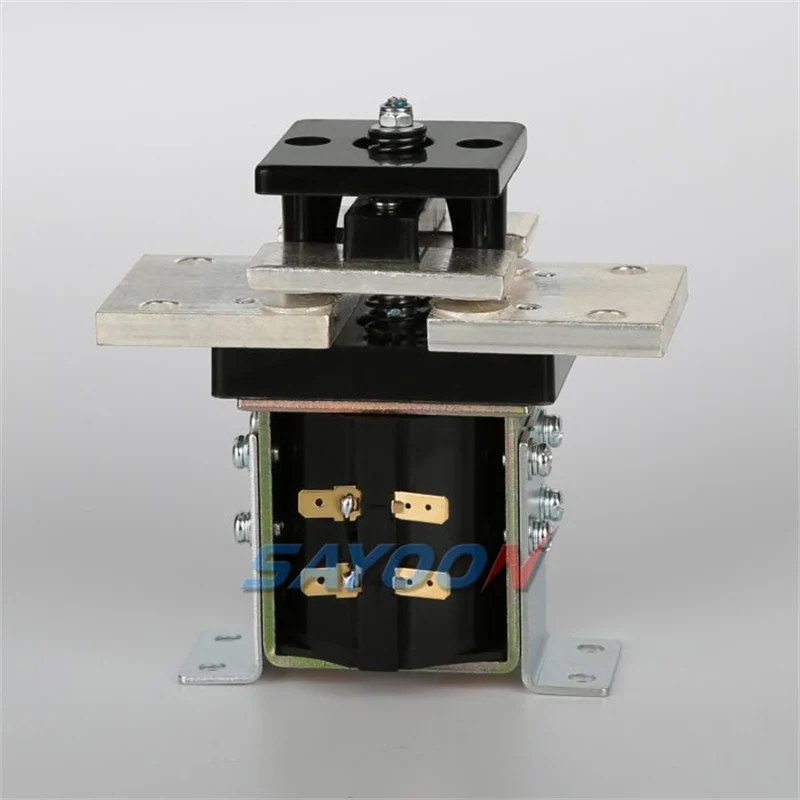
| Load terminal | 2-M8 screws (≤9.0 N.m appropriate) | M12 screw (≤30.0 N.m appropriate) |
| Fault rupture line | 2000 A / 5 ms at 48 V DC | 2000 A / 5 ms at 48 V DC |
| Protection / ambient | IP40 / -25 to +70 C | IP40 / -25 to +70 C |
Busbar drilling follows the terminal row: two M8 studs spread the joint on CZW800A, while SZJ800A concentrates it on one M12 stud with a much higher torque figure. Buy copper only after this row is frozen.
Part 4. How should integrators plan coil power and control sequencing?
Coil architecture drives the control-cabinet budget. CZW800A publishes a flat 20–45 W band, while SZJ800A publishes Start: 120–170 W, Keep: 6–12 W — a pull-in surge followed by economized holding.
Containers multiply the consequence. A distribution board that closes six SZJ-class coils simultaneously demands the supply survive six stacked start surges, so sequenced closing is the standard discipline; flat-band coils tolerate parallel closing within supply capacity.
| Sequencing question | Rule from published lines | Failure when ignored |
|---|---|---|
| Supply sizing | Cover start surge per closing group | Brownout during connect |
| Close ordering | Stagger Start/Keep coils | Stacked surges trip control supply |
| Steady-state budget | Sum keep watts across closed devices | Overheated control cabinet |
| Coil voltage option | Order from the published voltage list | Wrong-coil deliveries |
Part 5. How do fault, life, and environment rows shape the container file?
Both LV SKUs publish a fault rupture line of 2000 A / 5 ms at 48 V DC — a survivable-event window for coordination studies while breakers or fuses clear the fault. Protection ownership never transfers to the contactor.
Life and environment rows finish the integration file. Published electrical life is 10,000 operations (CZW800A) and 20,000 (SZJ800A) with 300,000 mechanical, and both publish -25 to +70 C ambient with IP40 protection, which means container placement must handle dust and moisture at the enclosure level.
| Container file row | CZW800A / SZJ800A value | Integration consequence |
|---|---|---|
| Rupture window | 2000 A / 5 ms | Coordinate with protection curves |
| Electrical life | 10,000 / 20,000 ops | Budget connect cycles per year |
| Mechanical life | 300,000 ops | Long-horizon maintenance plan |
| IP class | IP40 | Enclosure-level ingress planning |
| Ambient | -25 to +70 C | Verify hot-spot placement in container |
Part 6. Which SAYOON models anchor an 800 A integration RFQ?
Product recommendation: anchor 48 V-class container and charger-side integration on the CZW800A normally open DC contactor — its published ≤60 V class, 2-M8 hardware, 20–45 W coil band, and 2000 A / 5 ms rupture row cover the integration file end to end.
Why not other lines without review: the SZJ800A normally open DC contactor suits panels standardized on M12 hardware that want the Keep 6–12 W economy; buses above 60 V escalate to the sealed SEV800AH class; continuous loads beyond 800 A move to the 1000 amp DC contactor considerations.
Fit Boundary: the LV anchors are invalid above the published ≤60 V contact class, are not fault-clearing devices, and should not be paralleled for current sharing without an engineering review.
To convert the file into a quotation, send your interface duty sheet with bus voltage, current blocks, terminal plan, and sequencing scheme.
Part 7. What integration mistakes appear at the 800 A class?
- Placing a ≤60 V SKU on a 96 V or 400 V charger bus because the amp line matched.
- Paralleling two 400 A devices for 800 A duty without current-sharing analysis.
- Drilling busbar before freezing the 2-M8 versus M12 terminal row.
- Closing multiple Start/Keep coils simultaneously and browning out the control supply.
- Treating the 2000 A / 5 ms rupture row as a protection rating.
- Ignoring IP40 in dusty container bays that needed enclosure planning.
- Skipping cycle budgets against published electrical life on daily-cycling containers.
References
FAQs
What is an 800A DC contactor used for?
Typical duties are BESS container distribution points, telecom 48 V plant feeders, low-voltage charger-side branches, and service isolation where aggregated DC current reaches the 800 A class.
What voltage rating do BESS contactors need?
Match the published contact voltage class to the bus: CZW800A and SZJ800A publish ≤60 V, while high-voltage BESS main circuits point to the SEV800AH published at 5–1000 V.
Can two smaller contactors be paralleled instead?
Not without engineering review. Current sharing between paralleled contactors is unequal in practice, and no published SAYOON row defines a supported paralleling scheme.
What terminals do 800 A SKUs publish?
CZW800A publishes 2-M8 screws at ≤9.0 N.m appropriate; SZJ800A publishes one M12 screw at ≤30.0 N.m appropriate. Busbar drilling and torque tooling follow the chosen row.
What coil power do 800 A SKUs publish?
CZW800A lists a 20–45 W band; SZJ800A lists Start: 120–170 W with Keep: 6–12 W, so control supplies must survive start surges and sequenced closing is standard practice.
When should a charger interface move to SEV800AH?
When the DC bus exceeds the published 60 V LV class. SEV800AH publishes 5–1000 V contact voltage with the same 800 A DC-1 line and a sealed IP68 build.
Where should an 800 A RFQ start on this site?
Start at the CZW series pillar, split the decision by published voltage class, then send the interface duty sheet through the contact page for confirmation.