A 30A DC contactor duty in auxiliary and control circuits — pumps, fans, heaters, small battery feeders — maps onto the SAYOON catalog in two published ways: the nearest LV class is the 50 A SZJ50A-D, giving built-in headroom at ≤60 V, while exact 30 A classes exist as sealed SEV30AD and HEV30 models for higher-voltage or sealed environments; there is no 30 A LV SKU, so RFQs should quote the real published rows rather than a nominal 30 A label.
This application guide is for panel designers who wire the small DC branches that keep machines and containers running. The LV home for these duties is the SZJ series DC contactors pillar, and every mapping below points at a published table row.
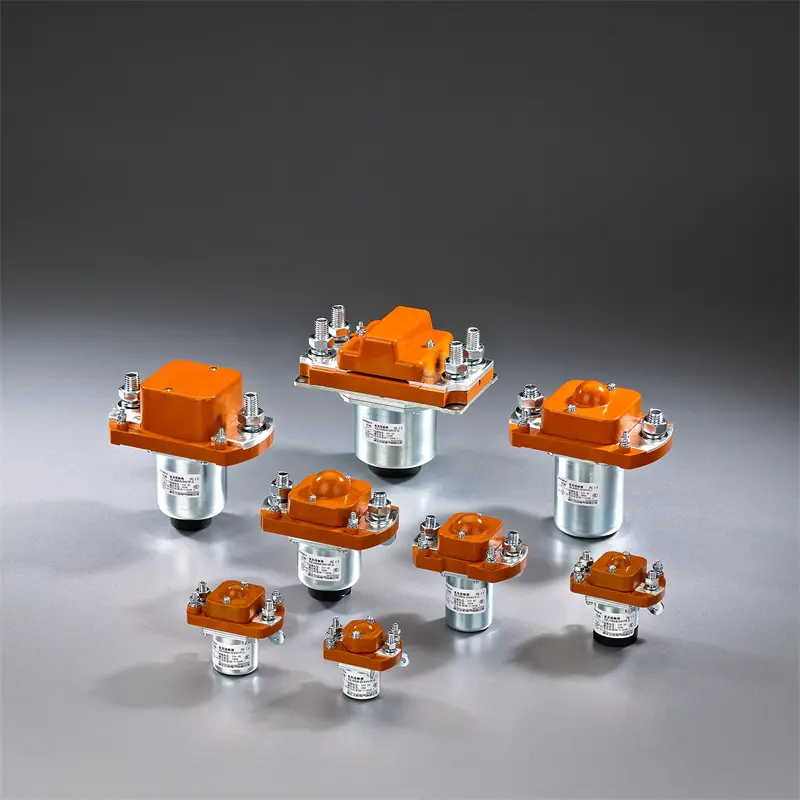
Part 1. Where do 30A DC contactor duties appear in auxiliary and control circuits?
A 30A DC contactor duty rarely sits on the main power path. It lives in the supporting layer of a machine or container: coolant pumps, cabinet fans, heater strips, lighting feeders, and small battery branches that must switch remotely and survive daily cycling.
Control-panel practice treats these branches as their own discipline. They switch often, they stay energized for long stretches, and their failures stop the main system indirectly — a dead cooling branch eventually trips the big equipment it protects.
| Auxiliary duty around 30 A | Typical bus | What the switch must tolerate |
|---|---|---|
| Coolant pump branch | 12–48 V | Daily cycling, motor inrush |
| Cabinet fan group | 12–48 V | Long always-on intervals |
| Heater strip feeder | 24–60 V | Resistive load, thermal cycling |
| Small battery feeder | 24–48 V | Occasional connect, standby watts |
Adjacent classes already have explainers on this site — see the 20 amp contactor basics and the 50A contactor key features guides.
Part 2. How does the 30 A class map onto published SAYOON SKUs?
Here is the honest catalog picture: SAYOON publishes no 30 A LV SKU. The 30 A number exists in the catalog only as sealed high-voltage classes, while the LV ladder starts at 50 A in the SZJ family. That fact decides the mapping.
| Your 30 A duty | Published SKU answer | Why it maps there |
|---|---|---|
| LV auxiliary branch at ≤60 V | SZJ50A-D (50 A class) | Nearest published LV class; headroom included |
| Branch above 60 V, or sealed environment | SEV30AD (30 A, 5–1000 V, IP68) | Exact 30 A line at sealed HV class |
| Program standardized on HEV codes | HEV30 (30 A, 200 V / 1000 V classes) | Same class inside the HEV code system |
The mapping rule for RFQs: write the real SKU class on the document. A branch spec that says 30 A but orders SZJ50A-D should record 50 A published class with 30 A duty, so nobody hunts for a phantom 30 A LV part later.
Part 3. Which published SZJ50A-D fields carry small LV branches?
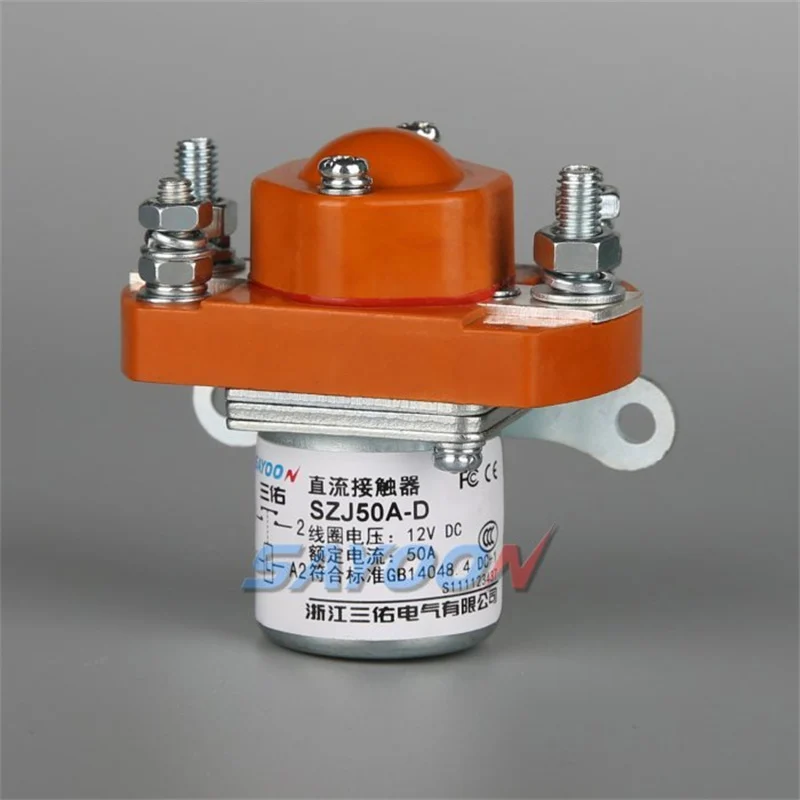
The SZJ50A-D normally open DC contactor publishes the complete small-branch picture: contact voltage ≤60 V, rated load current 50 A on the 48 V circuit line, coil power 4–9 W, and a single-coil D structure.

Installation rows are equally published: M5 load terminals at ≤2.5 N.m appropriate, M4 coil terminals at ≤1.2 N.m appropriate, ambient -25 to +70 C, and IP40 protection. Life rows list 20,000 electrical and 300,000 mechanical operations with certification lines CCC, CE, FCC, RoHS.
| Published SZJ50A-D field | Value | Small-branch consequence |
|---|---|---|
| Contact voltage / current | ≤60 V; 50 A | Covers 30 A duty with headroom |
| Coil power | 4–9 W | Cheap to hold on always-on branches |
| Terminals | M5 load; M4 coil | Light busbar and tooling plan |
| Fault rupture line | 600 A / 5 ms at 48 V DC | Coordination context for small branches |
| Life rows | 20,000 / 300,000 ops | Cycle budget for daily switching |
Part 4. When does a sealed 30 A class SKU fit better than an LV part?
Two published conditions move a 30 A branch off the LV ladder. First, bus voltage: anything above the SZJ ≤60 V line lands in the sealed classes, where the SEV30AD high voltage epoxy resin sealed DC contactor publishes 5–1000 V contact voltage with a 30 A DC-1 line.
Second, environment: SEV30AD publishes IP68 and ambient -40 to +85 C, which survives washdown bays, outdoor cabinets, and vehicle compartments where an IP40 part needs enclosure help. Its coil is published at 2–7 W with max switching current 300 A 320 VDC.
| Condition on the branch | Stay LV (SZJ50A-D) | Go sealed (SEV30AD / HEV30) |
|---|---|---|
| Bus ≤60 V, indoor panel | Yes | Optional |
| Bus above 60 V | No | Yes — published 5–1000 V or 200 V/1000 V classes |
| Washdown, dust, outdoor | Enclosure-level planning needed | IP68 published |
| Economizer coil preference | 4–9 W flat | HEV30 publishes H: Start 3–7, Keep 0.5–1.5 |
Part 5. How should relay-versus-contactor boundaries be drawn at 30 A?
The 30 A class sits exactly where relay and contactor catalogs overlap, and the relay taxonomy explains why: both are electromagnetic switches, differing in load class and construction robustness.
A practical boundary works in two questions. Does the branch switch real power — motors, heaters, feeders — rather than signals? And does failure stop production or safety systems? Two yes answers argue for contactor-class construction with published load lines, torque rows, and life figures.
- Signal-level duty at low amps: relay-class parts remain the economic answer.
- Power branch at 30 A with daily cycling: contactor-class construction with a published 50 A LV line or a sealed 30 A line.
- Mixed panels: standardize the power branches on one published family to simplify spares.
Part 6. Which SAYOON models anchor a small-branch RFQ?
Product recommendation: anchor ≤60 V auxiliary branches on the SZJ50A-D normally open DC contactor — the published 50 A class carries 30 A duty with headroom, the 4–9 W coil suits always-on panels, and the full table covers torque, life, and certification rows for the RFQ.
Why not other lines without review: the SEV30AD fits branches above 60 V or IP68 environments; HEV30 fits programs standardized on HEV codes or wanting its published economizer line; larger SZJ classes take over when continuous current exceeds 50 A.
Fit Boundary: the LV anchor is invalid above its published ≤60 V class, none of these parts perform fault clearing, and signal-level switching below the power boundary remains relay territory. Small coil-voltage questions pair well with the 12 V contactor relay specifications guide.
To quote a branch set, send your branch load list with load types, bus voltage, coil supply, and duty cycle.
Part 7. What small-class mistakes cause panel rework?
- Hunting for a 30 A LV SKU instead of mapping the duty onto the published 50 A class.
- Putting a relay-class part on a daily-cycling pump branch and replacing it quarterly.
- Ignoring coil watts across a dozen always-on auxiliary branches.
- Missing the ≤60 V line when an auxiliary branch taps a higher bus.
- Skipping the published M5/M4 torque rows and cracking small terminals.
- Ordering without the coil voltage code from the published list.
- Placing an IP40 part in a washdown bay without enclosure planning.
References
FAQs
What is a 30A DC contactor used for?
Typical duties are auxiliary and control branches: coolant pumps, cabinet fans, heater strips, lighting feeders, and small battery circuits that switch remotely around the 30 A class.
Does SAYOON publish a 30 A LV SKU?
No. The published LV ladder starts at the 50 A SZJ50A-D, while exact 30 A lines exist as sealed SEV30AD and HEV30 classes. RFQs should quote those real published rows.
Can a 50 A contactor run a 30 A load?
Yes — running a 30 A duty on the published 50 A SZJ50A-D class is normal headroom practice. Record the published class and the actual duty on the RFQ so spares stay traceable.
When should a 30 A branch use a sealed SEV30AD?
When the bus exceeds the LV ≤60 V line or the environment demands sealing: SEV30AD publishes 5–1000 V, 30 A DC-1, IP68, and -40 to +85 C ambient.
What coil watts do small-class SKUs publish?
SZJ50A-D publishes 4–9 W, SEV30AD publishes 2–7 W, and HEV30 publishes D: 3–7 W with an H economizer line of Start 3–7, Keep 0.5–1.5 W.
Is a relay enough for a 30 A DC branch?
For signal-level duty, yes. For power branches that cycle daily or feed motors and heaters, contactor-class construction with published load and life rows is the safer standard.
Where should a small-branch RFQ start on this site?
Start at the SZJ series pillar, map each branch onto a published class, then send the branch load list through the contact page for confirmation.