Five-hundred-amp DC paths appear in large material-handling systems, high-power BESS feeds, and industrial DC mains where multiple loads share a stiff bus. A 500a dc contactor at this level demands attention to thermal management, bus stiffness, and making/breaking under inductive loads. These engineering notes complement—not repeat—lower-amp selection guides. This guide focuses on practical evaluation steps for U.S. industrial and commercial buyers—measurement, documentation, and lifecycle support—not generic marketing claims. Where equipment selection is involved, cross-check public specifications on sayoon-dc.com and confirm coil voltage, duty cycle, and utilization category with your application engineer. Section checklists can be reused as RFQ attachments and commissioning handover outlines. Compare vendor datasheets at the same test voltage and category before shortlisting finalists.
Bus Stiffness and Fault Contribution at 500A Scale
Stiff DC buses supply high fault current—contactor breaking capacity and fuse coordination become critical design inputs.
Multiple parallel sources (batteries + rectifiers) increase available fault energy—model before selecting branch or main devices.
Industrial buyers should match continuous current to real duty cycle—not peak inrush alone—when comparing contactor datasheets.
Request electrical and mechanical life curves tested at your operating voltage class, not only at nominal catalog conditions.
Cross-check SAYOON DC contactor catalog for series that cover your voltage and ampacity before substituting part numbers.
Capture coil voltage, continuous current duty, and expected daily switching count in the RFQ so suppliers size contacts and categories correctly.
Verify utilization category (IEC DC-1 vs DC-3) against your load type—motor branches need different breaking duty than resistive battery connect.
Define acceptance tests before shipment—coil hold voltage, contact resistance, and dielectric checks—so commissioning disputes are less likely.
| Design input | Source | Impact on contactor |
|---|---|---|
| Isc at contactor | Short-circuit study | Breaking capacity |
| L/R ratio | Cable model | Arc duration |
| Parallel sources | Architecture | Fault share |
Thermal Management in Continuous 500A Service
Continuous 500A generates significant I²R heating at contacts and bus joints—enclosure cooling may be mandatory.
Manufacturer ratings assume specific ambient and mounting orientation—verify for your panel airflow.
IEC 60947-4-1 utilization categories DC-1 and DC-3 describe resistive versus motor-like breaking duty—misapplication shortens contact life.
For forklift and AGV programs, compare CZW low-voltage DC contactor series compact form factors against available panel space and vibration ratings.
Bidirectional energy flow (regen or charge/discharge) may require a bidirectional contactor—confirm topology before ordering unidirectional parts.
Capture coil voltage, continuous current duty, and expected daily switching count in the RFQ so suppliers size contacts and categories correctly.
Verify utilization category (IEC DC-1 vs DC-3) against your load type—motor branches need different breaking duty than resistive battery connect.
Define acceptance tests before shipment—coil hold voltage, contact resistance, and dielectric checks—so commissioning disputes are less likely.
Mechanical Support and Vibration on Mobile Platforms
Heavy mobile equipment mounting 500A contactors needs rigid brackets—flexing bus bars change contact pressure.
Use OEM-specified shock/vibration limits when contactors mount on frames rather than stationary panels.
Post-installation, log contact resistance trends and coil voltage at terminals during routine PM intervals.
Explore OEM/ODM services when standard catalog coils, brackets, or labels need customization for export programs.
See SAYOON application solutions for forklift, EV, UPS, and marine use cases.
Capture coil voltage, continuous current duty, and expected daily switching count in the RFQ so suppliers size contacts and categories correctly.
Verify utilization category (IEC DC-1 vs DC-3) against your load type—motor branches need different breaking duty than resistive battery connect.
Define acceptance tests before shipment—coil hold voltage, contact resistance, and dielectric checks—so commissioning disputes are less likely.
Documentation for High-Current DC Projects
Single-line diagrams should show contactor class, fuse sizes, and cable lengths for future fault studies.
Maintain a table of all 500A+ devices with part numbers and date codes for warranty traceability.
Post-installation, log contact resistance trends and coil voltage at terminals during routine PM intervals.
Explore OEM/ODM services when standard catalog coils, brackets, or labels need customization for export programs.
See SAYOON application solutions for forklift, EV, UPS, and marine use cases.
| Record | Owner | Update trigger |
|---|---|---|
| As-built single-line | EPC | Any feeder change |
| Contact R log | Maintenance | Quarterly PM |
| Spare contactor SN | Stores | Receipt of goods |
Replacement and Upgrade Planning
When upgrading bus voltage or current, revalidate contactor category and coil supply—not only ampacity.
Plan outage windows for contactor replacement proportional to production impact—500A paths rarely allow hot work.
Post-installation, log contact resistance trends and coil voltage at terminals during routine PM intervals.
Explore OEM/ODM services when standard catalog coils, brackets, or labels need customization for export programs.
See SAYOON application solutions for forklift, EV, UPS, and marine use cases.
Review nameplate data, environmental limits, and switching duty annually or after any major load change on the feeder.
Document as-built coil driver circuits and fuse sizes so future retrofits do not undervoltage the coil under peak plant load.
Recommended SAYOON Products
For project support, explore our related product line, solution options, and OEM/ODM capabilities on sayoon-dc.com.
FAQ
What is a 500a dc contactor used for?
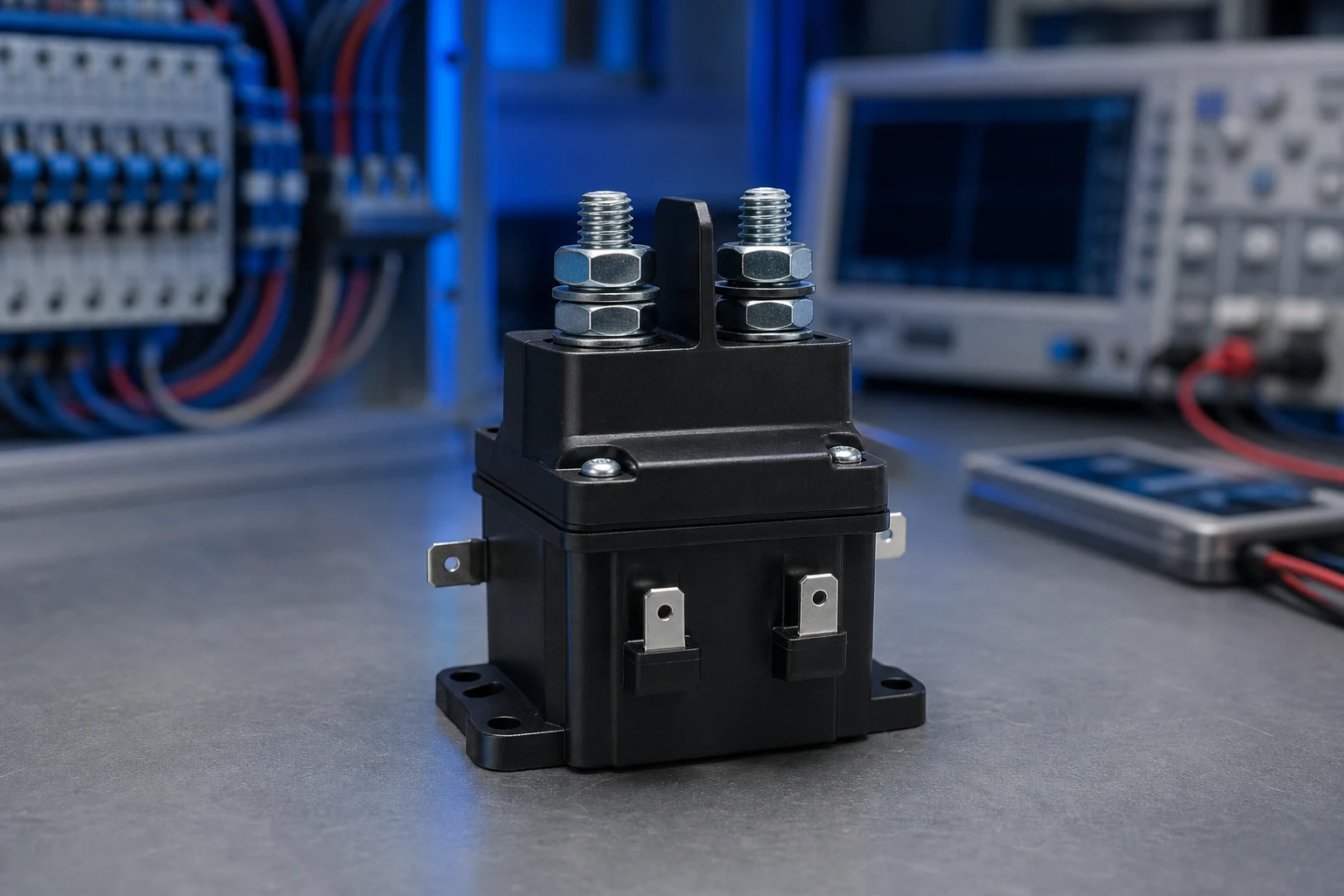
A 500a dc contactor switches high-current DC power paths under remote control—common in battery systems, traction drives, and industrial DC distribution where manual disconnect is impractical.
How do I size a 500a dc contactor?
Match continuous current to your duty cycle, select coil voltage to match the control circuit, and choose IEC utilization category (DC-1 vs DC-3) based on load type. Include margin for inrush on motor branches.
Can I use an AC contactor for this DC load?
No. DC arcs sustain without zero-crossing; AC-rated devices risk contact welding. Use a DC-rated contactor with appropriate contact gap and arc management.
What coil voltage options exist?
Industrial designs commonly use 12V, 24V, 48V, or 110V DC coils (or AC coils on separate control feeds). Verify hold power and temperature rise for continuously energized applications.
How is a 500a dc contactor different from a relay?
Contactors are built for higher continuous currents and frequent switching in power circuits; relays suit lower-power control. Main battery or traction paths typically require contactor-class devices.
Does SAYOON supply 500a dc contactor options?
SAYOON publishes CZW, SZJ, SEV, and HEV DC contactor series on sayoon-dc.com with OEM/ODM support. Confirm exact ratings and terminals against your datasheet before purchase.
References
- IEC 60947-4-1 — Contactors and motor-starters
- Schaltbau — DC contactor selection criteria
- VIOX — AC vs DC contactors
- SAYOON — DC contactor product lines
Ready to discuss your project? Contact SAYOON engineering support with your project parameters and technical requirements.