A DC contactor laboratory contract review checklist should turn a broad testing request into an agreed technical scope before work begins. Define the exact contactor configuration, the purpose of testing, the method and revision, specimen allocation, requested reporting and any pass/fail decision rule. Confirm that the laboratory can perform the requested work and identify any external activities. Price approval alone does not show that the proposed evidence will answer the buyer’s engineering or purchasing question.
Begin with the decision the evidence must support
A request such as “test this DC contactor” leaves the important question unanswered. The buyer may need a measurement for an investigation, evidence against a specified requirement, or a comparison between defined configurations. Each objective can lead to a different test scope and a different report. Describe the intended use in ordinary language before listing methods or asking for a quotation.
For example, investigating a field observation is different from demonstrating conformity to a complete product standard. A limited laboratory test cannot automatically establish all the ratings, endurance claims or application approvals of a contactor family. Ask engineering to identify the decision owner and the exact conclusion expected. The laboratory can then explain whether its proposed activities are capable of supporting that conclusion.
Identify the device beyond the product name
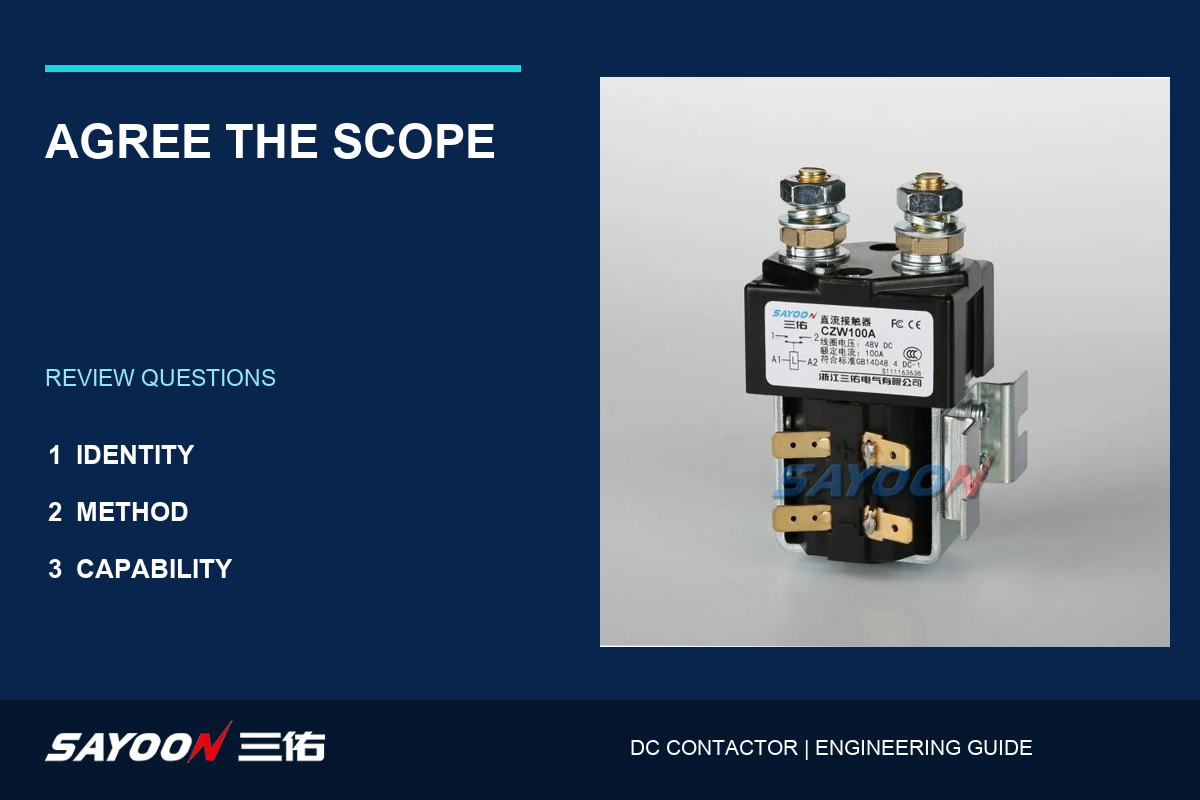
Record the ordered model, drawing revision and configuration information that affects the requested work. Depending on the project, relevant identifiers may include coil configuration, contact arrangement and specified accessories. Do not infer these details from a similar photograph or a file name. Obtain the manufacturer’s documentation for the actual supplied configuration and resolve discrepancies before specimens are dispatched.
The contract should connect the product description to the specimens received by the laboratory. Explain whether they are prototypes, production units, returned devices or otherwise conditioned samples. Their history can affect interpretation. This is particularly important when a test changes the item and the buyer expects later measurements on the same specimen. Product identification is an input to the review, not a substitute for a sampling plan.
Agree the method and the requested statement
Ask which published method or laboratory procedure will be used, including the applicable edition or revision and any agreed limitations. If the requested method is inappropriate or outdated, the provider should raise that concern during the review. A method name alone is insufficient when different configurations, conditions or reported quantities could answer different questions.
Where a conformity statement is requested, make the specification and treatment of measurement uncertainty clear. The decision rule should be addressed before testing rather than chosen after seeing a result close to a limit. This article does not prescribe a rule or acceptance threshold. The correct arrangement depends on the applicable specification, the agreed scope and the authorized technical decision.
Review the scope using a practical checklist
| Evidence field | Required information | Review purpose |
|---|---|---|
| Purpose | Decision and requested conclusion | Define what the evidence must answer |
| Scope | Configuration, method and revision | Avoid ambiguous testing requests |
| Capability | Resources and external activities | Confirm who performs the ordered work |
| Agreement | Deliverables, decision rule and changes | Keep the acknowledged order technically coherent |
Planning checklist based on the scoped technical reference and the applicable purchase documents; no universal acceptance limits are implied.
This is a proposed buyer checklist. UNIDO provides general implementation guidance, while CALA’s application document is specific to its accreditation programme. Use applicable general principles without importing environmental-testing or microbiological requirements into electrical contactor work. Neither source certifies a SAYOON product or establishes that a particular provider holds an appropriate scope.
Record unresolved questions alongside the party responsible for answering them. A checklist marked complete while its supporting drawing or method remains undefined creates false confidence. Give every important attachment a stable identity so the final order, laboratory acknowledgment and report can be compared against the same scope. The format can be simple if it preserves the actual agreement.
Confirm capability, resources and external activities
A provider’s general accreditation statement does not by itself demonstrate coverage of every requested activity. Review the relevant scope and ask the laboratory to explain any limits, non-accredited activities or work performed elsewhere. Keep the capability question connected to the exact method and characteristic, rather than accepting an unrelated certificate as sufficient evidence.
Where an external provider will perform part of the work, clarify which activity is involved and how the arrangement will be communicated and agreed. Ask how the resulting evidence will be identified in the final reporting package. This is distinct from choosing the cheapest quote: the buyer needs to know who performs the work and which technical responsibility and reporting boundaries apply to it.
Resolve sample allocation and test sequence
Agree how many specimens are required, who selects them, and which activities will use each specimen. The quantity must come from the test plan and applicable requirements, not from a generic purchasing template. Explain whether a result applies only to submitted specimens or whether a separate sampling basis supports a broader conclusion.
Test sequence deserves explicit discussion where earlier activity may alter a device. A specimen used for an investigation may not remain suitable for an unrelated baseline measurement. Ask the laboratory to identify conflicts before work begins. The contract review should establish that the proposed allocation can deliver the requested evidence; a separate detailed sampling or test plan can contain the technical implementation.
Define reporting and deliverables before accepting the quote
Specify whether the deliverable includes measured values, test conditions, specimen identities, uncertainty information where applicable, and a requested conformity statement. Define any need for photographs, data files or a technical explanation without assuming these are automatically included in a standard report. Ask which records can be supplied and which remain under the provider’s controlled retention arrangements.
Keep language precise. A report of selected measurements is not the same as a complete type-test report, and neither automatically authorizes a marketing certification claim. If procurement intends to share the evidence with an end customer, explain that intended use and check any restrictions. The scope should protect accurate interpretation rather than promise a favorable outcome or a conclusion that the activities cannot substantiate.
Handle changes through a repeated technical review
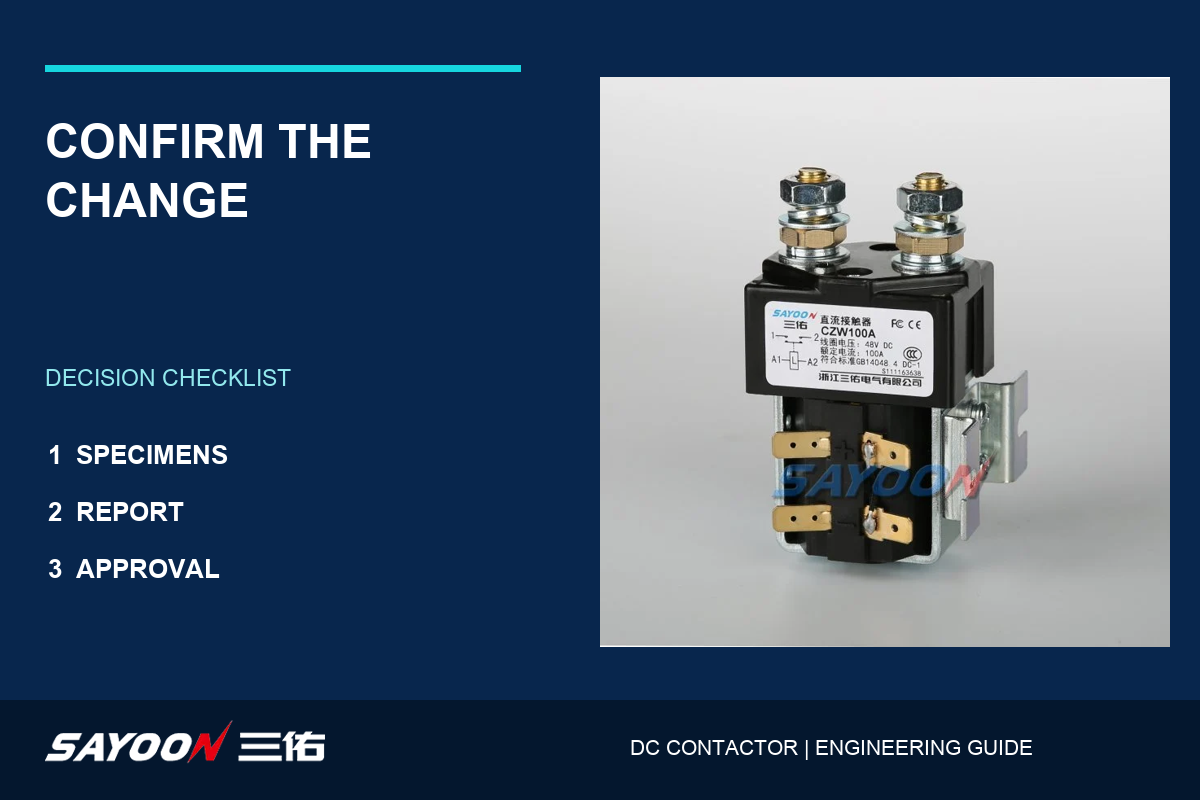
A project may change after the order is placed. The buyer might revise a drawing, change the intended operating condition or request a different reporting statement. Do not assume that forwarding a new attachment updates every part of the laboratory’s work. Ask for acknowledgment of the changed requirement and a review of its effect on method, specimens, resources, reporting and timing.
General ISO/IEC 17025 implementation guidance treats changes after work starts as a reason to revisit the review and inform affected personnel. For the buyer, a useful control is a short change record that identifies the previous agreement, the new request and the accepted outcome. This is a practical format suggestion, not a mandated universal form. Preserve earlier versions so already completed work can be interpreted correctly.
Apply the checklist to a hypothetical contactor order
Consider a buyer who asks for evidence concerning a specified contactor configuration before equipment integration. The initial quote lists several measurements but does not identify the drawing revision or whether a pass/fail statement is included. The buyer sends the approved configuration information and asks the laboratory to explain the intended method, report contents and limits of the proposed conclusion.
During review, the parties discover that one requested activity will be performed by an external provider and that a later test would alter the specimen needed for an earlier measurement. They clarify the external activity and revise specimen allocation before dispatch. The revised acknowledgment ties the accepted scope to the order. These are illustrative purchasing decisions; they do not describe actual product testing or establish that a particular configuration satisfies an application requirement.
Avoid common contract-review shortcuts
Do not copy a competitor’s report and ask for an identical certificate without establishing whether the method and specimen configuration apply. Do not treat a test list from a previous model as automatically suitable for a new ordered device. Do not leave the decision rule blank while requesting a definite conformity conclusion. Each shortcut shifts an unresolved technical question into the reporting stage.
Also distinguish schedule commitments from evidence quality. If the required resources or specimen quantities are unavailable, ask for an explicitly revised scope rather than an unchanged promise with undocumented omissions. A transparent limited investigation can still be useful, provided its limits are accepted and reported. The agreement should describe what will actually be done, not what purchasing originally hoped could fit the deadline.
Prepare a clear inquiry package
Send the manufacturer’s current product information, the exact configuration, the decision to be supported, relevant drawings and the proposed test requirements. Identify the person authorized to resolve technical questions and the person approving commercial changes. Request a written scope acknowledgment that lists assumptions and exclusions alongside the deliverables.
When discussing SAYOON contactors, start from the actual product page and obtain configuration-specific documentation as needed. Do not convert general laboratory guidance into unsupported product ratings. Keep the final testing order connected to engineering requirements and the intended use of the evidence. A well-defined inquiry makes it easier to compare offers because the providers are answering the same technical request rather than quoting superficially similar test names.
Educational video
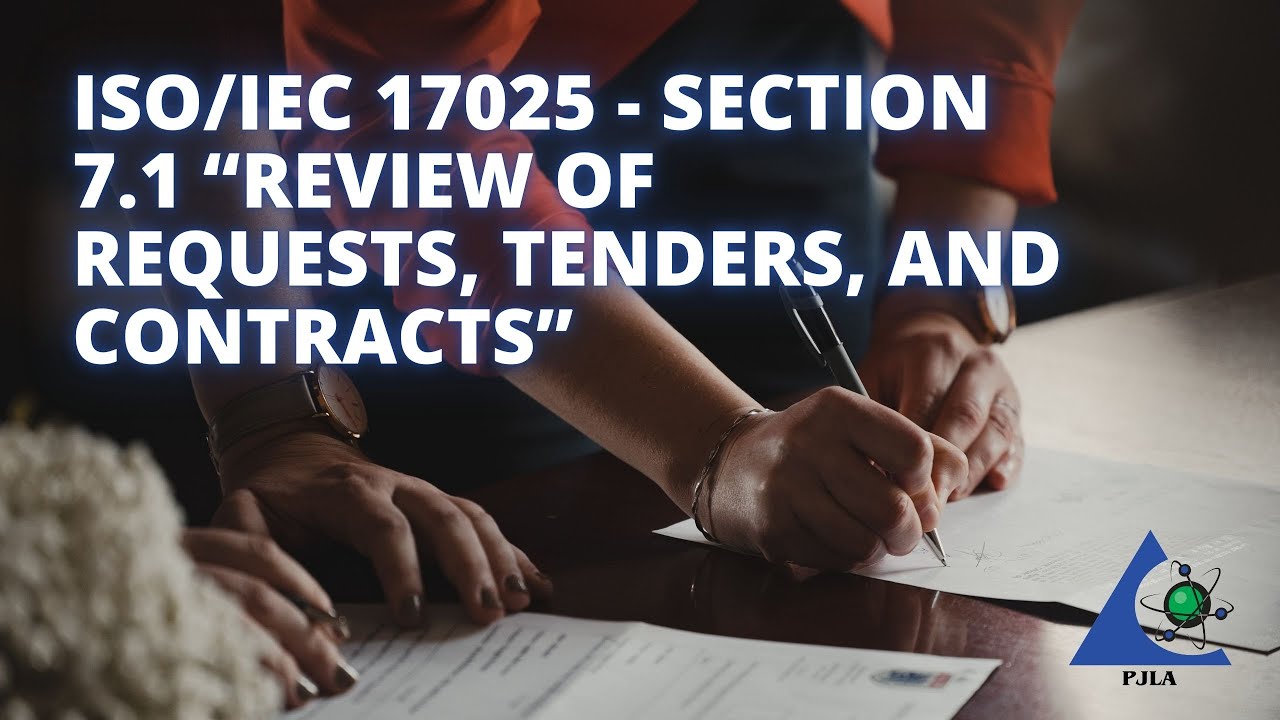
Perry Johnson Laboratory Accreditation Inc. explains review of requests, tenders and contracts for laboratory activities; this is scope-planning guidance, not evidence of contactor certification. This educational background does not assess a particular contactor or approve an equipment design.
Frequently asked questions
Is a signed laboratory quote enough to complete contract review?
Only if it captures an adequately defined and accepted technical scope. Confirm the product identity, method, capability, deliverables and important assumptions instead of relying on the signature or price alone.
Should the checklist specify a universal sample quantity?
No. Specimen quantities and allocation depend on the applicable method, test sequence and intended conclusion. Agree them for the actual project and identify who is responsible for selection.
When should a pass/fail decision rule be discussed?
Discuss it before testing when a statement of conformity is requested. Identify the specification and clarify the applicable rule rather than deciding after the measured result becomes known.
What happens if the drawing changes after work starts?
Ask for a repeated technical review and an acknowledged change to the agreement. Establish which completed activities remain applicable and inform the people affected by the revised scope.
Product and related guides
Discuss the application using the CZW100A Normally Open DC Contactor and the DC contactor selection guide. Related reading: DC Contactor Laboratory Accreditation: Verify the Scope, DC Contactor Outsourced Laboratory Testing: Buyer Checklist.
Technical references
Apply each reference within its stated scope. General methods do not establish a product rating or project acceptance.