DC relays are playing an increasingly important role in present-day electrical control systems. The relays are no longer considered as simply switches.
To certain engineers and buyers, they are considered as vital components affecting system safety, reliability of the current-switching process, maintenance scheduling process, and operational cost.
DC circuits do not have a natural tendency to pass through a currentless point to switching due to not having a zero current level. Consequently, control of the arc, choice of the contact material, distance of insulation, stability of the coil, and mechanical reliability become very important. In cases like electric forklifts or electric vehicles, loss of contactor would cause troubles like unplanned maintenance expenses, system protection, and downtime.
This shift is also reflected through the general market trends. According to a report by the International Energy Agency, electricity consumption will keep rising over the coming years up to 2026 due to the development of: electrification, demand in cooling, industrial processes, data centres and electric mobility. The growing use of electricity thereby creates a need for reliable components for switching in AC and DC power systems.
For producers with a long history in the field of DC contactors’ production the changes in this market will put additional requirements regarding engineering competence, quality control processes, proper product documentation, and stable batches of products manufactured. One of the companies engaged in DC contactors and electric control machinery manufacturing is Zhejiang Sayoon Electric Co., Ltd. established in 1998.
Market Demand for DC Contactors in Electrified Power Systems
Demand for DC contactors is highly related to growth of battery-operated devices and capably performing DC systems.
These applications usually need sufficient switching between batteries, electronic devices, electric systems, charging methods or safeguarding systems.
DC contractors have a lot of applications such as they are utilized in electric forklifts, electric vehicles, automated guided vehicles, battery energy storage systems, uninterruptible power supplies, base stations, battery charging systems, high-power motors and industrial controls.
Several practical trends are shaping buyer demand:
- Growth of electric forklifts, AGVs, and industrial electric vehicles;
- Wider deployment of battery energy storage systems in commercial and industrial sites;
- Increasing need for UPS and backup power reliability;
- Higher current requirements in power electronics and motor control systems;
- Greater attention to safety, insulation, arc suppression, and lifecycle cost.
The first driver has to do with the electric mobility market. The International Energy Agency estimates that global electric vehicle sales reached almost 14 million units in 2023. This number actually represents almost 18% of total car sales in that year. Eventhough not every vehicle application requires the same type of contactor, the trend means something in the context of the transition to battery powered systems as well as high voltage direct current systems.
Note 1: In B2B procurement, demand for DC contactors arises from various sources. The demand comes not only from the production of new equipment but also from replacement parts, fleet maintenance, system upgrades, OEM project expansion and inventory planning.
In actual sourcing, purchasers normally look for words like DC contactor producer,
high voltage DC contactor, magnetic latching DC contactor,
precharge contactor, EV DC contactor, and
energy storage contactor manufacturer. These terms imply that purchasers tend to seek for both product descriptions
as well as the technical assurance.
Why DC Contactors Are Critical in Modern Electrical Control Systems
DC contactor is defined as a device that works electrically and mechanically for switching the circuit of DC. The device consists of all the vital and significant parts including coils, magnetic systems, fixed and movable contacts, as well as the structure that suppresses the formation of an arc.
After energizing the coil, the magnetic system draws the movable component closer and joins the main contacts. Subsequently, the current travels through the DC load loop. Upon de-energizing the coil, the contact points open and cease the flow of current.
The problem lies in the fact that DC switching proves to be tougher compared to AC switching. In an AC circuit, the current is reversing direction and therefore falls to zero many times in a second. In DC switching, however, the circuit contains a continuous flow of current, making it easier for an arc to exist.
It is therefore necessary to bring about improvements in the DC contactors that are concerned with the provisions for creating an arc gap, distance, material, and insulation in order to avoid the formation of the associated DC arc. DC switching involves various technical problems that are highly demanding.
The following table summarizes common application areas and the buyer concerns behind them.
| Application Area | Typical DC Contactor Function | Buyer Evaluation Focus |
|---|---|---|
| Electric forklifts and AGVs | Battery and motor circuit switching | Rated current, vibration resistance, service life |
| Energy storage systems | Battery pack connection and protection | Voltage rating, insulation, arc suppression |
| UPS and backup power | DC power path control | Reliability, heat rise, compact design |
| EV and charging systems | High-voltage DC switching | Safety, contact gap, compliance documents |
| Industrial equipment | Motor and power circuit control | Load type, coil voltage, maintenance needs |
This chart shows a very significant rule of sourcing in that the right contractor must be chosen according to the actual use case scenario but not by its listing current ratings only.
Product Types and Specification Parameters Buyers Should Understand
DC contactors are made in different models and voltages for different applications. There are several types of contactors including low-voltage DC contactors, high-voltage DC contactors, magnetic latching DC contactors, pre-charging contactors, and other electrical control devices.
Sayoon provides an extensive line of products including low-voltage and high-voltage Direct Current contactors, magnetic latching Direct Current contactors, and pre-charge contactors along with motor controllers and foot accelerators. This kind of variety is suitable for people searching for DC switching solutions.
The main specification parameters consist of rated current, rated voltage, contact form,
coil voltage, coil type, electrical life, mechanical life, insulation resistance,
dielectric strength, operating temperature,
mounting style, and auxiliary contacts definition.
The information on the Sayoon product line indicates that the DC contactor series includes products with different rated current ranges from 50 to 1500A or 50-3000A according to different types and the coils necessary to meet application requirements.
| Specification | Common Options or Considerations | Why It Matters |
|---|---|---|
| Rated current | 50A to 3000A, depending on series | Must match load current and duty cycle |
| Rated voltage | Low-voltage or high-voltage DC systems | Affects insulation and arc control design |
| Contact type | NO, NC, 1NO1NC, SPDT, DPDT | Determines circuit logic |
| Coil type | Single coil, dual coil, magnetic latching | Influences power consumption and control method |
| Application | EV, forklift, UPS, ESS, motor control | Determines safety and performance requirements |
| Documentation | Datasheet, test report, compliance file | Supports buyer qualification |
Note 2: To determine the suitability of a DC contactor, it cannot only be based on the rated current.
The type of load, breaking conditions, frequency, environmental conditions, availability of installation space, and the expected life of the contactor also need to be taken into account.
If engineers and procurement departments are given confirmation of these parameters at the onset, then that would help minimize sample delays, selection errors in models and issues concerning after-sales service.
Material Selection and Manufacturing Control Behind DC Contactor Reliability
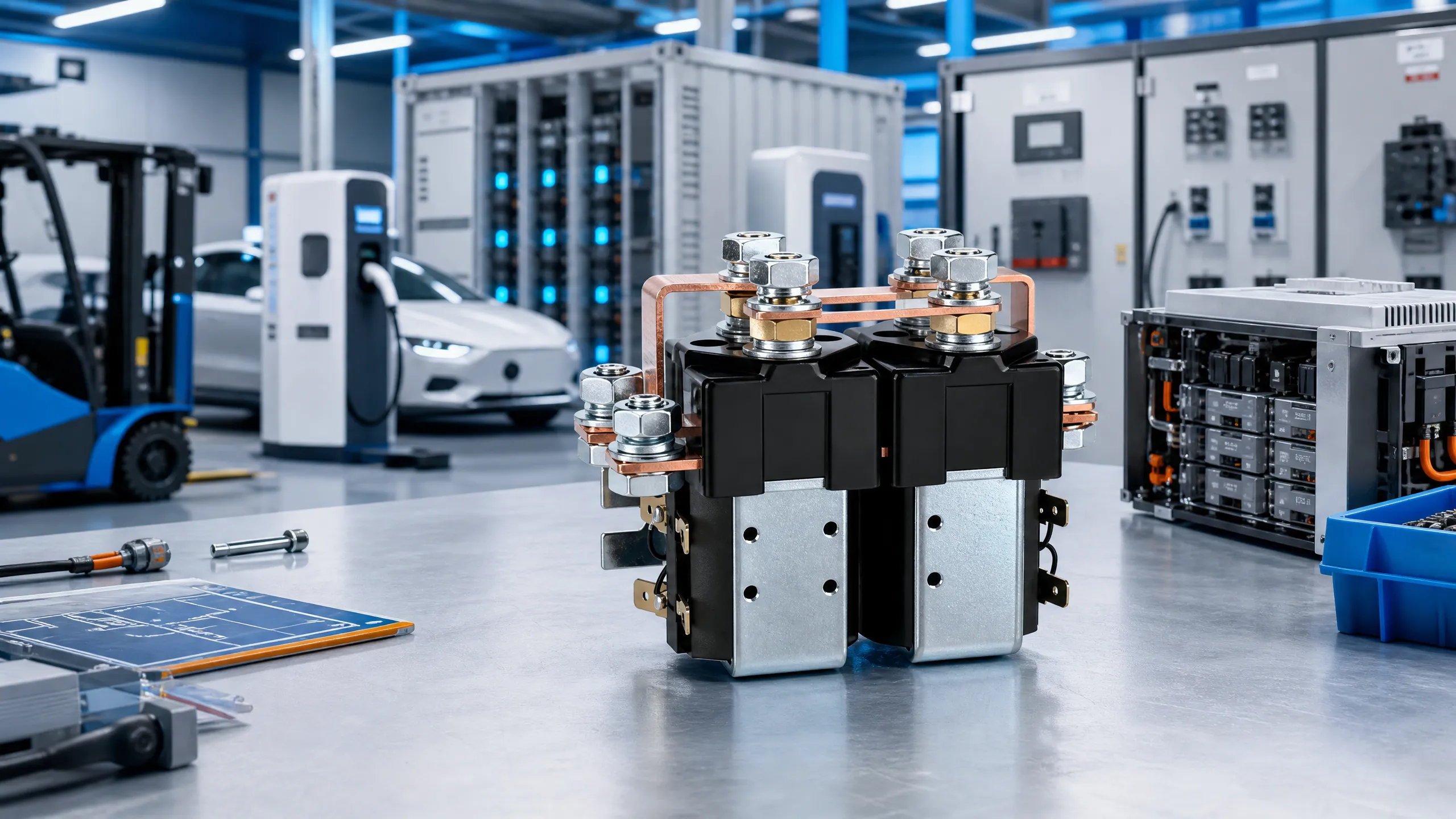
From the viewpoint of manufacturing, a DC contactor is not just any regular switch that is put together from its component parts. Its functioning results from the combination of electrical design examination, precision in mechanics, quality of materials, and process management.
The primary contact system must carry and interrupt DC current successfully. The choice of contact material determines the conductivity, the resistance to welding,
the degree of erosion under arcing, and heating of the component. Silver-based materials are widely used for contacts due to their high electrical conductivity and satisfactory resistance to wear in the switching conditions.
Any magnetic system must ensure stable pull-in and release characteristics. In case the magnetic core, armature, spring tension, and/or actuation are not standardized,
the contactor may demonstrate unstable closure, unwanted sounds, slow reaction speed, and uneven wearing of contacts.
The coil also forms a very important part of the system. Quality of coil wire, winding tension, resistance value, insulation of the wire, and temperature rise control all play a great importance in terms of reliability in the future. For example in electric forklifts, UPS systems, and energy-storage equipment, coil stability directly determines whether or not the contactor is going to perform properly in real working conditions.
In practice, the qualification of sample contactors is just the starting point of the manufacturing process. When manufacturing contactors in bulk, other important parameters need to be controlled, including coil electrical resistance consistent across batches, consistency in assembly of contactors, terminal tightness and thread quality, housing fitting, labeling, and packing.
The long standing experience of manufacturers such as Sayoon which has manufactured the DC contactor since 1998 gives them a good knowledge about producing the series of contactors for different current ratings and with different structures of coils and contacts. The experience does not only lie in the manufacturers’ good reputation.
Low-voltage switchgear and controlgear standards incline to be used by different stakeholders, because it contains various specifications that should be satisfied when using contactors motor starters or other control equipment.
Production Process: From Coil Winding to Final Assembly
The process of producing a DC contactor typically involves the inspection of input materials, the winding of coils, the assembly of magnetic parts, the manufacturing of working contacts,
the assembly of enclosures, the testing of product functions, and the final examination of the finished products.
When winding the coils, producers need to maintain the diameter of the cable, its resistance, winding tension, number of turns and quality of insulation. A stable coil contributes to the reliable pull-in and drop-out operation of the device. In case of magnetic latching DC contactors, the coil design is of the utmost importance, since the contactor has to remain in position with low hold power or using pulse control.
The magnetic assembly stage is important for alignment of the coil, the armature, the feedback spring, and the mobile element. A small deviation in the mechanical parameters can affect the noisiness of operations, the release speed, the contact force, and the duration of usage.
Contact system plays very important role in DC contactor manufacturing. Quality of the contact welding or riveting, contact pressure, contact gap and arc suppression mechanism affect the switching performance. Even a small imperfection can cause heat generation, uneven wear or short electrical endurance in high current applications.
The last stage of the assembly process is where the housing is fitted, terminals are positioned, labels are placed, and accessories are configured. Certain customers may also have their models fitted with customized labels, model markings, specific packages, and documentation that corresponds to their specifications.
At this point, disciplined production management is of utmost importance. Manufacturers do not require over-inflated claims to showcase their abilities. Rather, it is the effective management of the process, quality, and stability of products that are more relevant to buyers.
OEM Support for Equipment Manufacturers, Distributors, and Project Buyers
Countless business-to-business buyers are in need of something more than a standard catalog. The manufacturers of electric forklifts, integrators of electric vehicle systems, energy storage solution providers, power equipment companies, and electric equipment distributors might be looking for configurations of a specific product that meet their technical design requirements, branding needs or local industry needs.
OEM DC contactor assistance in practical sourcing may include private label branding, personalized product labels, modification of model number, selection of particular coil voltage, assortment of accessories, creation of an instruction manual, alteration of carton labels, country-specific manuals, packaging dedicated to the distributors or project supply.
Therefore, an electric forklift parts distributor will require DC contactors marked with clear current and voltage labels.
Alternatively, from an energy storage system integrator point of view, the OEM support will be more oriented towards model numbers, high-voltage compatibility, technical specifications, and batch traceability.
For instance, in the case of a power electronics manufacturer, pre-charging contactors and accessories would have their own specifications that should be satisfied by Sticks.
Prior to mass production, it is vital for the buyer to evaluate samples, specification documents, packaging designs, quality control guidelines, and appropriate labeling formats. This practice minimizes the chances of miscommunication and enables fruitful and effective long-term partnership.
According to Sayoon’s website, it provides OEM and application-oriented DC contactor products for known segments like electric vehicles, forklifts, uninterruptible power supply systems, and energy storage. This is used as a measure of supplier competence rather than as a claim of business capacity.
Quality Assurance from Functional Testing to Batch Traceability
QA is vital for DC contactors because DC contactors are used for applications involving high currents, and in other cases that may affect safety issues. Customers want to know that they can count on the products they purchase all the time and not only in the test samples.
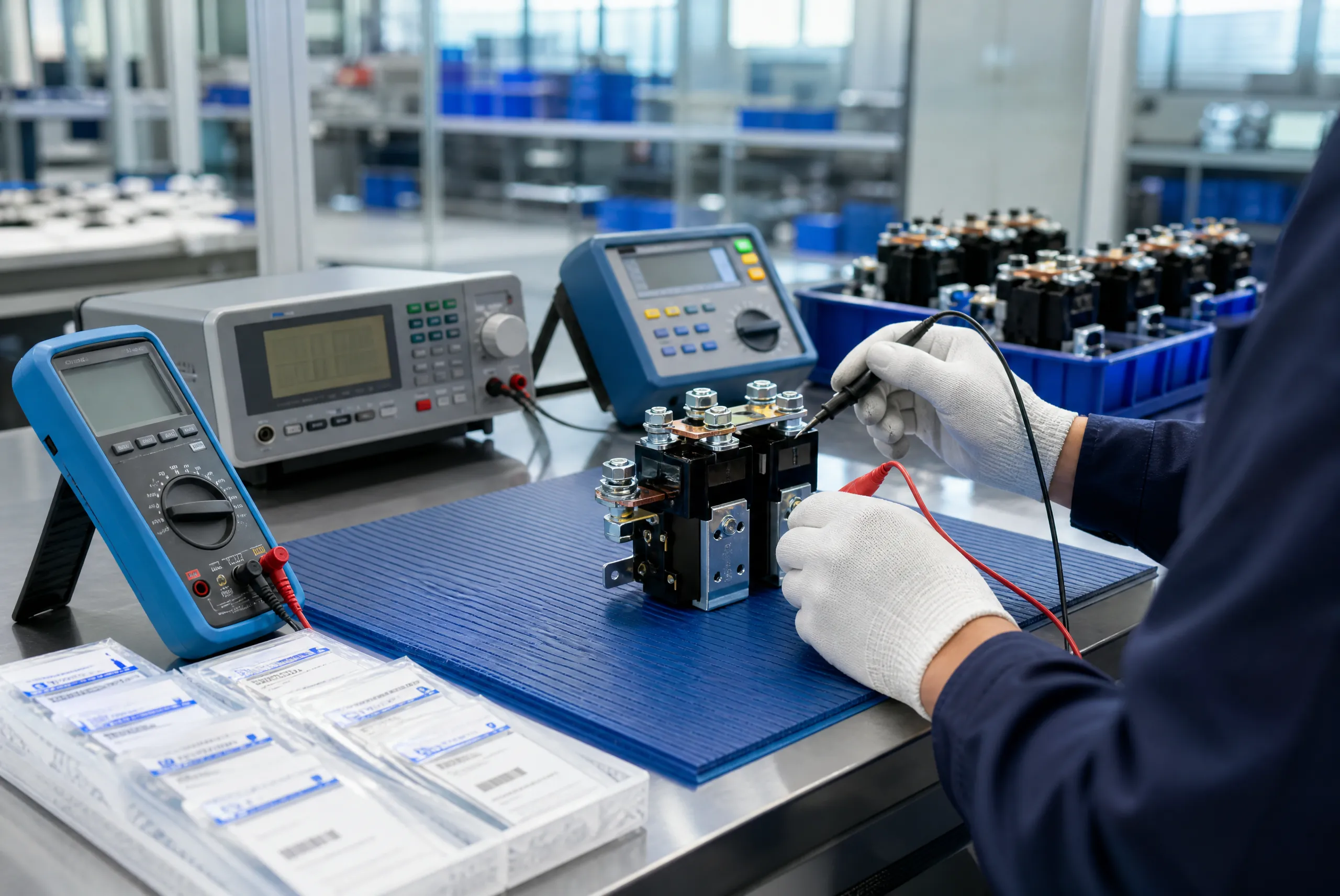
The quality assurance process usually involves several stages. One of these processes is incoming inspection whereby the inspection concentrates on various raw materials like coil wire, contact materials and so on. In-process inspection on the other hand concentrates on the following aspects: checking coil resistance, the total fit of all the components, the correct alignment of the contacts among others.
Finished DC contactors are commonly tested for:
- Pull-in and drop-out performance;
- Coil resistance and insulation condition;
- Contact continuity and contact resistance;
- Dielectric strength and insulation resistance;
- Mechanical operation and release action;
- Terminal tightness and visual appearance;
- Label accuracy and packaging consistency;
- Batch coding and traceability records.
Different tests may be conducted as per the nature of the product and the customer’s prerequisites, which may include heating tests, electric functional tests, mechanical endurance tests, vibration tests, and compliance documentation as recommended by the existing standards.
Note 3: Traceability is not just a means of controlling quality to OEM purchasers and distributors.
It helps after-sales research, maintenance of quantities, warranty assessment, and coordination between technical and purchasing departments as well.
A supplier that can clearly explain its inspection process, testing items, and documentation control gives buyers practical evidence of manufacturing discipline.
Buyer Guidance: How to Select a Reliable DC Contactor Supplier
Selecting a DC contactor supplier requires both technical and commercial evaluation. Buyers should confirm whether the supplier’s product range matches the target application, whether the contactor rating is suitable for the real circuit, and whether technical documentation is available for engineering review.
The first step is to define the application. A contactor used in an electric forklift may have different requirements from one used in an energy storage cabinet or UPS system. Load type, current level, voltage level, switching frequency, ambient temperature, vibration, installation direction, and available space should all be reviewed.
The second step is to confirm product specifications. Buyers should verify rated current, rated voltage, coil voltage, contact form, coil type, operating temperature range, insulation requirements, auxiliary contact needs, and mounting method. For high-voltage DC applications, arc control and insulation distance deserve particular attention.
The third step is to evaluate supplier support. A qualified supplier should be able to provide datasheets, model selection guidance, wiring or connection information, test documents, packaging details, and OEM confirmation when needed.
| Buyer Checkpoint | Why It Matters | Information to Confirm |
|---|---|---|
| Application type | Determines product structure and rating | EV, forklift, ESS, UPS, motor control |
| Rated current and voltage | Prevents overheating or switching failure | Load current, voltage level, duty cycle |
| Coil configuration | Affects control logic and power use | Coil voltage, single coil, dual coil, latching |
| Contact form | Supports circuit design | NO, NC, 1NO1NC, SPDT, DPDT |
| Quality testing | Reduces batch risk | Test items, inspection process, traceability |
| OEM support | Supports brand and project needs | Label, packaging, documentation |
For procurement teams, the lowest price may not represent the lowest total cost. A contactor failure can lead to equipment downtime, maintenance cost, delayed delivery, or field service issues. A more balanced sourcing decision considers product suitability, manufacturing consistency, technical communication, and long-term supply stability.
Lead Insight: What Buyer Search Behavior Reveals
Search behavior around DC contactors shows that buyers often need both technical understanding and supplier qualification information. Keywords such as high voltage DC contactor, EV DC contactor, magnetic latching DC contactor, precharge contactor, DC contactor for forklift, and energy storage DC contactor supplier indicate different stages of buyer intent.
Some users are still comparing product types. Others are preparing technical selection. A smaller but valuable group is ready to request quotations, samples, or OEM cooperation.
This search pattern suggests that manufacturers can support buyers by providing specification tables, wiring guidance, application notes, selection advice, and quality process explanations. Such content aligns with Google EEAT principles because it demonstrates experience, expertise, authoritativeness, and trustworthiness through practical information rather than promotional language.
For a manufacturer like Sayoon, light and relevant references to product experience, DC contactor specialization, and application coverage can help buyers understand the company’s role without turning the article into an advertisement.
Frequently Asked Questions
1. What is a DC contactor used for?
A DC contactor is used to switch and control direct current circuits in applications such as electric vehicles, forklifts, battery energy storage systems, UPS equipment, communication power systems, charging systems, and industrial DC motor control.
2. How is a DC contactor different from an AC contactor?
A DC contactor is designed to interrupt direct current, where the arc does not naturally extinguish at a zero-current point. This usually requires stronger arc suppression, suitable contact gap, and insulation design. AC contactors are designed for alternating current circuits, where current crosses zero periodically.
3. What specifications are most important when sourcing DC contactors?
Important specifications include rated current, rated voltage, coil voltage, contact form, coil type, electrical life, mechanical life, insulation resistance, dielectric strength, mounting method, operating temperature, and application conditions.
4. What is a magnetic latching DC contactor?
A magnetic latching DC contactor uses a latching mechanism to maintain its contact position with reduced continuous coil power, depending on the design. It is often considered in applications where energy saving or heat reduction in the control circuit is important.
5. What is a precharge contactor used for?
A precharge contactor is used to limit inrush current when capacitors in power electronics systems are first energized. It is commonly used in EV systems, energy storage systems, motor controllers, and high-voltage DC circuits.
6. Can DC contactors be customized for OEM projects?
Yes. OEM options may include private label branding, customized labels, model number adjustments, coil voltage selection, accessory combinations, packaging design, manuals, carton labels, and market-specific documentation.
7. What quality tests should buyers ask about?
Buyers should ask about pull-in and drop-out testing, coil resistance testing, contact resistance testing, insulation resistance testing, dielectric strength testing, mechanical operation testing, temperature rise review, final inspection, and batch traceability.
8. What information should buyers provide when requesting a quotation?
Buyers should provide rated current, rated voltage, coil voltage, application type, load condition, contact form, mounting requirements, estimated quantity, certification needs, OEM requirements, and destination market. Clear information helps the supplier recommend a more suitable model.
Conclusion
DC contactors are becoming increasingly important as electric mobility, energy storage, UPS equipment, industrial automation, and high-current DC systems continue to develop. For buyers, the right contactor must match the electrical load, switching conditions, control circuit, installation environment, and compliance expectations.
A professional sourcing decision should consider more than catalog ratings. Buyers need to evaluate material selection, coil design, arc suppression, production process, quality testing, OEM support, documentation, and supplier consistency.
Zhejiang Sayoon Electric Co., Ltd. has focused on DC contactors and electrical control components since 1998, which makes its product range and manufacturing experience relevant to buyers evaluating DC switching components for applications such as forklifts, EV systems, UPS equipment, and energy storage. In global B2B cooperation, reliable products, clear technical information, and consistent manufacturing support are often the foundation of long-term supplier relationships.
References
- International Energy Agency, Electricity 2024: Analysis and Forecast to 2026.
Available at: https://www.iea.org/reports/electricity-2024 - International Energy Agency, Global EV Outlook 2024.
Available at: https://www.iea.org/reports/global-ev-outlook-2024 - Zhejiang Sayoon Electric Co., Ltd., DC Contactors Product Information.
Available at: https://sayoon-dc.com/ - International Electrotechnical Commission, IEC 60947 Low-Voltage Switchgear and Controlgear Standards.
Available at: https://webstore.iec.ch/