Forklift OEMs should select a magnetic holding DC contactor for traction-related paths only after freezing bus voltage, continuous current, switching duty, coil-pulse capability, and open-on-control-loss rules — using magnetic holding primarily on long closed battery or distribution branches, and comparing standard electrically held coils when traction or pump motors jog frequently.
This selection guide is for industrial-truck and AGV electrical leads who need an auditable shortlist before releasing a BOM. Browse the magnetic holding DC contactor series for CZW-K / CZWH-K SKUs, and keep the AGV and electric forklift applications page open when mapping path roles to the truck architecture.
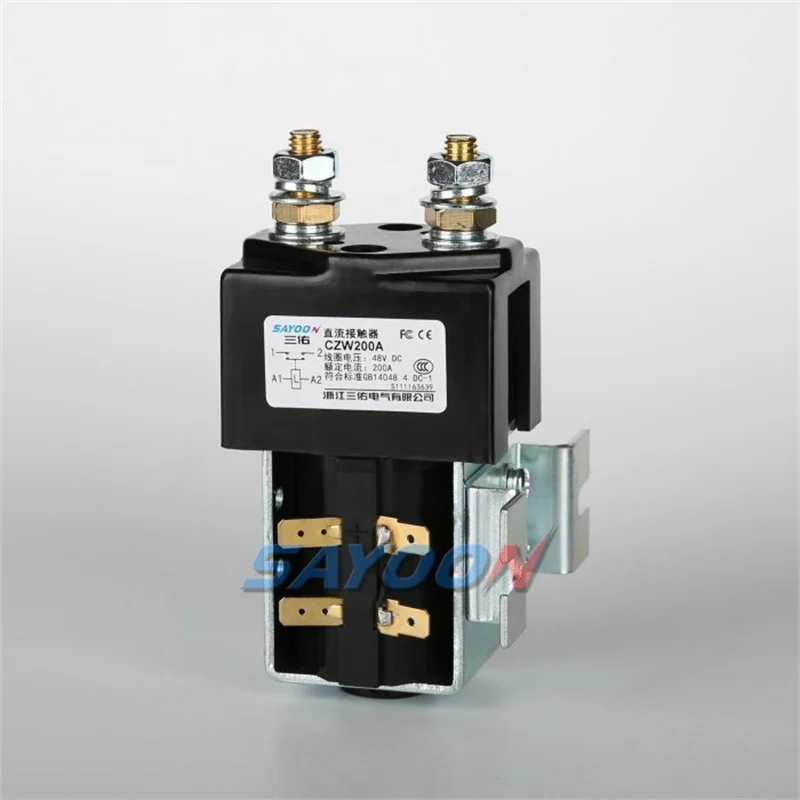
Part 1. How should forklift OEMs select a magnetic holding DC contactor for traction-related paths?
A magnetic holding dc contactor on a forklift RFQ is a latching / bi-stable DC switch that holds contact state after a coil pulse with published keep power of 0 W on CZW-K tables. “Traction-related” must be decomposed: main battery connect, traction motor branch, hydraulic pump branch, and auxiliaries often need different coil architectures even when they share one battery voltage.
Selection order for truck programmes:
- Freeze maximum bus voltage and continuous current per path.
- Classify duty — long closed, infrequent connect, or high-cycle jogging.
- Decide whether control-power loss must open that path.
- Confirm the truck controller can issue set/reset pulses if -K is shortlisted.
- Only then map to a published amp class on the magnetic holding or standard CZW series.
| Truck decision gate | Why it is first | Typical owner |
|---|---|---|
| Path role (battery / traction / pump / aux) | Architecture mismatch is costly | Lead electrical engineer |
| Bus voltage & continuous current | Sets amp class | Powertrain / battery |
| Cycle rate per hour | Chooses latching vs electrically held | Controls |
| Open-on-control-loss rule | Safety concept | Functional safety lead |
| Coil supply voltage | Harness and driver | Controls |
For voltage-class context across industrial trucks, cross-read the 48 V DC contactor guide for industrial trucks. For the coil architecture decision itself, see the latching contactor vs standard hold-power comparison.
Part 2. Which truck DC paths favor magnetic holding versus standard coils?
Magnetic holding earns its keep-power advantage on paths that stay closed for long intervals — for example a main battery connect that remains closed during a shift. High-cycle traction or pump jogging often favors standard electrically held coils because drivers are simpler and many safety concepts expect open-on-coil-loss behavior.
| Path role | Typical duty | Starting architecture to compare |
|---|---|---|
| Main battery connect / distribution | Long closed | Magnetic holding CZW-K |
| Accessory / lighting / low-cycle aux | Long or medium closed | Magnetic holding if pulse driver exists |
| Traction motor branch | Higher cycle, inductive | Standard CZW first; -K only after duty review |
| Hydraulic pump motor | Intermittent but frequent | Standard CZW first |
| Precharge or special energy path | Program-specific | Separate RFQ row — do not reuse traction SKU |
Do not assign one part number to every pole on the truck. A battery-connect -K SKU and a traction standard SKU can coexist on the same vehicle when duties differ.
Part 3. What voltage, current, and duty fields freeze the amp class?
Cited CZW-K SKUs publish contact voltage ≤80 V with load-current examples on a 48 V DC-1 circuit. That matches many low-voltage industrial-truck buses, but it is not a high-voltage pack rating. Freeze your maximum working voltage with headroom process before reading amp labels.
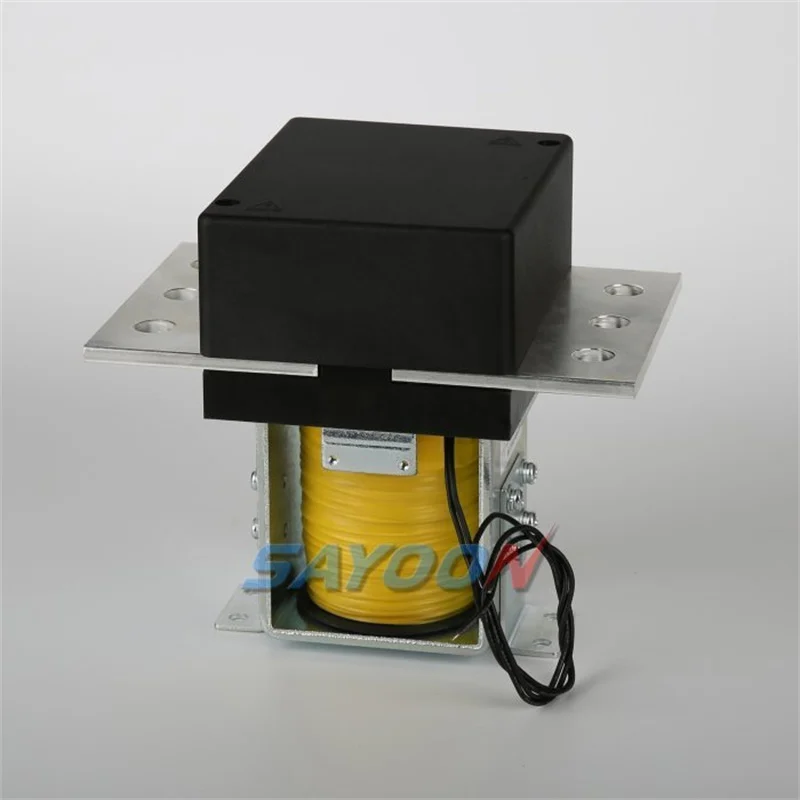
| Starting CZW-K class | Published load current (48 V DC-1) | Published Keep power | Also read first |
|---|---|---|---|
| CZW100A-K | 100 A | Keep: 0 | Pulse 200 ms–1 s |
| CZW200A-K | 200 A | Keep: 0 | K Start 15–20 W; fault 1000 A/5 ms @48 V |
| CZW400A-K | 400 A | Keep: 0 | K Start 18–30 W; M10 load terminal |
Map continuous path current to the published load-current line, then leave thermal headroom per your process. If continuous current exceeds the published class, step up — do not rely on peak traction inrush as the continuous rating.
Operating frequency on these -K pages is published as ≤6 times per minute (square wave). Paths that exceed that command rate need a different architecture or engineering review.
Part 4. How do coil pulse drivers and fail-safe rules change on industrial trucks?
Magnetic holding requires a set pulse to close and a reset pulse to open. Truck controllers that only switch coil power continuously need a pulse former or a different contactor class. Document coil rated voltage against the truck control net — CZW200A-K lists coil options including 12 V, 24 V, 36 V, 48 V, 60 V, 72 V and additional values on the product page.
Truck control checklist
- Match coil rated voltage to the control battery / DC-DC output.
- Enforce published pulse width (CZW200A-K / CZW400A-K: 200 ms ≤ t ≤ 1 s).
- Record set/reset polarity on the vehicle harness drawing.
- Decide path-by-path whether control-power loss must open the circuit.
- Add optional auxiliary contacts when the vehicle controller needs state feedback.
| Fail-safe question | If answer is yes | Architecture implication |
|---|---|---|
| Must this path open when control power dies? | Safety/isolation requirement | Prefer electrically held or add separate isolator |
| Must state survive control glitches? | Ride-through desired | Magnetic holding may help — document intentionally |
| Is command rate high during a shift? | Traction/pump jogging | Re-check operating-frequency limit |
Part 5. Which mechanical and environment checks matter in forklift compartments?
Forklift compartments add vibration, dust, and service-access constraints. Published CZW200A-K / CZW400A-K mechanical tables list ambient −25~+70 °C, IP40 (IEC 60947), and vibration notes at the fixed position — use those lines as the starting environmental gate, then apply any tougher customer truck spec on top.
| Mechanical / environment field | Why trucks care | Action on RFQ |
|---|---|---|
| Mounting bracket type (M / L / 2L …) | Compartment orientation | State preferred bracket code |
| Load terminal size (M8 / M10) | Cable lug hardware | Align with harness kit |
| Mass / outline | Bracket resonance | Request drawing revision |
| IP class | Dust and wash exposure | Confirm IP40 is enough or add enclosure strategy |
| Vibration / shock lines | Traction floor abuse | Compare to truck test profile |
If the truck programme needs a sealed HV epoxy device instead of an IP40 LV magnetic holding unit, stop and move to the HV series — do not stretch ≤80 V contact-voltage SKUs.
Part 6. What RFQ table shortlists CZW-K SKUs for material-handling programs?
Use one RFQ row per path. Mark Pass / Review / Fail before releasing samples.
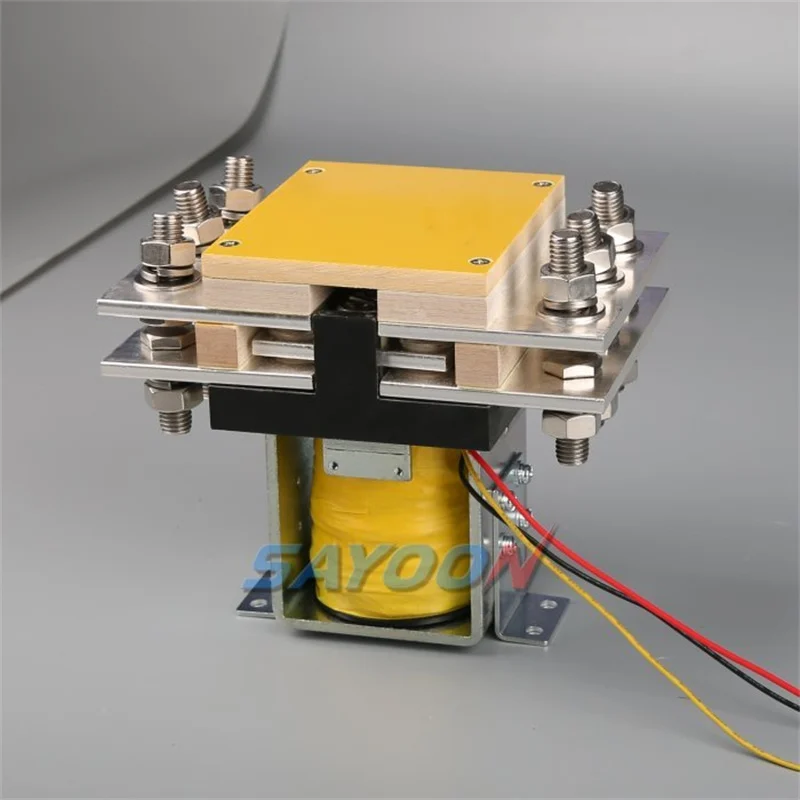
| RFQ line | Battery-connect path | Traction / pump path | Owner |
|---|---|---|---|
| Max contact voltage | Power | ||
| Continuous current & duty | Thermal | ||
| Cycle rate / hour | Controls | ||
| Coil architecture | Magnetic holding candidate | Standard or -K after review | Controls |
| Coil voltage | Harness | ||
| Pulse driver available? | Firmware | ||
| Open-on-control-loss required? | Safety | ||
| Aux feedback | Vehicle controller | ||
| Bracket / terminal | Mechanical | ||
| Cert marks on label | Compliance |
Product recommendation: start many mid-current long closed branches with the CZW200A-K magnetic holding DC contactor when published needs fit ≤80 V and 200 A DC-1 @48 V. Step to the CZW400A-K magnetic holding DC contactor when continuous current requires the 400 A class. For high-cycle traction or pump jogging with open-on-coil-loss expectations, compare standard CZW series DC contactors on a separate RFQ row.
Fit Boundary: Not suitable when contact voltage exceeds the published ≤80 V class, when pulse drivers are unavailable, when safety requires automatic open on control loss without a separate isolator, or when command rate exceeds published operating-frequency limits.
To confirm a shortlist, send forklift voltage and duty notes with the completed matrix.
Part 7. What forklift selection mistakes delay magnetic holding approvals?
- Labeling every truck pole “traction” and forcing one -K SKU onto high-cycle motor branches.
- Ignoring open-on-control-loss until the truck safety review.
- Matching amp labels without reading the 48 V DC-1 test context on the SKU page.
- Driving -K coils from continuous outputs with no pulse timing.
- Exceeding published ops/minute during aggressive jogging tests.
- Skipping bracket and terminal codes until the harness is tooled.
- Assuming IP40 magnetic holding parts replace sealed HV contactors on higher-voltage platforms.
References
- IEC — International Electrotechnical Commission
- Latching vs Non-Latching Relay Selection Guide — VIOX
FAQs
What is a magnetic holding DC contactor on a forklift?
It is a latching DC contactor that holds its contact state after a coil pulse, typically with published keep power of 0 W on SAYOON CZW-K tables. On trucks it is most often evaluated for long closed battery or distribution paths rather than every motor branch.
Can one contactor serve traction and pump motors?
Only if both paths share voltage, current, duty, and fail-safe rules. Most programmes keep separate RFQ rows because pump and traction jogging differ from battery-connect duty.
Which coil voltages are published on CZW200A-K?
The CZW200A-K product page lists coil rated voltages including 6 V, 12 V, 24 V, 36 V, 48 V, 60 V, 72 V, 84 V, 120 V, 150 V, 220 V, and related options. Match the truck control net before sampling.
When should buyers prefer standard CZW over -K on trucks?
Prefer standard electrically held CZW SKUs for high-cycle traction or pump jogging, or when the safety concept requires the path to open when coil power is lost.
What contact voltage do CZW200A-K and CZW400A-K publish?
Both product pages list contact voltage ≤80 V. Do not use these SKUs as high-voltage pack disconnect devices.
Where should teams start AGV and forklift application browsing?
Start with the AGV and electric forklift applications solution page, then open the magnetic holding and CZW series pillars for SKU tables.
What Keep power do CZW200A-K and CZW400A-K publish?
Both list Keep: 0 on their coil power lines, with separate K Start bands (15–20 W and 18–30 W respectively). Re-read the SKU page before freezing the BOM.