El difference between ac and dc contactor designs starts with how each device extinguishes the electrical arc when contacts open under load. An AC contactor gets help from current zero-crossing; a DC contactor must force the arc out because the current never pauses. This article compares arc behavior, coil and core construction, polarity rules, substitution risks, typical uses, and a concrete low-voltage DC model next step.
Arc Extinction: Why AC and DC Contactors Behave Differently
AC and DC contactors diverge first at arc extinction: alternating current repeatedly crosses zero, while direct current does not.
In an AC circuit, the current waveform passes through zero twice each cycle. At 60 Hz that creates up to 120 zero-crossing events per second, and a contact-materials brief notes that this can limit maximum arc time to less than 8 ms in that framing. After the arc collapses near zero, polarity reverses and a thin ion sheath near the new cathode makes immediate restrike harder under many mid-voltage conditions.
A DC circuit has no natural zero-crossing. When contacts open, the electrical arc can keep burning until the contactor drives arc voltage above the source voltage. A high-voltage DC switching whitepaper states the quench condition as arc voltage larger than the DC source voltage, and it describes break-arc temperatures above 5000 K that melt and redeposit contact metal.
That is why dc contactor arc extinction designs often add magnetic blowout, longer arc paths, or sealed chambers. Ampere labels alone do not capture this physics.
| Feature | AC contactor | DC contactor |
|---|---|---|
| Current behavior | Alternating; zero-crossing each half-cycle | Continuous one-way current |
| Arc extinction assist | Waveform zero helps collapse the arc | Device must force the arc out |
| Typical arc hardware | Arc chute sized for AC duty | Stronger chute, magnetic blowout, or sealed chamber |
| Wear pattern | More random polarity over time | Longer arcs; consistent polarity can wear one face harder |
Coil, Core, and Contact Design Differences
Coil and core design follow the same current-type split: AC magnetics fight alternating flux, while DC magnetics hold a steady field.
An AC coil sees inductive reactance that limits current once the armature seats. The magnetic core is commonly laminated to reduce eddy-current heating, and a shading ring keeps the armature from buzzing at flux zeros. Those choices support frequent switching on motors, HVAC, and lighting panels.
A DC coil current is limited mainly by winding resistance, sometimes with an economizer circuit for pull-in versus hold. Solid cores are common because flux is steady. Contacts and gaps are usually heavier because the arc lasts longer without zero-crossing help.
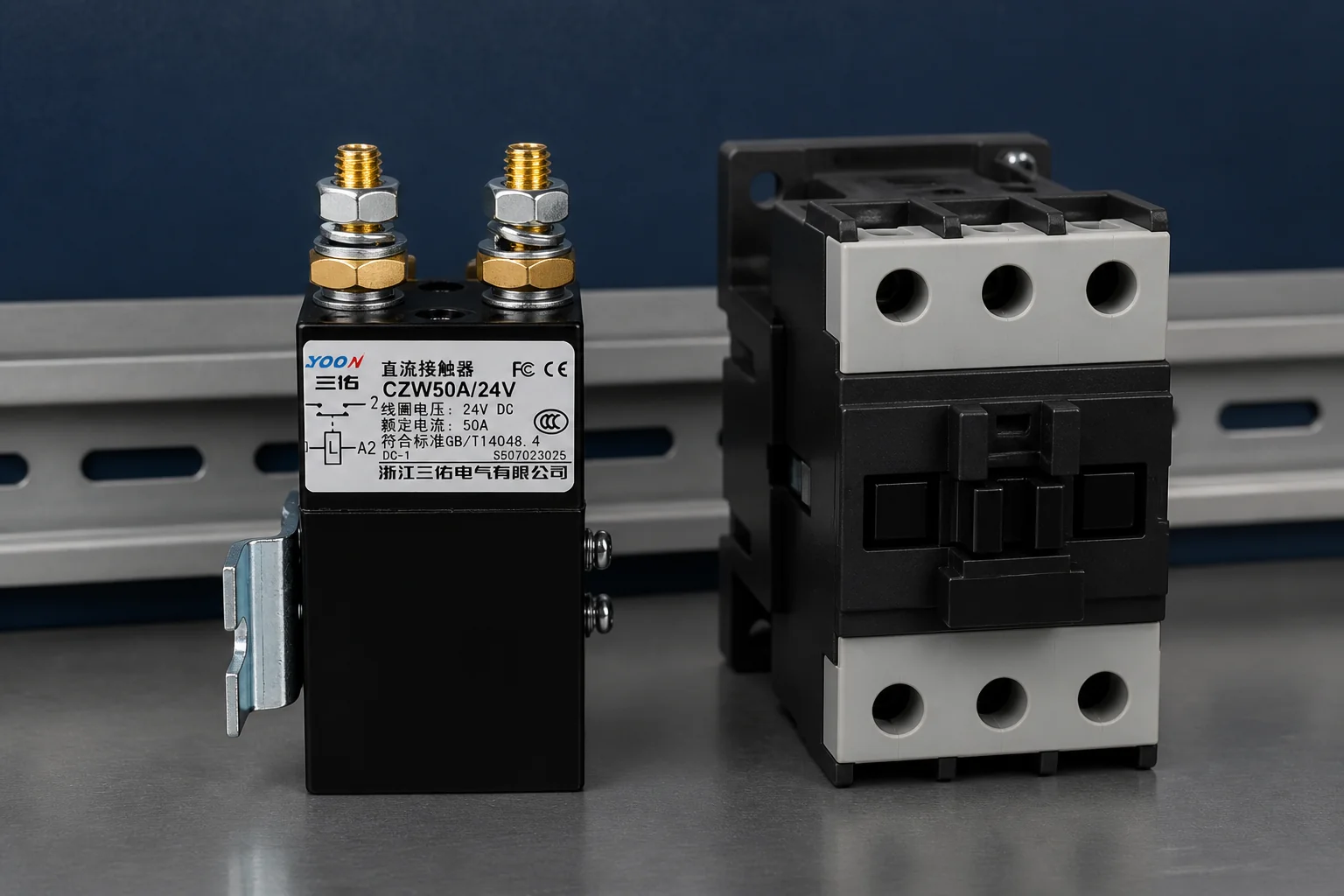
Readers comparing ac vs dc contactor datasheets should separate two questions: what energizes the coil, and what the main contacts must interrupt. A contactor with a DC coil that still interrupts AC main current is not automatically rated for a battery or solar DC bus.
Polarity and Directional Arc Control on DC Circuits
Polarity matters on many DC contactors because magnetic arc steering is directional.
Magnetic blowout fields stretch the arc into a chute or longer path. If that field is polarized, reversing the main-circuit polarity can weaken or misdirect the arc. Field installers on DC solar disconnects often warn that AC phase labels are interchangeable in ways DC poles are not, and that spark-chute hardware can be directional.
Check terminal plus/minus marks and the model drawing before landing conductors. Not every DC contactor is polarized, but treating every DC device as polarity-blind is a common wiring risk.
Can You Use an AC Contactor on a DC Circuit?
In almost every practical panel, the answer to “can I use ac contactor for dc” is no unless the manufacturer datasheet explicitly rates that DC voltage, current, and utilization category.
The failure mode is not subtle. Contacts may weld, the arc may leave the chamber, or the circuit may fail to open when commanded. Community engineers repeatedly reject the shortcut of reading a VAC-only ampere label and assuming it covers a similar VDC number.
Importante: A 600 VAC disconnect rating does not prove safe interruption on a 110 VDC actuator circuit. Ask for a device with an explicit DC rating for the working voltage. Source: community engineering Q&A on VAC-only disconnects used on DC actuators.
If a datasheet lists a limited DC rating, follow that exact voltage, current, and duty—not a rule-of-thumb conversion from the AC figure. Utilization category still matters: resistive DC-1 duty is not the same problem as highly inductive DC motor duty.
| Selection check | What to verify |
|---|---|
| Current type | AC load vs DC load on the main path |
| Contact rating | Explicit DC voltage and current, not AC-only |
| Utilization category | Duty matches the load, not only nameplate amperes |
| Suministro de bobina | Coil voltage type matches the control circuit |
| Polarity | Marks and drawing reviewed when the DC design is polarized |
| Fault strategy | Short-circuit and protective coordination remain defined |
Where AC Contactors and DC Contactors Are Typically Used
Choose by the current the main contacts interrupt, then confirm ratings—not the other way around.
AC contactors dominate three-phase motors, HVAC compressors, pumps, fans, lighting panels, and factory automation cabinets that switch alternating current. Frequent start-stop cycles fit AC designs that lean on zero-crossing assisted extinction.
DC contactors belong on battery strings, solar DC sides, EV and charging DC paths, UPS DC buses, telecom power racks, forklifts, AGVs, plating lines, and other continuous-current circuits. Stored energy raises available fault current, so forced arc extinction is part of the safety budget.
A hybrid machine can use both: an AC contactor on the AC motor feeder and a DC contactor on the battery or DC distribution path. Sharing one device across both current types because the ampere numbers “look close” recreates the substitution failures above.
Select a DC Contactor for Low-Voltage DC Panels
Once the load is confirmed as DC, select a DC-rated contactor family and a contact form that matches the drawing—not an AC leftover from the parts bin.
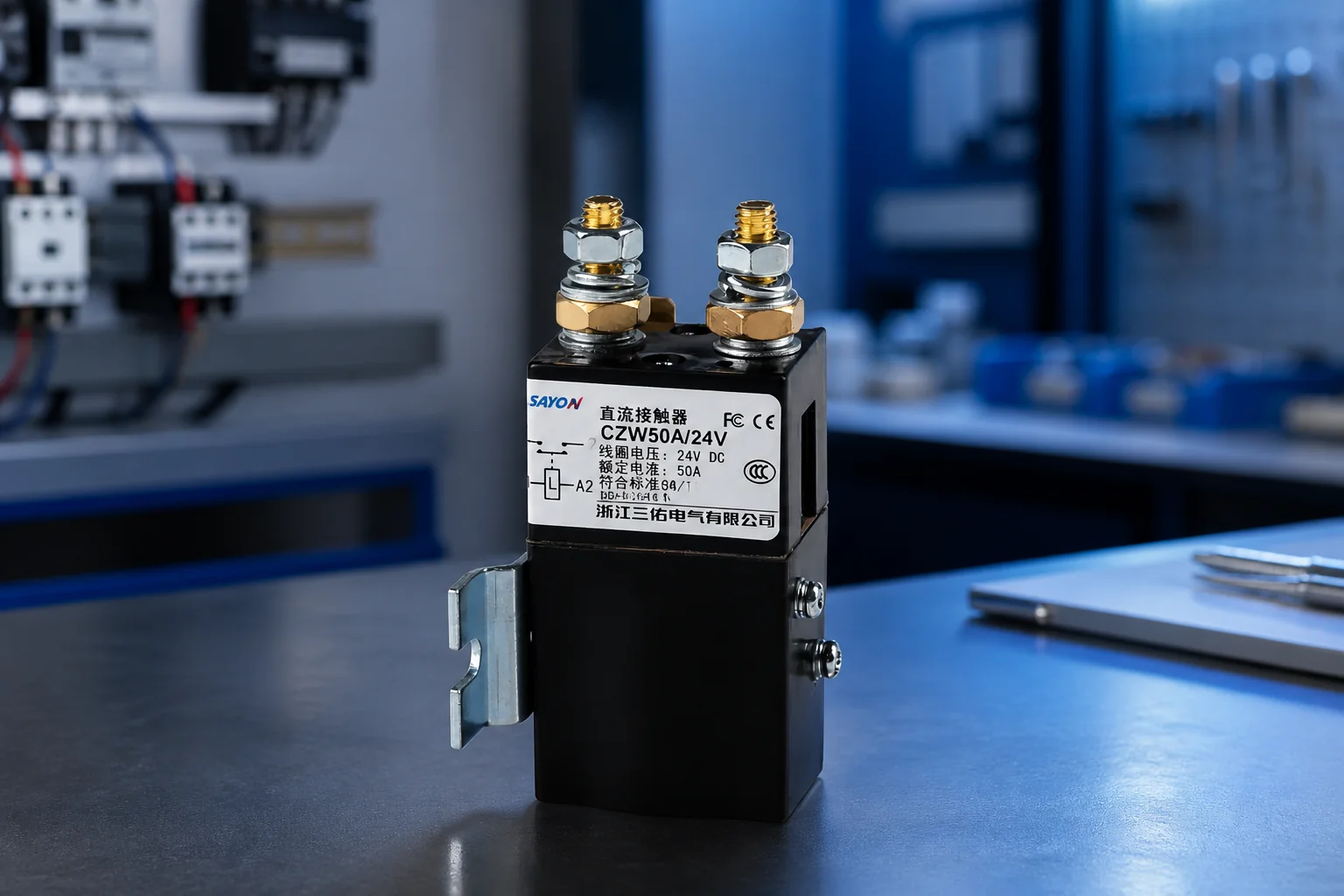
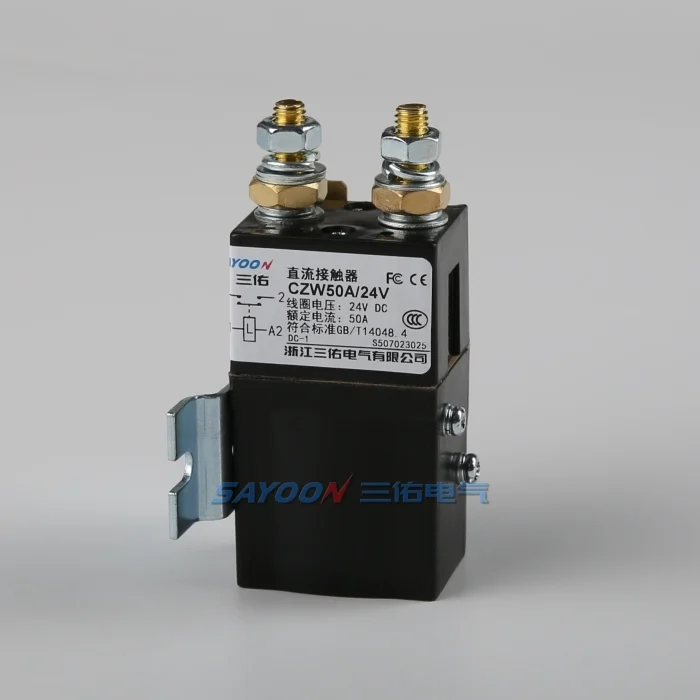
For a normally open low-voltage DC control path, the CZW50A normally open DC contactor is a concrete public example. The model page lists a 1 NO contact form, contact voltage up to 60 V DC, and a 50 A rating on a 48 V circuit under DC-1. Typical published uses include electric forklift, telecom power, UPS, and plating electronic-control circuits.
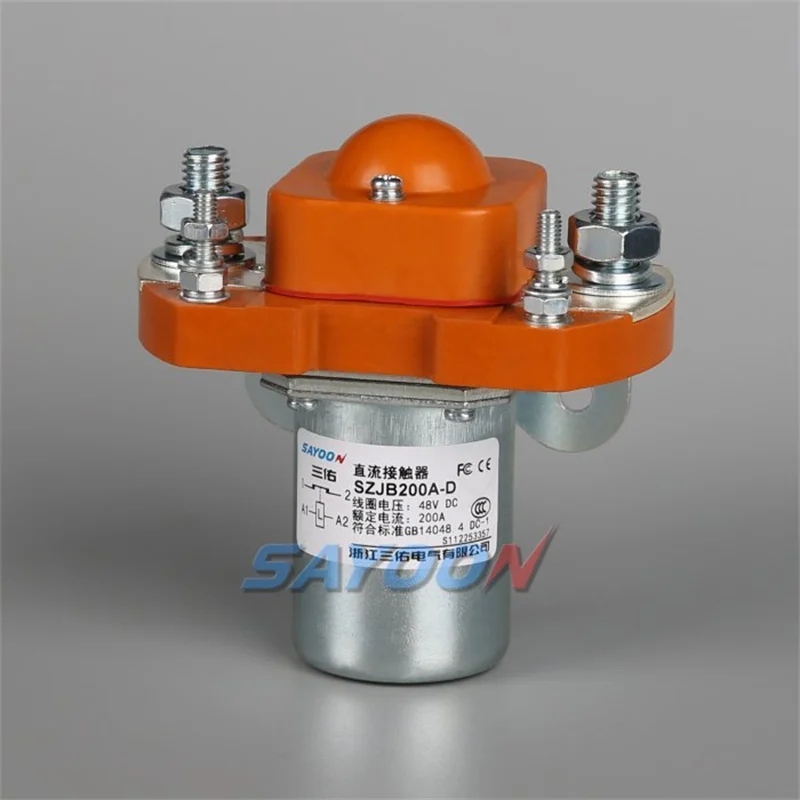
Browse the CZW series DC contactor hub and the productos pillar when you need neighboring current classes or related DC families. If the schematic requires a normally closed main path, review SZJB300A-D as a 1 NC candidate, then confirm coil voltage, mounting, and the project drawing before freezing the BOM.
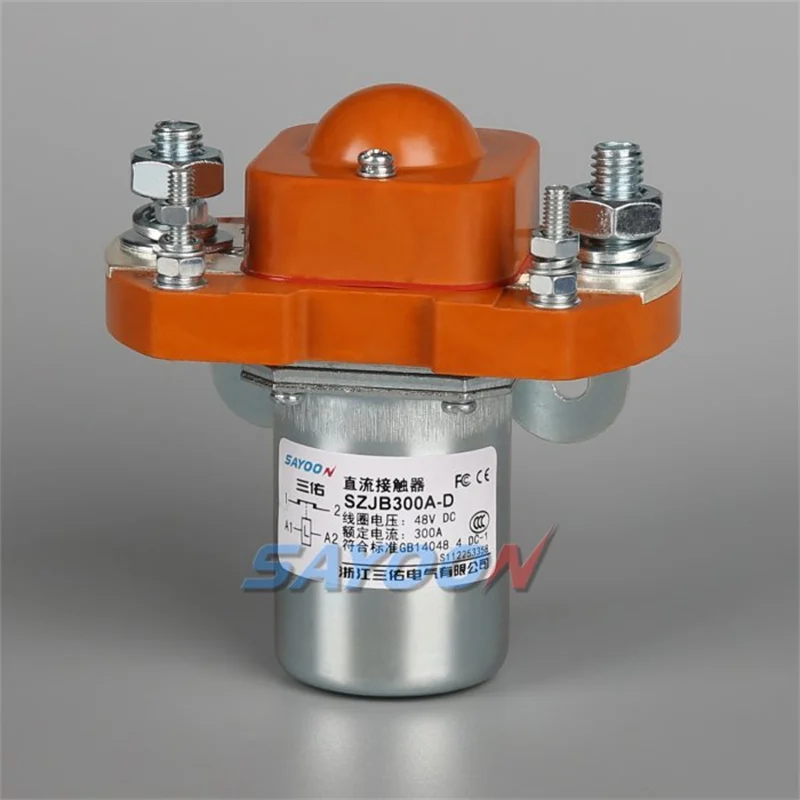
Do not treat NO/NC labels as a finished safety design. They describe contact form on the selected model page; the drawing and datasheet still decide fit. The same drawing review applies when a battery disconnect stays closed until a coil command opens it.
Preguntas frecuentes
Can I use an AC contactor for DC?
Only when the manufacturer datasheet explicitly rates the contactor for that DC voltage, current, and duty. Otherwise the missing zero-crossing assist can leave a sustained arc and welded contacts.
What is the main difference between an AC contactor and a DC contactor?
The main difference is arc extinction physics. AC interruption benefits from current zero-crossing; DC interruption must force arc voltage above the source.
Why is a DC arc harder to extinguish?
Direct current never crosses zero, so the arc can continue until the contactor stretches, cools, or deflects it enough that arc voltage exceeds the circuit voltage.
Are AC and DC contactors interchangeable?
No as a general rule. Matching ampere numbers without matching current type and utilization category is a common cause of premature contact failure.
Do DC contactors need correct polarity?
Some do. Polarized magnetic blowout designs need plus/minus terminals oriented per the drawing; always read the marks instead of assuming AC-style indifference.
What is the difference between an AC coil and a DC coil?
An AC coil relies on inductive behavior with laminated cores and often a shading ring. A DC coil is resistance-limited for steady flux and commonly uses a solid core, sometimes with an economizer.
Can a DC contactor be used on an AC circuit?
Sometimes the contacts can carry AC if ratings allow, but the device may be larger and costlier than a purpose-built AC contactor. Confirm coil type and contact ratings before substituting.
Which SAYOON model fits a normally open low-voltage DC path?
CZW50A is a published normally open DC example with 1 NO contacts, contact voltage ≤60 V DC, and 50 A at 48 V under DC-1 on its product page. Confirm the drawing and datasheet for the final project.