NO and NC contactor configuration becomes useful when it is read as a control-circuit decision rather than a label on a component. An NC contact keeps its named path complete before the operating action opens it, while an NO contact completes its path when the operating action closes it. In motor control, that difference determines how a starter runs, how an overload stops it, how a seal-in circuit holds it, and how a breaker trip receives its command.
Read NO and NC from the unoperated control state
The first question is always: what does this identified contact do before the coil or operating mechanism changes state? NO means that path begins open and closes after operation. NC means that path begins closed and opens after operation.
This is more than a definition. A motor-control drawing may show a main contactor path, an overload contact, a stop input, a seal-in contact, an alarm contact, and an ACB trip circuit. All of them can use NO or NC labels, yet each label answers a different operational question.
El Instrumentation Tools explanation of NO and NC contacts is the useful starting point: normal means the unoperated state. Once that reference is fixed, the circuit function tells you why the designer chose one contact form over another.
The motor starter path: energize to run
In a conventional magnetic motor starter, energizing the contactor coil pulls in the main contacts and connects the motor to its supply. The control circuit therefore treats the coil as the point where the run command becomes a physical switching action. A start command closes an NO path long enough to energize the coil.
After the coil picks up, the starter can use an auxiliary NO contact as a parallel holding path. The start button may be released, but the newly closed auxiliary contact keeps the coil energized. This is why NO contacts are naturally associated with a start command and a seal-in circuit.
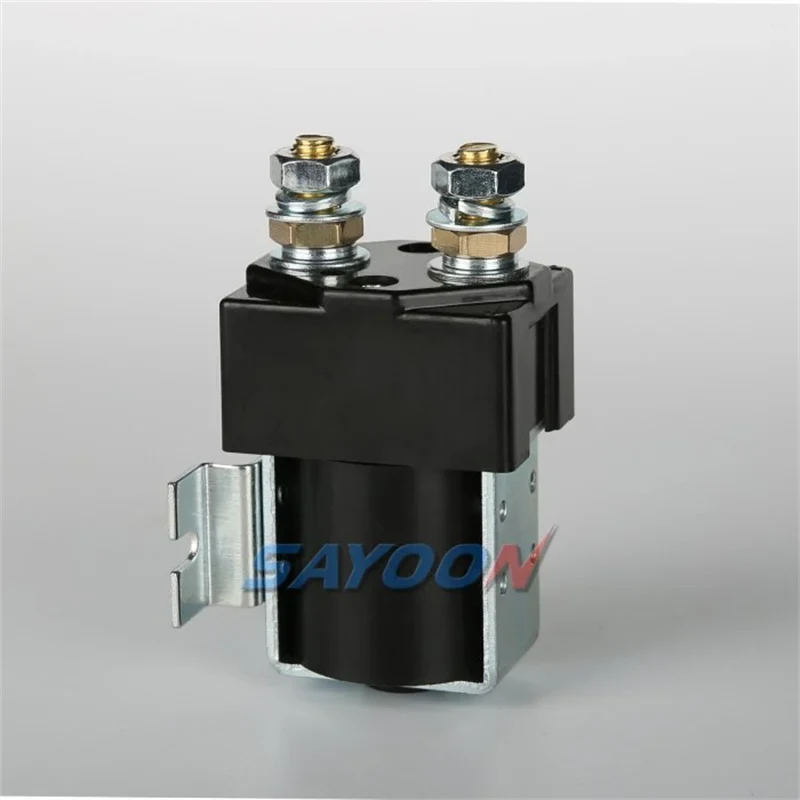
The main contacts and the auxiliary holding contact should not be treated as the same decision. The main contacts carry the motor switching task. The auxiliary contact carries the control logic that says the starter should remain picked up after a momentary command.
| Circuit element | Rest state that matters | What happens when the coil operates | Trabajo típico |
|---|---|---|---|
| Start command | NO | closes long enough to energize the coil | begins a run command |
| Main contactor path | usually open before pickup | closes to connect the load | switches the motor path |
| Seal-in auxiliary contact | NO | closes after pickup | keeps the coil energized |
| Stop or overload path | NC | opens to remove coil energy | stops the starter |
Overload protection: break the coil path to stop the motor
An overload relay is commonly placed in the coil control path so that an overload event opens an NC contact and drops out the contactor coil. Once the coil loses energy, the main contacts open and the motor stops. The protection action therefore uses an NC path because the circuit is complete during normal running and opens when the protection device acts.
This arrangement makes the stop command direct and easy to read on a ladder diagram. The coil must stay energized for the motor to run; opening one series control element removes that energy. The leading motor-protection discussion from Industrial Monitor Direct uses this relationship to explain why NC overload contacts dominate starter control circuits.
Importante: The contact form should follow the job of the path. A path whose job is to keep a running starter energized until a stop or trip event occurs is naturally built around an NC series control contact.
An NO overload output may still appear on a relay for alarm, PLC input, event logging, or a different control philosophy. The presence of that NO output does not turn the normal starter stop path into an NO path. Read the path that actually reaches the contactor coil.
Two-wire and three-wire control use NO and NC differently
Two-wire control uses a maintained command such as a pressure switch, float switch, thermostat, or selector switch. When that maintained input is closed, the contactor coil remains energized; when it opens, the coil drops out. If power returns while the maintained command is still closed, the coil can energize again.
Three-wire control separates the start action from the run state. The start button is NO and momentary. A stop button and overload contact are NC and series-connected, while a contactor auxiliary NO contact becomes the holding circuit after the coil has picked up.
The practical difference is visible after an outage. Two-wire control can restore the command if the maintained input remains closed.
Three-wire control loses the seal-in path when the coil drops out and requires a fresh start action. That is a control-behaviour choice, not a cosmetic difference in contact symbols.
| Control scheme | NO role | NC role | What the operator experiences |
|---|---|---|---|
| Two-wire control | maintained run command | stop/protection series path | command may return when supply and maintained input return |
| Three-wire control | momentary start plus seal-in contact | stop and overload series path | operator gives a fresh start command after dropout |
Shunt trip and under-voltage release are different NO/NC decisions
ACB and breaker control introduce another reason that NO and NC must be read from the circuit job. A shunt-trip coil trips a breaker when it receives energy. The command path is therefore commonly NO: the trip event closes a path that energizes the coil.
An under-voltage release works from the opposite idea. Its coil is held energized while the breaker is allowed to remain closed; removal of coil energy releases the mechanism and trips or prevents closing. The control path can therefore use NC logic so that a trip event or loss of control power opens the path and de-energizes the release coil.
This comparison is not an argument that one approach is always superior. It shows why a reader cannot select NO or NC by looking only at the word “trip.” The operating mechanism decides whether the circuit must energize a coil to act or remove energy from a coil to act.
Use auxiliary contacts for seal-in, indication, and interlock logic
Auxiliary contacts let the control system know what the contactor is doing or prevent two incompatible commands from existing at the same time. An NO auxiliary contact can light a run indication, feed a PLC input, or form the holding path. It becomes active after the contactor picks up.
An NC auxiliary contact can block a second coil from energizing while the first contactor is active. In a forward/reverse starter, for example, an NC auxiliary contact from the forward contactor can sit in series with the reverse coil command. When forward is active, that NC path opens and prevents the reverse coil from receiving a simultaneous command.
The key is to distinguish this electrical interlock from the main motor path. The interlock protects the logic of two coil commands. The main contacts still perform the actual load switching, so auxiliary labels should never be used as a shortcut for declaring the main contact configuration.
Choose the contact form that matches the circuit job
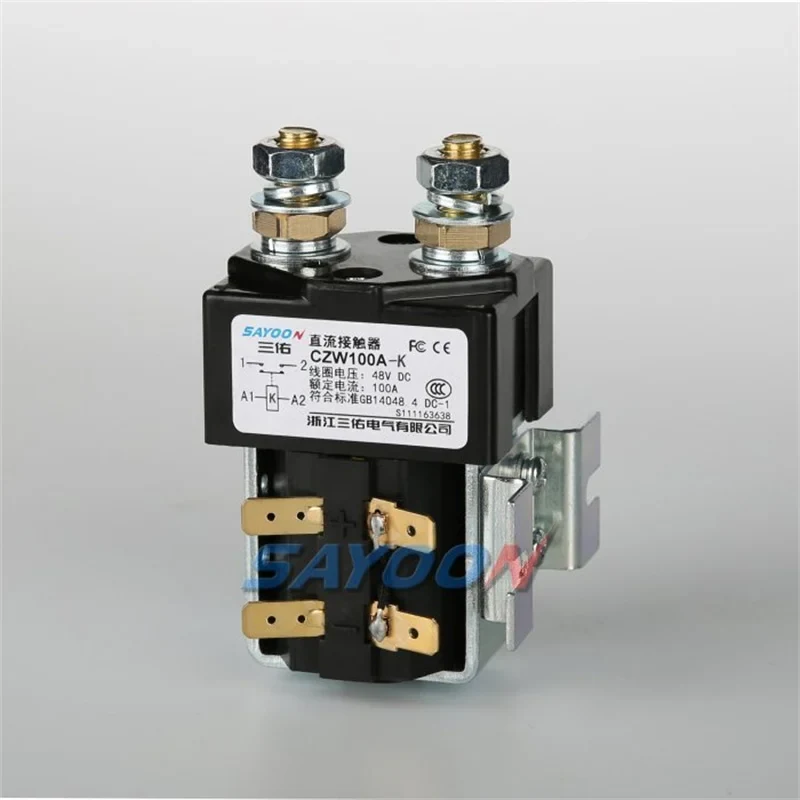
Use an NO main contactor when the main path should close after the coil receives its run command. SAYOON’s Contactor de CC normalmente abierto CZW50A gives a direct product route for that kind of contact-form decision.
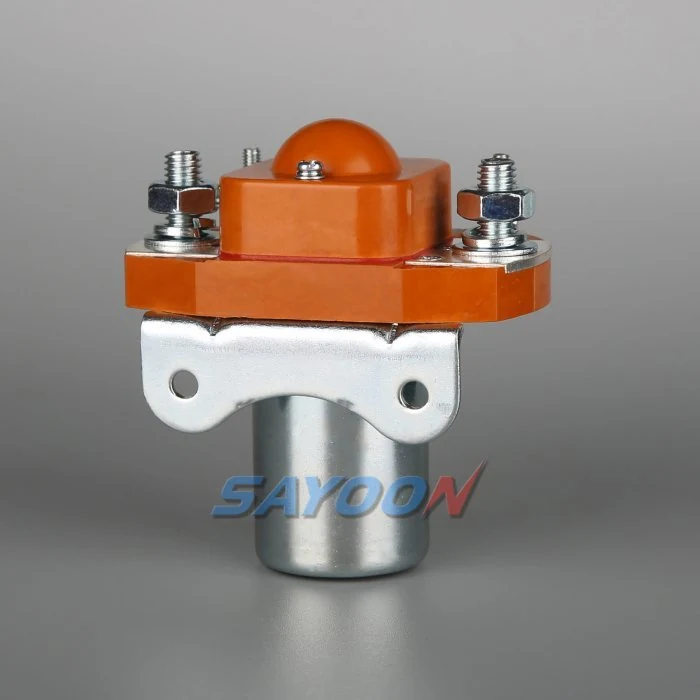
Use an NC main contactor when the circuit job calls for a main path that begins closed and opens after the operating command. SAYOON’s Contactor de CC normalmente cerrado SZJB300A-D is the corresponding normally closed product direction. The wider SAYOON DC contactor range provides the product-family starting point for additional motor-control applications.
NO and NC are not competing labels; they are tools for shaping a circuit’s response. Start with the circuit job, identify the coil or mechanism that changes state, and then choose the contact form that makes the motor starter, overload path, holding circuit, interlock, or trip circuit behave the way the application requires.
Preguntas frecuentes
What does NO and NC mean in a motor control circuit?
NO describes a contact that is open before it operates and NC describes a contact that is closed before it operates. In motor control, that state is applied to a specific path such as start, stop, overload, seal-in, or trip.
Why is an overload relay contact usually NC?
The NC overload contact completes the coil path while the motor is running. An overload event opens that path, drops out the contactor coil, and opens the main contacts.
What is the difference between two-wire and three-wire control?
Two-wire control uses a maintained command. Three-wire control uses a momentary NO start command, NC stop/protection contacts, and an NO holding circuit.
When should an NO contact energize a trip coil?
Use an NO command path when the mechanism acts after a coil receives energy, as with a shunt-trip coil. The trip command closes the path and energizes the mechanism.
What is the difference between UVR and shunt trip?
Under-voltage release acts when its holding energy is removed, while shunt trip acts when its trip coil receives energy. They are opposite control principles, so they naturally produce different NO/NC path choices.
Can an auxiliary contact decide the main contact form?
No. Auxiliary contacts define logic, indication, and interlock behaviour. The main contact form must be chosen from the main circuit job.
Which SAYOON contactor direction fits an NO or NC main path?
Utiliza el Contactor de CC normalmente abierto CZW50A route for a normally open main-path direction and the Contactor de CC normalmente cerrado SZJB300A-D route for a normally closed main-path direction.